

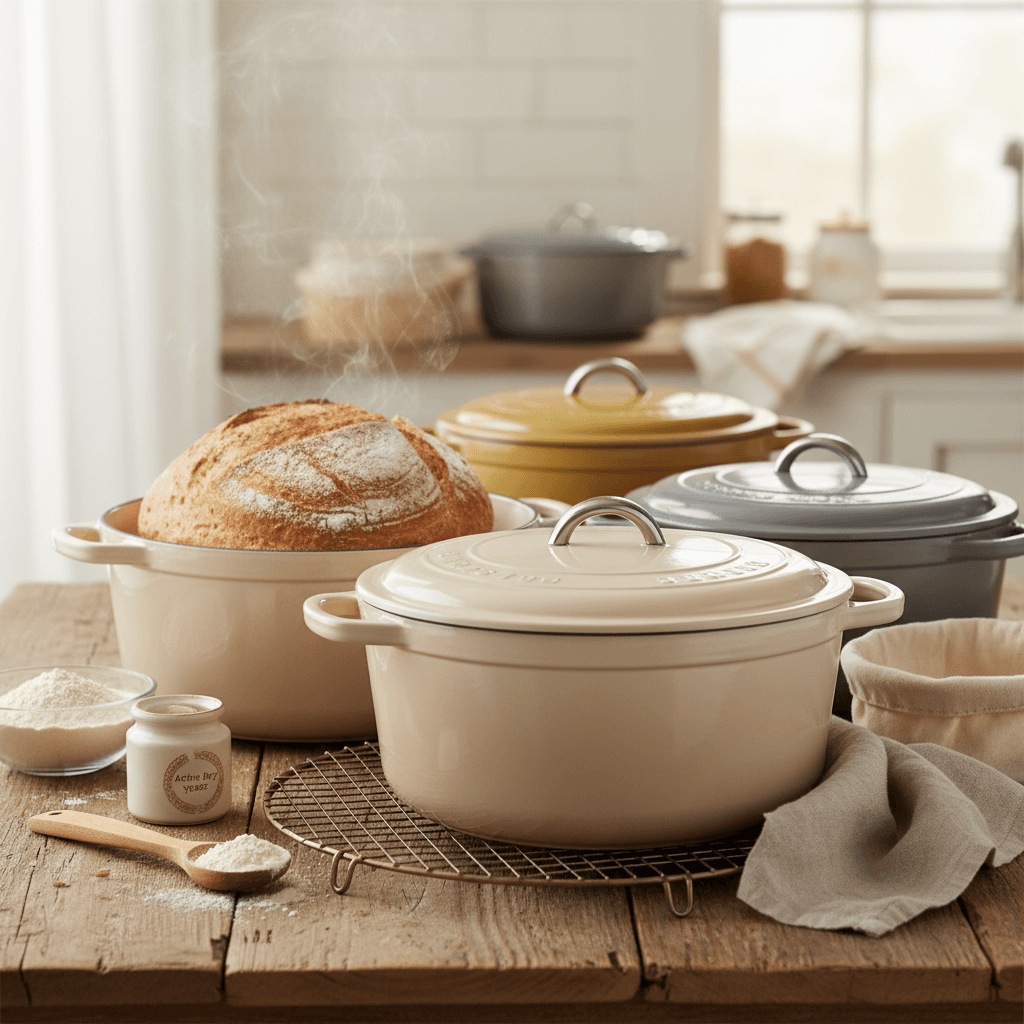
A Dutch oven is the single most effective tool for getting a crispy, well-risen crust on homemade bread — and for gluten-free bakers, it's arguably even more important than it is for wheat bakers. Here's why it matters and which ones are worth your money.
Key takeaways
- Dutch ovens trap steam during the first phase of baking, which is critical for gluten-free bread because the crust needs to set quickly before the loaf loses structure.
- A 5-quart round Dutch oven is the ideal size for most gluten-free boule and sourdough recipes.
- Cast iron and enameled cast iron both work well, but enameled versions are easier to clean and resist sticking better with GF doughs.
- Preheating your Dutch oven to 450-500°F is essential — a lukewarm pot won't generate enough steam.
- You don't need to spend $300. Several excellent options exist under $60 that perform nearly as well as premium brands.
- Combo cookers (with a skillet lid) make it much easier to load sticky gluten-free dough safely.
Why Dutch ovens matter even more for gluten-free bread
Steam is the secret weapon behind a great bread crust, and a Dutch oven is the simplest way to create a steam-rich environment in a home oven. When you bake inside a sealed pot, moisture from the dough gets trapped, keeping the surface pliable long enough for the bread to fully expand before the crust hardens.
For gluten-free bread, this is especially critical. Without gluten's elastic protein network to hold structure, GF doughs rely heavily on starches, binders like xanthan gum or psyllium husk, and rapid crust formation to maintain their shape. If the crust sets too early (in a dry oven), the bread can't rise fully. If it sets too late (or never properly), the loaf can collapse as it cools. A Dutch oven hits the sweet spot — intense, even heat plus trapped steam — giving your GF loaf the best shot at a proper rise and a crust that actually cracks when you slice into it.
This is especially true for gluten-free sourdough, where the dough is often wetter and more fragile than standard yeast bread. The enclosed baking environment lets the loaf spring up in the first 15-20 minutes before you remove the lid to let the crust brown and crisp.
If you're still building out your gluten-free baking setup, our Confident Gluten-Free Baker Toolkit walks you through every tool and technique you need — including how to get the most out of your Dutch oven.
What to look for in a Dutch oven for bread baking
Not every Dutch oven is created equal when it comes to bread. Here's what actually matters:
Size and shape
A 5 to 5.5-quart round Dutch oven is ideal for most bread recipes. It's large enough for a standard boule but small enough to concentrate steam effectively. Oval Dutch ovens work for batards and longer loaves, but round is more versatile for GF bread since most recipes produce round boules.
Material
You have two main choices: bare cast iron and enameled cast iron. Both retain heat beautifully. Bare cast iron is cheaper and practically indestructible, but sticky GF doughs can be harder to release from it. Enameled cast iron has a smoother surface, cleans up easier, and won't react with acidic sourdough — but it costs more and the enamel can chip over time at very high temperatures.
Lid design
You need a tight-fitting lid that traps steam effectively. Some Dutch ovens have self-basting lids with bumps on the underside — these are fine for bread but not necessary. What matters most is a secure seal. Avoid lids with plastic or silicone knobs unless they're rated for at least 500°F (most aren't, but replacements are cheap).
Weight
This is worth thinking about. A preheated Dutch oven at 475°F is heavy and dangerous. If you have wrist or grip concerns, a lighter option or a combo cooker (more on that below) may be safer.
7 best Dutch ovens for bread baking
We've researched these options with gluten-free bread specifically in mind. Here are our top picks.
| Dutch oven | Size | Material | Best for | Price range |
|---|---|---|---|---|
| Lodge Cast Iron Combo Cooker | 3.2 qt | Bare cast iron | Easy dough loading, GF sourdough | $ |
| Lodge 5-Quart Cast Iron Dutch Oven | 5 qt | Bare cast iron | Budget pick, everyday baking | $ |
| Cuisinart Chef's Classic Enameled Cast Iron | 5 qt | Enameled cast iron | Best value enameled option | $$ |
| Tramontina Enameled Cast Iron Dutch Oven | 5.5 qt | Enameled cast iron | Mid-range all-rounder | $$ |
| Le Creuset Signature Round Dutch Oven | 5.5 qt | Enameled cast iron | Premium quality, lifetime warranty | $$$$ |
| Staub Round Cocotte | 5.5 qt | Enameled cast iron (matte black interior) | Best crust browning, self-basting lid | $$$$ |
| Lodge Enameled 6-Quart Dutch Oven | 6 qt | Enameled cast iron | Larger loaves, versatile cooking | $$ |
Best overall: Lodge cast iron combo cooker
The Lodge Combo Cooker is our top recommendation for gluten-free bread bakers, and it's not the most obvious choice. At 3.2 quarts, it's smaller than a traditional Dutch oven, but the design is genius for bread. The shallow skillet serves as the base (where your dough sits), and the deeper pot inverts over it as the lid. This means you're loading your fragile GF dough into a shallow pan instead of dropping it into a scorching-hot deep pot — a huge advantage when you're working with sticky, delicate dough that doesn't hold its shape the way wheat dough does.

Lodge Cast Iron Combo Cooker - PFAS-Free 2-in-1 3.2 Quart Deep Pot and 10.25 Inch Skillet Set - Dutch Oven with Skillet Lid for Sourdough, Frying, and Camping - Made in the USA
Check price on Amazon →It's affordable, nearly indestructible, and produces excellent oven spring. The only downside is the size — if you're making larger loaves, you'll want something bigger.
Best budget Dutch oven: Lodge 5-quart cast iron
The Lodge 5-Quart Dutch Oven is the workhorse option. It's heavy, it holds heat like a champ, and it costs less than a bag of specialty GF flour. The bare cast iron surface does require a bit more prep (parchment paper is your friend here), but for the price, nothing else comes close. Pre-seasoned from the factory and built to last generations.
Best enameled option under $100: Cuisinart Chef's Classic
If you want the easier cleanup of enamel without the premium price tag, the Cuisinart Chef's Classic is excellent. The light-colored interior makes it easy to monitor browning, and the enamel surface releases GF bread more readily than bare cast iron. The knob is oven-safe to 500°F, which is a nice touch that some competitors miss.
Best premium pick: Staub Round Cocotte
The Staub 5.5-Quart Round Cocotte is the bread baker's dream if budget isn't a concern. Its matte black enameled interior promotes better browning than light-colored enamel, and the self-basting spikes on the lid continuously redistribute moisture during baking. For gluten-free sourdough, where every bit of steam matters, this design genuinely makes a difference. The heavy lid creates an exceptionally tight seal, and the whole unit retains heat better than almost anything else on the market.
How to bake gluten-free bread in a Dutch oven
Getting the technique right matters just as much as the pot you use. Here's the process to follow for every GF loaf:
- Preheat aggressively. Place your Dutch oven (with the lid on) in the oven and preheat to 450-475°F for at least 30 minutes. The pot needs to be fully saturated with heat. Use an instant-read thermometer to verify your oven is actually hitting temperature — many ovens run 25°F or more off.
- Prepare your dough on parchment. Shape your GF dough on a piece of parchment paper. This is non-negotiable for gluten-free bread — the dough is too sticky and fragile to transfer without it. You can use the parchment as a sling to lower the dough into the hot pot.
- Score the dough. Use a sharp blade or lame to score the top. For GF bread, score a bit shallower than you would for wheat bread — about 1/4 inch deep. This gives the loaf a controlled place to expand.
- Bake covered for 20-25 minutes. This is the steam phase. Keep the lid on and resist the urge to peek.
- Remove the lid and bake another 20-25 minutes. This lets the crust brown and crisp. If you're unsure whether the bread is done, check the internal temperature — it should read 205-210°F. If you're getting gummy centers, you likely need more time in this uncovered phase.
- Cool completely on a wire rack. This is where many GF bakers go wrong. Cutting into the bread too early lets steam escape and can make the crumb gummy. Give it at least an hour, ideally two.
Weighing your ingredients with a good kitchen scale is also essential for consistent results — GF flour blends vary wildly in density, and a cup of one blend can weigh 30% more than a cup of another.
Common Dutch oven bread mistakes (and how to avoid them)
Even with the right equipment, a few pitfalls can derail your bake:
Not preheating long enough
Cast iron takes time to heat through completely. If you only preheat for 10-15 minutes, the bottom of the pot won't be hot enough to give you good oven spring. Always allow at least 30 minutes at full temperature.
Skipping the parchment paper
GF dough sticks to everything. Even a well-seasoned or enameled pot can grab onto wet GF dough. Always use parchment paper as a liner and a transfer sling. Some bakers also lightly dust the parchment with rice flour for extra insurance.
Using too large a Dutch oven
If your pot is too big relative to your dough, the bread will spread out flat instead of rising up. The dough should fill roughly half to two-thirds of the pot's base diameter. For most GF bread recipes, a 5 to 5.5-quart pot is the sweet spot.
Forgetting to check internal temperature
GF bread can look perfectly golden on the outside while still being raw in the center. Always verify doneness with an internal temperature check. This is one of the most common issues in gluten-free bread troubleshooting.
Dutch oven vs. baking stone vs. loaf pan for gluten-free bread
Each method has its place, but they produce very different results with GF bread.
| Method | Steam | Crust quality | Best for | GF-friendliness |
|---|---|---|---|---|
| Dutch oven | Excellent (trapped) | Crispy, artisan-style | Boules, sourdough | Excellent |
| Baking stone + steam pan | Moderate (escapes quickly) | Good but inconsistent | Pizza, flatbreads | Tricky — dough spreads |
| Loaf pan | None (open baking) | Soft, sandwich-style | Sandwich bread, everyday loaves | Very good |
For artisan-style gluten-free bread with a crackly crust and open crumb, nothing beats a Dutch oven. If you're making sandwich bread, a quality loaf pan is the better choice. And if you're working with a baking stone, you'll struggle to generate enough steam for GF bread without a lot of extra setup.
Tips for getting the best gluten-free sourdough from your Dutch oven
Gluten-free sourdough has exploded in popularity, and for good reason — the long fermentation improves flavor, digestibility, and texture. But it does require some adjustments to your Dutch oven technique:
- Use psyllium husk as your binder. It creates a more extensible dough that handles oven spring better than xanthan gum. Check out our guide on the best binders for gluten-free bread for the full breakdown.
- Don't skip the cold proof. Shaping GF sourdough and refrigerating it overnight (8-12 hours) firms up the dough significantly, making it much easier to score and load into the Dutch oven.
- Load from frozen or cold. Going straight from the fridge to a screaming-hot Dutch oven actually helps GF sourdough. The temperature differential maximizes oven spring.
- Keep your dough hydration in check. GF sourdough recipes often call for high hydration, but too much water makes the dough impossible to shape. If your dough is unmanageable, see our tips on making gluten-free bread less sticky.
Once your Dutch oven is ready, our no-knead gluten-free bread recipe is built around exactly this method: 40 minutes covered so the trapped steam drives the rise, then uncovered to set the crust.
Buying one as a present? Our gifts for bakers guide sorts picks by budget, from stocking stuffers to splurges.
Frequently asked questions
Can you use a regular pot instead of a Dutch oven for bread?
You can use any oven-safe pot with a tight-fitting lid, as long as it's made of a material that handles high heat (450°F+). Stainless steel pots work in a pinch but don't retain heat as well as cast iron, which means less oven spring. Avoid anything with plastic handles or non-stick coatings that aren't rated for high temperatures.
What size Dutch oven is best for gluten-free bread?
A 5 to 5.5-quart round Dutch oven is the best all-around size for gluten-free bread. It's large enough to accommodate most boule recipes while being small enough to concentrate steam around the dough. If you primarily bake smaller loaves, a 3.2-quart combo cooker like the Lodge works beautifully.
Do you need to grease a Dutch oven for bread?
Not if you use parchment paper, which we strongly recommend for gluten-free bread. GF doughs are stickier than wheat doughs and can bond to even well-seasoned cast iron. Parchment paper eliminates the problem entirely and makes cleanup effortless. If you prefer not to use parchment, a generous coating of rice flour can help.
Why does my gluten-free bread not rise in the Dutch oven?
The most common causes are insufficient preheating (the pot wasn't hot enough), over-proofing the dough before baking, or not using enough binder. Make sure you preheat for a full 30 minutes and that your dough still has some rise left when it goes into the oven. Our guide on how to make gluten-free bread rise properly covers this in detail.
Is enameled or bare cast iron better for baking bread?
Both produce excellent bread. Bare cast iron is cheaper and slightly better at heat retention, while enameled cast iron is easier to clean and less reactive with acidic sourdough. For gluten-free bakers, enameled has a slight edge because the smoother surface releases sticky GF dough more easily. Either way, always use parchment paper as a liner.

Written by
Co-founder, BakingSubs
Co-founder of BakingSubs, where he turns the science of ingredient substitutions into tested, reliable guidance for home bakers.
Related Posts
Bake with Confidence
See all
Confident Gluten-Free Baker Toolkit
The science-based system that replaces gluten's seven invisible jobs so your baking turns out soft, fluffy, and foolproof — every time.

Gluten-Free Recipe Vault
Instant access to our complete library of proven gluten-free recipes — no waiting, no guesswork, just results that work tonight.

Fix Your Gluten-Free Bread
Learn the 3-step formula to make bread rise and stay soft, discover why your loaves collapse, and get a tested sandwich bread recipe that actually works.