

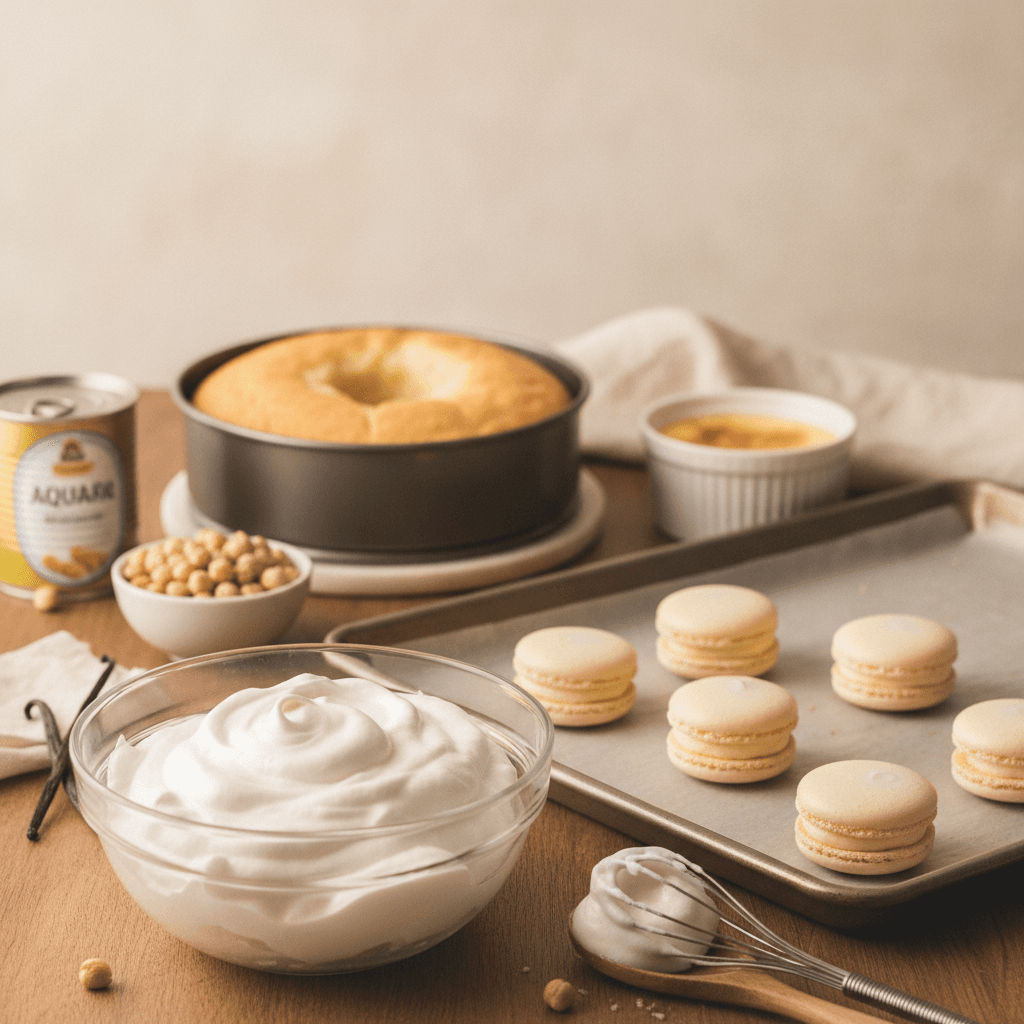
Aquafaba — the liquid from a can of chickpeas — can mimic egg whites in meringues, mousses, and certain cakes. But it has real limits that most online guides gloss over, and understanding where it works versus where it falls apart will save you wasted batches and frustration.
Key takeaways
Aquafaba whips into stiff peaks like egg whites, but the foam is less stable and more sensitive to fat, heat, and timing.
The standard substitution ratio is 3 tablespoons (about 45ml) of aquafaba per one egg white.
It works best in meringues, macarons, marshmallows, and mousse — applications where egg whites primarily provide aeration.
It struggles in recipes where egg whites also provide structural protein, like angel food cake, where the result tends to collapse or stay gummy in the center.
Adding 1/8 teaspoon cream of tartar per 3 tablespoons of aquafaba helps stabilize the foam significantly.
Not all canned chickpea liquid performs the same — sodium content, brand, and whether you use reduced liquid all affect whipping results.
What aquafaba actually is (and why it whips)
Aquafaba is the starchy, protein-rich cooking liquid left over from simmering chickpeas (or other legumes, though chickpea liquid is the standard). The name literally means "bean water" — coined by Goose Wohlt in 2015 when he popularized its use as a vegan egg white replacement.
The reason it whips is that chickpea cooking liquid contains saponins, proteins, and carbohydrates that can trap air bubbles in a way structurally similar to the albumin proteins in egg whites. It's not identical — aquafaba foams are inherently weaker and less heat-stable — but the resemblance is close enough to work in many applications.
You can get aquafaba from a standard 15-ounce can of chickpeas, which typically yields about 1/2 cup (roughly 120ml) of liquid. That's enough to replace approximately 2-3 egg whites depending on the recipe. For a deeper look at how egg whites function in baking and what any substitute needs to replicate, see our guide on egg functions in baking.
The substitution ratio and how to adjust it
The widely accepted ratio is 3 tablespoons of aquafaba to replace 1 egg white. For a whole egg (where you'd use aquafaba as a stand-in for both white and yolk functions), the ratio is the same 3 tablespoons, though results are less reliable since aquafaba doesn't replicate yolk's fat or emulsification.
Egg component | Aquafaba amount | Reliability |
|---|---|---|
3 tablespoons (45ml) | High — works well in most whipped applications | |
1 whole egg (binding only) | 3 tablespoons (45ml) | Moderate — provides some binding but no fat |
1 egg yolk | 1 tablespoon (15ml) | Low — cannot replicate fat or lecithin |
If your aquafaba seems thin or watery, you can reduce it on the stovetop before whipping. Simmer the liquid in a saucepan until it's reduced by about one-third. Let it cool completely before whipping — heat will prevent foam formation. Reduced aquafaba tends to whip faster and hold peaks longer because the protein and starch concentration is higher.
Where aquafaba works well
Aquafaba performs best in recipes where egg whites are primarily responsible for aeration — trapping air to create volume and lightness. Here's where it genuinely delivers:
Meringues
This is aquafaba's signature application. Whipped aquafaba with sugar can produce meringue cookies that are crisp on the outside and marshmallowy inside. The catch: aquafaba meringues take longer to dry out in the oven than egg white meringues. Many bakers report needing an extra 15-30 minutes at low temperature (around 200-225°F / 95-107°C) compared to traditional meringue. Humidity is also a bigger enemy — aquafaba meringues absorb moisture from the air more readily and can turn sticky within hours in a humid kitchen.
Macarons
Vegan macarons made with aquafaba are possible, though they're notoriously finicky. The shells tend to be more fragile and slightly less smooth than egg-white versions. Using aged aquafaba (left uncovered in the fridge for 24-48 hours so some moisture evaporates) can improve results. Even experienced macaron bakers should expect a higher failure rate with aquafaba — hollow shells and cracked tops are more common.
Mousse and whipped toppings
Aquafaba whips into a light foam that works well as the base for chocolate mousse or as a dairy-free whipped topping. Stabilizing it with a small amount of cream of tartar and sugar helps it hold its shape longer. Without stabilization, aquafaba foam deflates faster than whipped egg whites — often within 20-30 minutes at room temperature.
Light cakes and cupcakes
In recipes where whipped egg whites are folded into batter for lift (like chiffon-style cakes), aquafaba can work as a substitute. The crumb tends to be slightly denser and the cake may not rise quite as high, but the results are generally acceptable. This is a better application than trying to use aquafaba as a whole-egg replacement in a standard butter cake, where it can't replicate the binding and moisture-retention roles of a full egg.
Where aquafaba falls short
Understanding the limitations matters more than knowing where it works. Here are the applications where aquafaba reliably underperforms or fails:
Angel food cake
Angel food cake depends on egg whites for both aeration and structural protein. When the cake bakes, egg white proteins coagulate and set the foam into a stable structure. Aquafaba proteins don't coagulate the same way — they lack the tensile strength to hold up a tall, spongy cake. The result is typically a cake that rises in the oven but collapses as it cools, often with a gummy or wet center. This is one of the clearest failure cases.
Recipes that need binding strength
If a recipe calls for egg whites primarily as a binder — holding together a cookie dough or coating a nut topping — aquafaba provides only weak binding. Chia seeds or flaxseed are generally better choices for binding because they form a gel that physically holds ingredients together.
High-fat batters
Fat destabilizes aquafaba foam even faster than it destabilizes egg white foam. If you're folding whipped aquafaba into a batter that contains butter, oil, or chocolate, you need to work quickly and fold gently. Even then, expect more volume loss than you'd get with egg whites. A recipe with more than about 30% fat by weight relative to flour is a risky candidate for aquafaba substitution.
Custards and quiches
Aquafaba cannot set into a firm gel the way eggs do when heated. Custard, flan, quiche filling, and similar applications rely on egg protein coagulation for their structure. Aquafaba will not thicken or set these preparations. You'd need a different approach entirely — typically a combination of starch and plant-based milk.
How to whip aquafaba successfully
Whipping aquafaba is slower than whipping egg whites. Here's what affects the outcome:
Temperature: Cold aquafaba whips better than room-temperature aquafaba. Chilling it in the fridge for at least an hour before whipping improves foam stability.
Equipment: A stand mixer with a whisk attachment is strongly recommended. Whipping aquafaba by hand is technically possible but extremely tedious — it can take 15-20 minutes to reach stiff peaks with a hand whisk, compared to 8-12 minutes with a stand mixer. A KitchenAid stand mixer or similar is the practical choice here. A hand mixer works too, though it may take a few minutes longer than a stand mixer.
Bowl cleanliness: Just like with egg whites, any trace of grease or fat in the bowl will prevent aquafaba from whipping properly. Use a clean, dry metal or glass bowl. Plastic bowls can retain oil residue even after washing.
Cream of tartar: Adding 1/8 teaspoon of cream of tartar per 3 tablespoons of aquafaba makes a noticeable difference in foam stability. The acid helps strengthen the protein network trapping the air bubbles. This is the single most impactful tip for better aquafaba results.
Sugar timing: If you're making meringue, add sugar gradually once the aquafaba reaches soft peaks — just as you would with egg whites. Adding sugar too early slows down foam formation. Adding it too late can cause the foam to deflate.
Does the brand of chickpeas matter?
Yes, and this is one of the most underappreciated variables. Different brands of canned chickpeas produce aquafaba with different viscosity, sodium content, and protein concentration. Some brands add calcium chloride or other firming agents that can affect whipping performance.
As a general rule, aquafaba from no-salt-added or low-sodium chickpeas tends to whip more reliably because the higher sodium in regular canned chickpeas can sometimes interfere with foam stability. That said, many bakers report good results with standard salted chickpea liquid — the effect of sodium varies by brand and batch.
Homemade aquafaba from dried chickpeas cooked from scratch is another option. The advantage is control — you can cook the chickpeas until the liquid reaches your desired concentration. The disadvantage is inconsistency — without the standardized process of commercial canning, homemade aquafaba varies more from batch to batch. If you go this route, aim for liquid that has the viscosity of thin egg whites — it should coat a spoon lightly but not be as thick as syrup.
Aquafaba vs. other vegan egg white substitutes
Aquafaba isn't the only option for replacing egg whites in vegan baking. Here's how it compares to the most common alternatives:
Substitute | Best for | Limitations | Whips to stiff peaks? |
|---|---|---|---|
Meringues, mousse, macarons, light cakes | Weak binding, no protein coagulation, humidity-sensitive | Yes | |
Flax egg (1 tbsp ground flax + 3 tbsp water) | Binding in cookies, muffins, quick breads | Cannot whip, adds visible flecks, slight nutty flavor | No |
Chia egg (1 tbsp chia + 3 tbsp water) | Binding in dense baked goods, brownies | Cannot whip, gel texture, visible seeds unless ground | No |
Commercial egg replacer powder (e.g., Bob's Red Mill) | General-purpose binding and light leavening | Cannot whip to stiff peaks, varies by brand | No (some partial foaming) |
Methylcellulose-based replacers | Structural applications needing heat-set gelling | Less available, requires specific ratios, unfamiliar to most home bakers | No |
The key distinction: aquafaba is the only common vegan substitute that can actually whip to stiff peaks. If a recipe depends on whipped egg whites for volume, aquafaba is your primary option. If the recipe just needs binding, other vegan egg substitutes are often more reliable. For help choosing the right substitute for your specific recipe, our guide on choosing egg substitutes breaks down the decision by function.
Common mistakes with aquafaba in baking
These are the errors that most commonly lead to failed batches:
Using aquafaba from the wrong legume. Chickpea liquid is the standard for a reason — it has the best balance of proteins and starches for whipping. Liquid from black beans, kidney beans, or white beans can sometimes work, but the flavor is often stronger and the whipping performance less predictable. Stick with chickpeas unless you have a specific reason not to.
Not reducing thin aquafaba. If the liquid pours like water, it probably won't whip well. Reducing it by simmering until it thickens slightly (and then cooling it completely) concentrates the proteins that make foaming possible.
Folding too aggressively. When incorporating whipped aquafaba into a batter, fold gently with a spatula using the cut-and-turn method. Stirring or mixing vigorously will knock out the air you just spent 10 minutes whipping in. This matters even more with aquafaba than with egg whites because the foam is inherently less stable.
Skipping the stabilizer. Cream of tartar isn't optional with aquafaba the way it sometimes is with egg whites. The foam needs the help. Without it, you'll often get peaks that look stiff in the bowl but collapse within minutes once you stop whipping.
Expecting identical results. Aquafaba meringues will not be exactly like egg white meringues. They may be slightly chewier, take longer to dry, and have a shorter shelf life. Aquafaba cakes may be slightly denser. Setting realistic expectations prevents disappointment. For a broader look at common egg substitution pitfalls, see our guide on egg substitute mistakes.
Storage and shelf life
Unused aquafaba from an opened can keeps in the refrigerator for up to 5 days in a sealed container. It can also be frozen — pour it into ice cube trays in 1-tablespoon portions so you can thaw exactly what you need. Frozen aquafaba keeps for 3-4 months. Thaw it in the refrigerator overnight before using, and give it a good shake or stir since it can separate slightly during freezing.
Once whipped, aquafaba foam should be used immediately. Unlike whipped egg whites, which hold their structure for a reasonable window, whipped aquafaba begins deflating within minutes. Have your other ingredients prepped and ready before you start whipping.
A note on flavor
One concern people raise is whether aquafaba tastes like chickpeas. In most baked applications, the answer is no — or at least, not detectably. The small amount used (3 tablespoons per egg white) is diluted by sugar, flour, chocolate, or whatever else is in the recipe. In plain meringues with only sugar and aquafaba, some people report a very faint savory note, but most find it undetectable once the meringue is baked and dried. If you're particularly sensitive to it, using aquafaba from no-salt-added chickpeas and reducing it before use can minimize any residual flavor.
Frequently asked questions
Can you use aquafaba from canned chickpeas without cooking it first?
Yes. The liquid from commercially canned chickpeas is already cooked during the canning process and is ready to use straight from the can. You can optionally reduce it by simmering to concentrate the proteins, but no additional cooking is required before whipping or adding it to batters.
How long does it take to whip aquafaba to stiff peaks?
With a stand mixer on medium-high speed, aquafaba typically takes 8-12 minutes to reach stiff peaks — roughly twice as long as egg whites. A hand mixer may take 12-15 minutes. Factors like temperature (colder is better), concentration of the liquid, and whether you've added cream of tartar all affect whipping time.
Does aquafaba work in gluten-free baking?
Yes. Aquafaba is naturally gluten-free and works the same way regardless of whether the recipe uses wheat flour or gluten-free flour blends. In gluten-free baking, where structure is already a challenge, pairing aquafaba with a binding agent like xanthan gum can help compensate for the structural limitations of both the flour and the aquafaba.
Can you use aquafaba as a substitute for whole eggs in cookies?
You can, but results are mixed. In cookies, eggs provide binding, moisture, and some leavening. Aquafaba handles the moisture component but is a weak binder. Cookies made with aquafaba instead of whole eggs tend to spread more and may be more fragile. For cookies, a mashed banana or flax egg often performs better as a whole-egg replacement because they provide stronger binding.
Is aquafaba safe for people with soy allergies?
Standard aquafaba from chickpeas does not contain soy. However, always check the label on canned chickpeas, as some brands may process their products in facilities that also handle soy. People with legume allergies (which can include chickpeas) should avoid aquafaba entirely, as it contains the same proteins found in the beans themselves.

Written by
Co-founder, BakingSubs
Co-founder of BakingSubs, where he turns the science of ingredient substitutions into tested, reliable guidance for home bakers.
Related Posts
Bake with Confidence
See all
Confident Gluten-Free Baker Toolkit
The science-based system that replaces gluten's seven invisible jobs so your baking turns out soft, fluffy, and foolproof — every time.

Gluten-Free Recipe Vault
Instant access to our complete library of proven gluten-free recipes — no waiting, no guesswork, just results that work tonight.

Fix Your Gluten-Free Bread
Learn the 3-step formula to make bread rise and stay soft, discover why your loaves collapse, and get a tested sandwich bread recipe that actually works.