

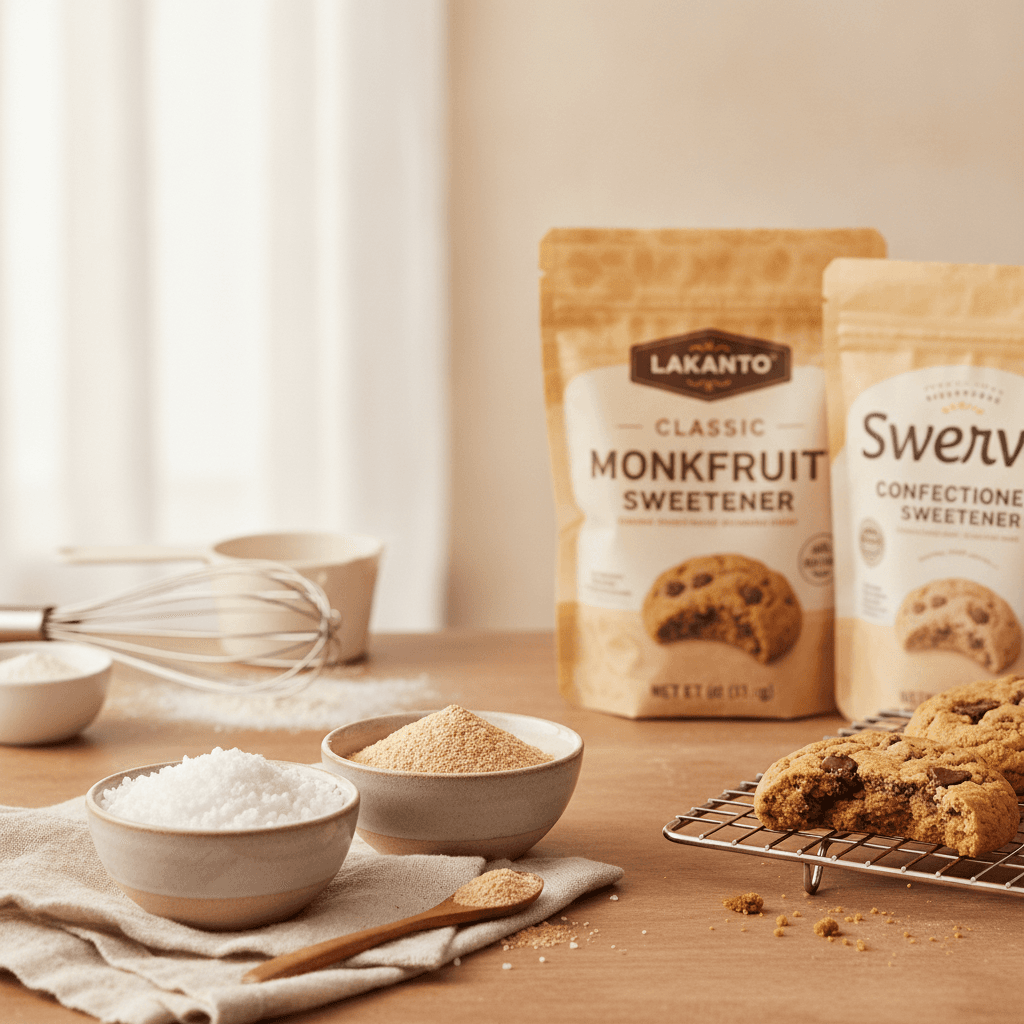
Lakanto Classic is a two-ingredient sweetener (non-GMO erythritol plus monk fruit extract) that delivers 0 calories and 0 g net carbs per serving under standard keto accounting. It measures 1:1 like white sugar, carries Non-GMO Project Verified and Kosher certifications, and sits at the premium end of the monk fruit market at roughly $0.91 per ounce on Lakanto.com. Below, we break down every label detail, compare Lakanto head-to-head with Swerve, and explain who should buy it and who should skip it.
Key takeaways
- Only two ingredients: Non-GMO erythritol and monk fruit extract. No natural flavors, no oligosaccharides, no fillers.
- 0 g net carbs, 0 calories per serving when erythritol is fully subtracted (the standard keto convention). The USDA database lists 2 g net carbs per 4 g serving using a different calculation method that only partially subtracts erythritol.
- Erythritol is a sugar alcohol that does not caramelize or brown like real sugar. If browning matters for your recipe, Lakanto's newer allulose-blend line may be a better fit.
- Premium pricing: At $0.91/oz on Lakanto.com for the 1 lb bag, Lakanto costs more per ounce than Swerve Granular, which lists at $7.99 for 12 oz (about $0.67/oz) on Swerve's site.
- Certifications: Non-GMO Project Verified, Kosher (Pareve). Also marketed as gluten-free and vegan.
- Lakanto now offers two blend philosophies: erythritol-based (Classic, Golden, Powdered, Brown, Baking) and allulose-based (Classic Allulose, Golden Allulose), plus a newer "Reduced Sugar" line that contains real sugar and is not zero-sugar.
Lakanto vs. Swerve: comparison table
Swerve Granular is Lakanto Classic's closest shelf competitor. Both are erythritol-based, 1:1 sugar replacements with 0 calories and 0 g net carbs (keto convention). The differences come down to ingredient count, what provides the extra sweetness beyond erythritol, and baking behavior.
| Criteria | Lakanto Classic | Swerve Granular |
|---|---|---|
| Ingredients | Non-GMO erythritol, monk fruit extract (2 ingredients) | Erythritol, allulose, natural flavor, xanthan gum (4 ingredients; reformulated December 2023) |
| Calories per serving | 0 | 0 |
| Net carbs (keto convention) | 0 g | 0 g |
| Sugar alcohols per serving | 4 g per 1 tsp (4 g) | Yes (erythritol-based; exact per-serving figure not confirmed in this review) |
| Sugar replacement ratio | 1:1 | 1:1 |
| Sweetness source beyond erythritol | Monk fruit extract (mogrosides) | Allulose + natural flavor |
| Caramelization / browning | Does not caramelize (erythritol chemistry) | Swerve says its added allulose enhances browning of baked goods |
| Cooling effect likelihood | Possible (erythritol absorbs heat when dissolving) | Possible (erythritol is still the main ingredient) |
| Certifications | Non-GMO Project Verified, Kosher (Pareve); marketed as gluten-free and vegan | Non-GMO and gluten-free (per manufacturer) |
| Contains "natural flavors" | No | Yes |
| Price tier | Premium | Mid-range to premium |
The biggest practical difference for bakers: Swerve now includes allulose, which Swerve says enhances browning, while Lakanto Classic's erythritol-monk fruit formula does not caramelize. If you are making cookies or crumbles where golden color matters, that is worth knowing. For frostings, beverages, and recipes where browning is irrelevant, the formulas perform similarly on paper.
For a broader look at how monk fruit sweeteners stack up, see our 13 monk fruit sweetener brands compared for baking.
How we ranked and evaluated
We evaluated Lakanto's sweetener line on verifiable, label-based criteria only:
- Ingredient simplicity — fewer ingredients with recognizable names rank higher.
- Nutrition label — calories, net carbs (keto convention: total carbs minus fiber minus sugar alcohols), and sugar alcohols per serving.
- Certifications — Non-GMO Project Verified, Kosher, Gluten Free, Vegan, Organic.
- Format and versatility — available forms (granulated, powdered, brown, packets) and replacement ratio.
- Price per ounce — based on the manufacturer's listed price or widely available retail price.
We did not taste, bake with, or test any product. Taste and texture descriptions below are either manufacturer claims (labeled as such) or predictions based on the ingredient's known chemistry (also labeled).
The full Lakanto product line, explained
Erythritol-blend sweeteners
These are Lakanto's original line. Every product in this group uses erythritol as the bulk sweetener and monk fruit extract for additional sweetness.
- Classic — White sugar replacement, 1:1 ratio. Two ingredients: non-GMO erythritol, monk fruit extract. 0 cal, 0 g net carbs per 1 tsp (4 g). Available in 8.29 oz, 1 lb, 1.76 lb, 3 lb, and 5 lb bags.
- Golden — Raw cane sugar / brown sugar replacement. Same two ingredients: erythritol, monk fruit extract. 0 cal, 0 g net carbs per serving. Lakanto markets it as a raw cane sugar replacement. Available in the same size range as Classic.
- Powdered — Powdered sugar replacement. Kosher Certified (Pareve). Useful for recipes where sugar's role is structural, like frostings and glazes.
- Brown — Brown sugar replacement (erythritol + monk fruit).
- Baking — Contains erythritol, tapioca fiber, chicory root inulin, monk fruit extract, and cellulose gum. Lakanto markets it for moisture retention and better browning, targeting two common mistakes when baking with monk fruit sweetener.
- 2:1 Packets — On-the-go stick packs with erythritol and monk fruit extract, twice as sweet as sugar.
Allulose-blend sweeteners
Launched in October 2023, these swap erythritol for allulose. The ingredient list is just two items: allulose and monk fruit extract. Lakanto's allulose line is labeled erythritol-free.
- Classic Allulose — White sugar replacement. Lakanto claims zero calories and zero net carbs, and markets it as erythritol-free.
- Golden Allulose — Raw cane sugar replacement. Lakanto references "prebiotic characteristics."
Allulose is a rare sugar. FDA first issued a 'no questions' letter on a GRAS notice for it in 2012 (GRN 400). Its chemistry allows it to participate in Maillard browning and caramelization, which erythritol cannot do. That makes the allulose line a better candidate for recipes where you want golden-brown cookies or caramelized toppings.
Allulose is typically listed as a carbohydrate on US nutrition labels but contributes zero net calories, according to Lakanto's allulose page. The FDA permits allulose to be excluded from added sugars and total sugars counts on labels.
"Reduced sugar" line (not zero-sugar)
Lakanto also launched a "Reduced Sugar" line that blends real sugar (date sugar, coconut sugar, or cane sugar) with monk fruit extract. These claim about 70% less sugar and fewer calories than regular sugar. They are not zero-sugar or keto-friendly. If you are buying Lakanto specifically for a sugar-free or low-carb diet, double-check the label and make sure you are picking from the erythritol-blend or allulose-blend line, not the reduced-sugar line.
For more on how date sugar works in baking, we have a separate comparison.
The erythritol net carb question: 0 g or 2 g?
This is a genuine point of confusion, and it is worth a clear explanation. Lakanto Classic lists 4 g total carbohydrate per 1 tsp (4 g) serving. All 4 g come from erythritol, which is a sugar alcohol.
Under the standard keto convention, you subtract all erythritol from total carbs because erythritol is not metabolized for energy and has a glycemic index of 0. That gives you 0 g net carbs.
However, the USDA-sourced data on NutritionValue.org lists 2 g net carbs per 4 g serving. That figure subtracts only half of the 4 g of sugar alcohol, a convention some nutrition databases apply to all sugar alcohols.
Which number should you use? If you are following a ketogenic diet and your tracking app subtracts erythritol fully, 0 g net carbs is the figure you will see. If you use a USDA-based tracker, you may see 2 g. The physiological reality is the same either way: erythritol does not raise blood glucose. For a deeper look at how different sweeteners score on the glycemic index, see our glycemic index of baking sweeteners guide.
Baking behavior: what erythritol chemistry predicts
Since we have not baked with Lakanto, here is what the ingredient chemistry tells us about how it should behave in recipes:
- No caramelization. Erythritol does not undergo Maillard browning or caramelization. Baked goods will be paler than sugar-sweetened versions. This is a chemistry-based prediction, not a taste observation.
- Possible cooling sensation. Erythritol absorbs heat when it dissolves, which can create a cooling effect in the mouth. This is more noticeable in uncooked applications (frostings, no-bake fillings) than in baked goods where the erythritol is fully dissolved during mixing and baking.
- Recrystallization risk. Erythritol can recrystallize as baked goods cool, potentially creating a gritty or crunchy texture in items like cookies or frostings. This is a known property of erythritol across all brands, not specific to Lakanto. Using the powdered version reduces this risk because finer crystals dissolve more completely.
- Low hygroscopicity. Unlike sugar, erythritol attracts and holds very little moisture. Baked goods may dry out faster. Lakanto markets its Baking Sweetener, which adds tapioca fiber, chicory root inulin, and cellulose gum, as retaining moisture.
These behaviors affect every erythritol-based sweetener, not just Lakanto. If you are new to sugar-free baking, our guide on texture changes with health swaps covers the most common surprises.
Who should buy Lakanto (and who should skip it)
Buy Lakanto if:
- You want the shortest possible ingredient list. Two ingredients (erythritol + monk fruit extract) is as clean as erythritol-based sweeteners get. No natural flavors, no oligosaccharides.
- You need verified certifications. Lakanto Classic is Non-GMO Project Verified and Kosher (Pareve), and it is marketed as gluten-free and vegan.
- You want a full product ecosystem. Lakanto offers granulated, powdered, brown, baking-specific, packet, and allulose-blend versions under one brand, so you can stock your sugar alternatives pantry from a single source.
- You specifically want to avoid "natural flavors" on the label. Some shoppers prefer to know exactly what is in their sweetener, and Lakanto's two-ingredient formula delivers that.
Skip Lakanto if:
- You are on a tight budget. At $0.91/oz for the 1 lb bag on Lakanto.com, it is a premium-priced sweetener. Larger bags may cost less per ounce depending on the retailer, but Lakanto sits at the higher end of the market. Our sweetener price comparison covers budget to premium picks.
- You need browning and caramelization. The erythritol-blend Classic and Golden will not brown. Consider Lakanto's own allulose-blend line, or a competitor like Swerve (which added allulose in its December 2023 reformulation to improve browning).
- You are sensitive to the cooling effect of erythritol. If you have noticed a minty-cool sensation with other erythritol-based sweeteners, Lakanto Classic will likely produce the same effect. The allulose-blend version eliminates erythritol entirely.
- You want a sweetener with some real sugar for partial reduction. Lakanto's "Reduced Sugar" line does this, but at that point you are no longer buying a zero-sugar product. You might also consider other methods to reduce sugar in baking.
A worked cost comparison: Lakanto vs. a hypothetical baking week
Say you bake two batches of cookies per week, and each batch calls for 1 cup of sugar (roughly 7 oz by weight). Replacing that sugar 1:1 with Lakanto Classic means you use 14 oz per week.
- At $0.91/oz (Lakanto.com price for the 1 lb bag): 14 oz x $0.91 = $12.74 per week, or about $55.21 per month on sweetener alone.
- If you buy the 3 lb bag (48 oz) from Amazon, the per-ounce cost is lower, but exact Amazon pricing fluctuates. Even at a modest discount, a heavy baker will notice the cost difference versus granulated white sugar, which runs roughly $0.04-0.06/oz at most grocery stores.
That is a roughly 15x to 23x price premium over white sugar. For occasional baking, the difference is small in absolute dollars. For someone baking daily or running a monk fruit sweetener-based product line, it adds up fast.
Contrarian take: two ingredients is not always better
The "clean label" appeal of Lakanto's two-ingredient formula is real, but it comes with a trade-off that rarely gets discussed. Swerve's added ingredients are not just filler: Swerve says the allulose in its 2023 reformulation enhances browning, and that xanthan gum helps batters mix smoothly. Lakanto's own Baking Sweetener addresses the same gap by adding tapioca fiber, chicory root inulin, and cellulose gum, which Lakanto markets for moisture retention and better browning.
So if you are choosing Lakanto Classic over Swerve purely because "fewer ingredients = better," consider what those extra ingredients actually do. In baking, a functional additive aimed at dry, pale cookies might be more valuable than a shorter ingredient list. The best choice depends on what you are making, not on ingredient count alone.
Monk fruit safety and regulatory status
In 2010, FDA issued a 'no questions' letter on the first GRAS notice for monk fruit (luo han guo) extract (GRN 301). Monk fruit's sweetness comes from antioxidants called mogrosides, not from fructose or glucose, which is why it has a glycemic index of 0.
Erythritol is described by Lakanto as "a sugar alcohol naturally found in grapes, pears, mushrooms, soy sauce, cheese, wine, beer and corn." Lakanto says monk fruit (Luo Han Guo) is 250 to 300 times sweeter than sugar, so only a tiny amount is needed in each serving.
Frequently asked questions
Is Lakanto monk fruit sweetener keto-friendly?
Yes. Lakanto Classic contains 0 calories and 0 g net carbs per serving when erythritol is fully subtracted, which is the standard keto accounting method. The USDA database shows 2 g net carbs per 4 g serving using a different formula, but the physiological impact is the same: erythritol does not raise blood glucose. Lakanto's allulose-blend line is also keto-compatible.
Does Lakanto monk fruit sweetener have a cooling aftertaste?
Erythritol absorbs heat when it dissolves, which can create a cooling sensation in the mouth. This is a known property of erythritol chemistry, not unique to Lakanto. It is most noticeable in uncooked applications like frostings. Lakanto's allulose-blend products do not contain erythritol and should not produce this effect.
Can you use Lakanto Classic for caramelizing or browning?
No. Erythritol does not undergo Maillard browning or caramelization. If you need browning, Lakanto's allulose-blend sweetener is a better choice because allulose chemistry allows caramelization. Swerve also says the allulose in its current formula enhances browning. For more on how different sweeteners affect your recipe, see our guide.
What is the difference between Lakanto Classic and Lakanto Golden?
Both use the same two ingredients (erythritol and monk fruit extract) and have 0 calories and 0 g net carbs. The difference is flavor profile: Lakanto markets Golden as a raw cane sugar replacement. Classic is designed as a white sugar replacement.
Is Lakanto worth the price compared to Swerve?
That depends on your priorities. Lakanto has a cleaner two-ingredient label (no natural flavors), while Swerve's current four-ingredient formula includes allulose, which Swerve says enhances browning in baked goods. Lakanto is generally priced at the premium end. If ingredient simplicity and certifications (Non-GMO Project Verified, Kosher) matter most to you, Lakanto justifies the cost. If browning performance or budget matters more, Swerve or other options in our natural sweeteners for low-sugar baking roundup may be a better fit.
Sources
- Lakanto Classic Monkfruit Sweetener product page
- Lakanto Golden Monkfruit Sweetener product page
- Lakanto new products (Reduced Sugar line)
- Lakanto: All about allulose sweetener
- Lakanto help center / FAQ
- Lakanto blog: Allulose blend launch announcement
- NutritionValue.org: Lakanto Classic nutrition data (USDA)
- Vitacost: Lakanto Classic listing
- Whole Foods Market: Lakanto Golden listing
- Kroger: Lakanto Classic Allulose listing
- Swerve: Granular product page
- Swerve: New and improved formula (December 2023)
- Amazon Q&A: Lakanto vs. Swerve seller response
- NutriScan: Lakanto Golden nutrition and safety data
- FoodsCo: Lakanto Classic listing (monk fruit 250x sweeter)
- A Food Historian: Swerve vs. Lakanto comparison
- MonkVee: Monk fruit vs. Swerve (cooling effect)

Written by
Co-founder, BakingSubs
Co-founder of BakingSubs, where he turns the science of ingredient substitutions into tested, reliable guidance for home bakers.
Related Posts

Bake with Confidence
See all
Confident Gluten-Free Baker Toolkit
The science-based system that replaces gluten's seven invisible jobs so your baking turns out soft, fluffy, and foolproof — every time.

Gluten-Free Recipe Vault
Instant access to our complete library of proven gluten-free recipes — no waiting, no guesswork, just results that work tonight.

Fix Your Gluten-Free Bread
Learn the 3-step formula to make bread rise and stay soft, discover why your loaves collapse, and get a tested sandwich bread recipe that actually works.