

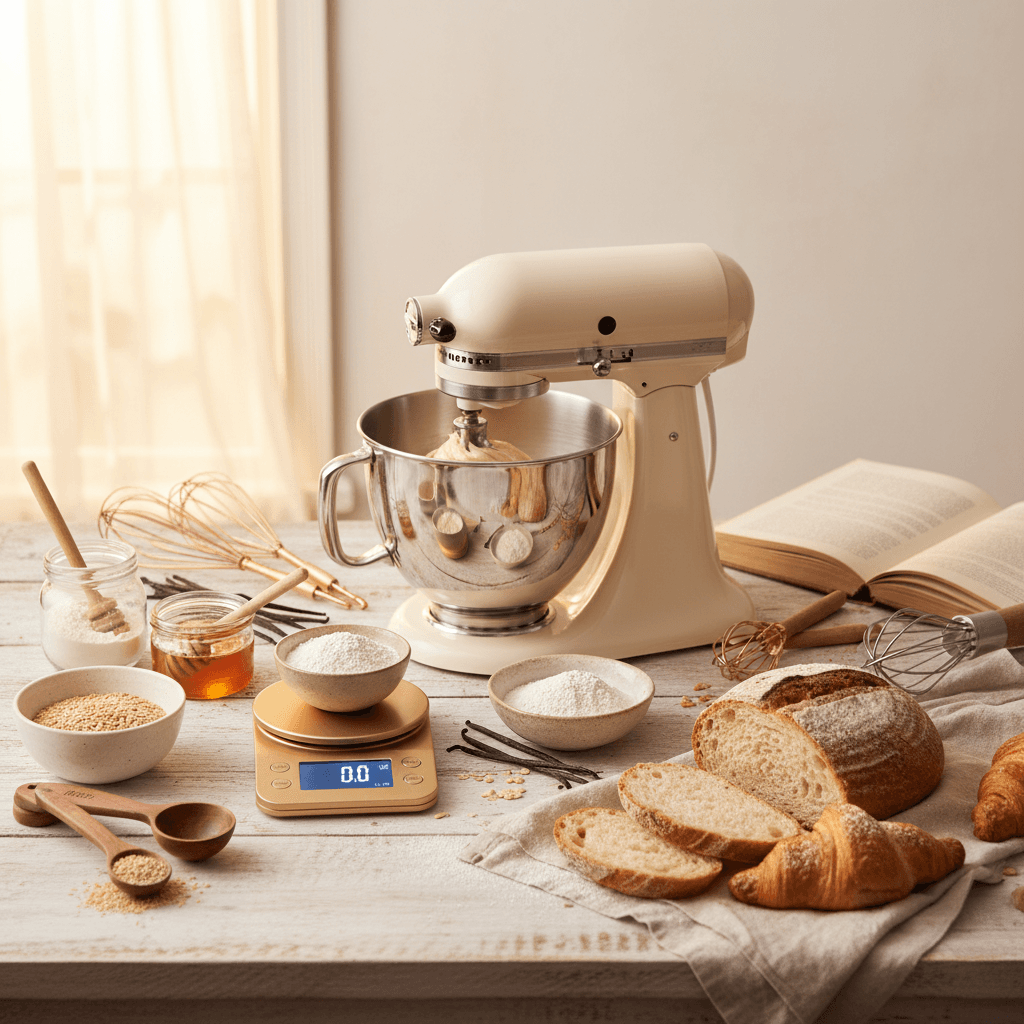
You already know how to bake. Now you want tools that keep up with your ambitions. We put together this guide to the high end baking tools every serious baker needs, organized by price bracket so you can upgrade strategically or find the perfect gift for the baker who has everything.
Key takeaways
- Premium baking tools justify their cost through better temperature accuracy, more consistent results, and dramatically longer lifespans than budget alternatives.
- A precision digital scale and an instant-read thermometer deliver the biggest performance jumps per dollar spent, especially in gluten-free baking where measurement accuracy is critical.
- Not every expensive tool is worth it. We call out specific categories where mid-range options perform nearly as well as top-tier ones.
- The best upgrades target your weakest link. If your bread is under-proofed, a proofing box matters more than a fancy mixer attachment.
- We organized everything into three price brackets ($25-50, $50-100, $100+) so you can prioritize based on your budget.
Why premium baking tools actually matter
The difference between a $10 scale and a $50 scale is not about aesthetics. It is about whether your scale reads 120g of almond flour accurately or drifts by 15-20g depending on where the bowl sits on the platform. In gluten-free baking especially, where we do not have gluten to paper over measurement errors, precision is everything. A few grams too much starch can turn a tender cake into a gummy mess.
Premium tools also last. Cheap silicone spatulas can wear out several times over in the time a single high-quality one stays flexible and stain-free. Over five years, the "expensive" tool is often cheaper per use.
That said, we will be honest throughout this guide about when premium is not worth it. Some categories have diminishing returns, and we will tell you where your money is better spent elsewhere.
If you are building out a serious gluten-free baking setup, our Confident Gluten-Free Baker Toolkit walks you through the essential foundations. The tools below are the next level up from those basics.
Best high end baking tools under $25-50
These are the upgrades that deliver outsized results for a modest investment. If you are just starting to level up your toolkit, begin here.
Precision digital scale with 0.1g accuracy
A scale that reads to 0.1g lets you measure leaveners, xanthan gum, and salt with the kind of accuracy that actually changes outcomes. Budget scales typically only read to 1g, which means your 3g of xanthan gum could be anywhere from 2.5g to 3.5g. That is a massive range for an ingredient this powerful.
A solid pairing is the Escali Primo P115C for everyday weighing and an American Weigh LB-501 for small measurements. The LB-501 runs about $30 and includes a wind guard for accurate readings on tiny quantities. Compared to a $12 grocery store scale, readings stabilize faster, the platform is larger, and it does not auto-shut-off mid-recipe.
Price range: $25-40
Worth it? Absolutely. This is the single highest-impact upgrade for any baker.
Instant-read thermometer
If you have ever pulled a loaf of gluten-free bread out of the oven only to find a raw center, you know why internal temperature matters. Gluten-free bread looks done on the outside well before it is actually finished inside. A good instant-read thermometer reads in 2-3 seconds and is accurate to within 1 degree Fahrenheit.
The ThermoWorks ThermoPop (around $35) is the sweet spot. It is not as fast as the famous Thermapen, but it is accurate, waterproof, and a fraction of the cost. Budget thermometers often take 10-15 seconds to stabilize and can be off by 5-10 degrees, which is the difference between perfectly baked and underdone.
Price range: $30-40
Worth it? Yes. Essential for bread, custards, and candy work.
Heavy-gauge half sheet pans
Thin sheet pans warp in the oven, creating hot spots that burn cookie edges while leaving centers underdone. Heavy-gauge aluminum pans from Nordic Ware distribute heat evenly and stay flat. They also will not buckle when you pour batter onto them for a jelly roll.
The Nordic Ware Natural Aluminum Half Sheet runs about $15-20 each. We recommend buying at least two. Compared to the flimsy pans that come in bakeware sets, the difference in cookie consistency is striking. Your gluten-free cookies will bake more evenly from edge to center.
Price range: $15-20 each (buy two for $30-40)
Worth it? One of the best bargains in baking. These last decades.
Bench scraper and bowl scraper set
A stainless steel bench scraper and a flexible bowl scraper seem basic, but premium versions make a real difference. A good bench scraper has a comfortable handle, a perfectly straight edge, and enough heft to cut through cold butter or stiff dough. The bowl scraper should be flexible enough to conform to curved surfaces but stiff enough to actually move thick batters.
The OXO Good Grips set is about $15-20 for both pieces. Cheap scrapers have rough edges that drag through dough and handles that dig into your palm during extended use.
Price range: $15-25 for a set
Worth it? Yes, and they are great stocking stuffers for bakers.
Best high end baking tools from $50-100
This bracket is where you start seeing significant performance jumps. These tools address specific pain points that hold back experienced bakers.
Oven thermometer and oven calibration
Most home ovens are off by 25-50 degrees from what the dial says. This is not a defect; it is just reality. A high-quality oven thermometer like the ThermoWorks DOT (around $43) sits inside your oven and gives you a continuous, accurate reading. Unlike cheap dial thermometers that are hard to read and can be off by 15 degrees themselves, the DOT uses a probe with a digital display that stays outside the oven.
If your gluten-free bakes have been suffering from poor rise or inconsistent browning, an inaccurate oven is often the culprit. This is one of those tools that makes everything you bake better, not just one category.
Price range: $40-55
Worth it? Extremely. You cannot fix what you cannot measure.
USA Pan bakeware collection
USA Pan makes commercial-grade bakeware with a corrugated surface that promotes airflow and even browning. Their loaf pans, round cake pans, and muffin tins are made from aluminized steel with a silicone coating that is genuinely nonstick without being Teflon-based.
A full set of essentials (two 9-inch round pans, a loaf pan, and a muffin tin) runs about $70-90. The difference versus basic nonstick pans is most obvious with delicate gluten-free batters that tend to stick. These release cleanly every time, and the corrugated surface means you get better crust development on breads and cakes.
Price range: $70-90 for a core set
Worth it? Yes, particularly for bread and cake bakers.
Silicone baking mats (high quality)
Not all silicone mats are created equal. Cheap ones off-gas at high temperatures, do not lie flat, and develop sticky spots within months. The Silpat brand mats (around $25-30 each, so $50-60 for a pair) are fiberglass-reinforced, food-safe at higher temperatures, and maintain their nonstick properties for years.
For gluten-free baking, where we often work with stickier, wetter doughs, a reliable nonstick surface is not a luxury. It is a necessity.
Price range: $50-60 for two
Worth it? Yes, but only if you buy the real thing. Generic mats are a waste of money.
Bread proofing box
If you bake gluten-free bread regularly, a proofing box is a game-changer. Gluten-free doughs are more temperature-sensitive than wheat doughs, and consistent warmth during proofing makes the difference between a dense brick and a light, airy loaf. A good proofing box maintains a steady temperature regardless of your kitchen conditions.
Options range from the Brod and Taylor Folding Proofer (around $80-100) to DIY setups. We have a full breakdown in our proofing box guide if you want to compare models.
Price range: $80-100
Worth it? Essential for serious bread bakers. Optional for everyone else.
Best high end baking tools over $100
These are the big investments. Each one can transform a specific area of your baking, but they are only worth it if you bake frequently enough to justify the cost.
Stand mixer upgrade
If you are still using a hand mixer for gluten-free bread doughs, you are working harder than you need to. A stand mixer with a powerful motor handles the extended mixing times that gluten-free batters often require. The KitchenAid Artisan (around $350-400) is the standard recommendation, but we actually think the KitchenAid Professional 600 Series (around $400-450) is the better buy for serious bakers. The bowl-lift design is more stable, the motor is stronger, and the 6-quart bowl handles double batches without overflow.
Where premium is not worth it: if you primarily make cookies and quick breads, a good hand mixer does the job. The stand mixer really earns its keep with bread doughs, meringues, and extended whipping tasks.
Price range: $350-450
Worth it? Yes for bread and pastry bakers. Overkill for occasional cookie bakers.
Grain mill for fresh flour
Freshly milled flour tastes noticeably different from store-bought, and for gluten-free bakers, milling your own means you control exactly what goes into your blends. No risk of cross-contamination from shared equipment. We have a detailed guide to the best grain mills for gluten-free flour that covers the full range of options.
The Mockmill 100 (around $200) attaches to your KitchenAid stand mixer and produces excellent flour from rice, oats, millet, and other gluten-free grains. A standalone mill like the Mockmill 200 (around $350) gives you more control and capacity.
Price range: $200-500
Worth it? Yes if you bake frequently and care about flour freshness and cross-contamination. Not necessary for casual bakers.
Convection toaster oven for dedicated gluten-free baking
Many serious gluten-free bakers keep a dedicated oven that never touches gluten. A high-quality countertop convection oven like the Breville Smart Oven Pro (around $250-280) bakes as well as many full-size ovens for everything up to a 9x13 pan. The convection fan promotes even browning, and the precise temperature control is actually better than many standard ovens.
This is also a practical choice if you share a kitchen with gluten-eating household members and need to prevent cross-contamination.
Price range: $250-350
Worth it? Yes for dedicated gluten-free households or anyone who wants a second oven.
Digital kitchen scale with connectivity
For bakers who develop their own recipes or follow baker's percentages, a connected scale like the Acaia Pearl (around $150) offers real-time weight tracking, flow-rate monitoring, and app connectivity. It is overkill for following recipes, but for recipe development, it is a revelation. You can track exactly how much liquid you added, how fast your dough hydrated, and reproduce results precisely.
Price range: $130-160
Worth it? Only for recipe developers and obsessive tinkerers. A standard precision scale serves most bakers perfectly.
Quick comparison by price bracket
| Price bracket | Tool | Approximate cost | Impact level |
|---|---|---|---|
| $25-50 | Precision digital scale (0.1g) | $25-40 | Very high |
| $25-50 | Instant-read thermometer | $30-40 | Very high |
| $25-50 | Heavy-gauge half sheet pans (pair) | $30-40 | High |
| $25-50 | Bench and bowl scraper set | $15-25 | Moderate |
| $50-100 | Oven thermometer (digital probe) | $40-55 | Very high |
| $50-100 | USA Pan bakeware set | $70-90 | High |
| $50-100 | Silpat baking mats (pair) | $50-60 | Moderate |
| $50-100 | Bread proofing box | $80-100 | High (bread bakers) |
| $100+ | Stand mixer (Pro series) | $350-450 | Very high |
| $100+ | Grain mill | $200-500 | High (frequent bakers) |
| $100+ | Dedicated convection oven | $250-350 | High (GF households) |
| $100+ | Connected digital scale | $130-160 | Moderate (recipe devs) |
When premium baking tools are not worth the money
We want to be honest: not every upgrade justifies the premium. Here are a few categories where you can save your money.
Measuring cups and spoons. If you are weighing everything (and you should be), fancy measuring cups are decorative at best. A basic stainless steel set for occasional volume measurements is fine.
Mixing bowls. Unless you need a specific feature like a pour spout or non-slip base, a set of stainless steel bowls from any reputable brand works great. The $80 artisan ceramic bowls look beautiful but do not mix batter any better.
Rolling pins. A simple wooden French-style rolling pin (no handles) gives you more control than any premium alternative. Marble rolling pins are heavy and cold, which is nice for pastry but not essential. A $15 wooden pin does the job.
Decorating tools. Unless you are doing professional-level cake decorating, the Ateco or Wilton standard tips and bags work perfectly. Premium decorating tools are for professionals billing by the hour.
How to prioritize your baking tool upgrades
If you are building your premium toolkit gradually, here is the order we recommend based on impact per dollar:
- Precision scale - affects every single recipe you make
- Oven thermometer - fixes the most common invisible problem in home baking
- Instant-read thermometer - eliminates guesswork on doneness
- Heavy-gauge sheet pans - immediate improvement in cookie and pastry results
- Quality bakeware (USA Pan or similar) - better release and browning
- Stand mixer - if you bake bread or pastry regularly
- Proofing box or grain mill - for specialized needs
The first three items on this list total about $100-135 and will improve your baking more than any single $400 purchase. Start there.
Frequently asked questions
What is the most important baking tool to upgrade first?
A precision digital scale with 0.1g accuracy is the single most impactful upgrade for any baker. It improves every recipe you make by ensuring accurate measurements, which is especially critical in gluten-free baking where small variations in flour or binder amounts can dramatically change texture. Expect to spend $25-40 for a quality option.
Are expensive stand mixers worth it for gluten-free baking?
Yes, if you bake bread or work with stiff doughs regularly. Gluten-free bread doughs often need longer mixing times to properly hydrate starches and activate binders like xanthan gum or guar gum. A powerful stand mixer handles this without overheating. However, if you mostly bake cookies and quick breads, a good hand mixer is perfectly adequate.
Do I need a dedicated oven for gluten-free baking?
You do not strictly need one, but a dedicated countertop convection oven eliminates cross-contamination concerns if you share a kitchen with gluten eaters. It also gives you more precise temperature control than many full-size ovens. Models like the Breville Smart Oven Pro cost $250-350 and bake nearly as well as a standard oven for most recipes.
What premium baking tools make the best gifts for serious bakers?
In the $25-50 range, a ThermoWorks ThermoPop thermometer or a pair of Nordic Ware half sheet pans are universally appreciated. In the $50-100 range, a set of USA Pan bakeware or premium Silpat mats are excellent. Over $100, a KitchenAid Professional stand mixer or a grain mill will thrill any dedicated baker.
Is it worth buying a grain mill for making gluten-free flour at home?
If you bake several times a week and care about flour freshness or cross-contamination safety, a grain mill is a worthwhile investment. Freshly milled rice, oat, or millet flour tastes noticeably better than pre-milled options and gives you complete control over your flour blends. For occasional bakers, high-quality commercial blends like those from Bob's Red Mill are perfectly good.

Written by
Co-founder, BakingSubs
Co-founder of BakingSubs, where he turns the science of ingredient substitutions into tested, reliable guidance for home bakers.
Related Posts
Bake with Confidence
See all
Confident Gluten-Free Baker Toolkit
The science-based system that replaces gluten's seven invisible jobs so your baking turns out soft, fluffy, and foolproof — every time.

Gluten-Free Recipe Vault
Instant access to our complete library of proven gluten-free recipes — no waiting, no guesswork, just results that work tonight.

Fix Your Gluten-Free Bread
Learn the 3-step formula to make bread rise and stay soft, discover why your loaves collapse, and get a tested sandwich bread recipe that actually works.