

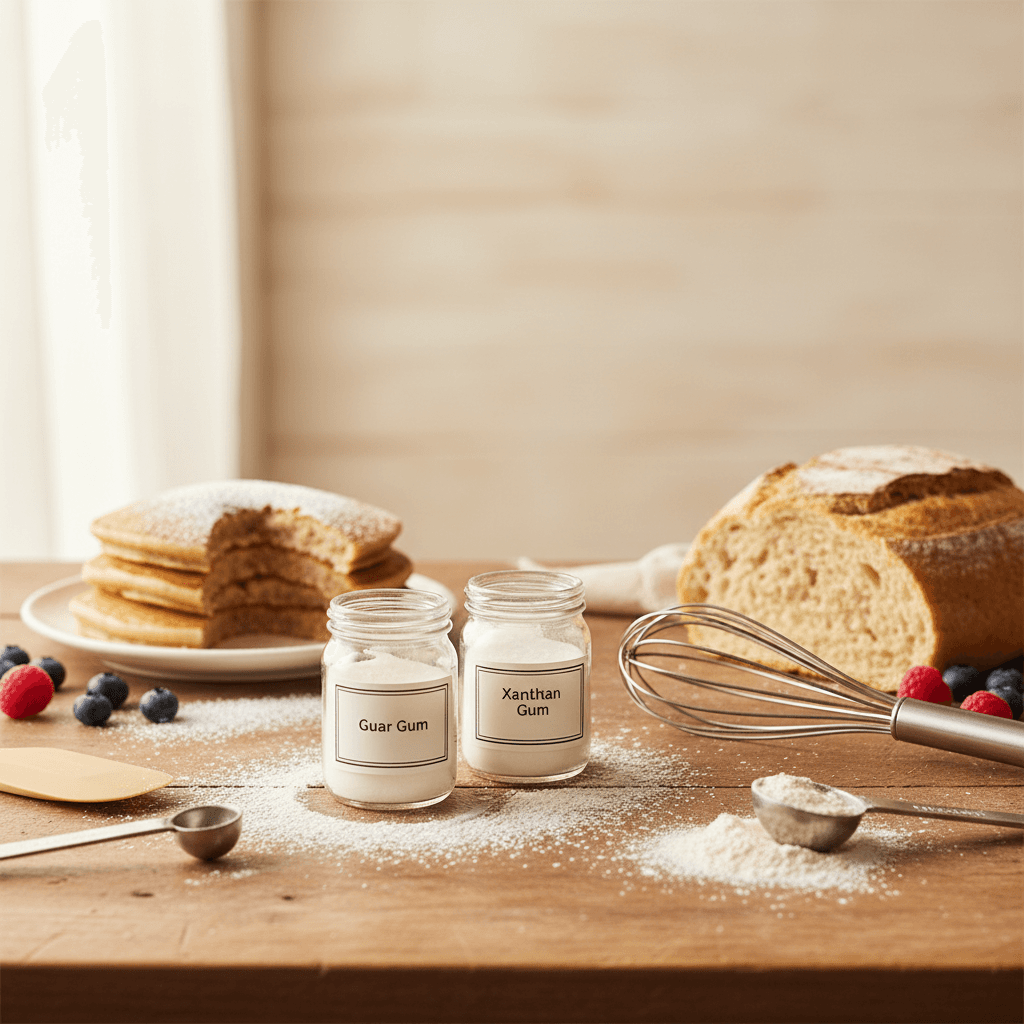
Guar gum and xanthan gum both replace gluten's binding and thickening power, but they behave differently in different recipes. Choosing the wrong one (or the wrong amount) is one of the fastest ways to end up with gummy bread or crumbly cookies. Here's everything you need to know to pick the right gum for every bake.
Key takeaways
- Xanthan gum is better for bread and recipes that need elasticity and stretch, while guar gum works best in cold or no-bake applications, pastries, and cookies.
- Guar gum is made from ground guar beans and is generally cheaper. Xanthan gum is produced through bacterial fermentation and costs more per ounce.
- You can substitute one for the other at roughly a 1.5:1 ratio (use 1.5x the amount of guar gum to replace xanthan gum).
- Using too much of either gum is the most common mistake — it causes dense, gummy, or slimy textures.
- Some bakers get the best results by combining both gums in a single recipe, using about half the amount of each.
- People with corn sensitivities should be cautious with xanthan gum, which is often derived from corn-based glucose.
What guar gum and xanthan gum actually do in gluten-free baking
Both gums act as binders and emulsifiers that mimic some of gluten's key jobs — trapping gas bubbles, holding moisture, and giving structure to doughs and batters. Without them (or another binder like psyllium husk), gluten-free baked goods tend to crumble apart or fall flat.
But they aren't identical. They come from completely different sources, hydrate differently, and perform better in specific types of recipes. Understanding those differences is what separates a good gluten-free baker from someone who just follows the back of the flour bag.
Where guar gum and xanthan gum come from
Guar gum is a natural plant-based product made by grinding the endosperm of guar beans (a legume grown primarily in India and Pakistan). It's minimally processed and has been used in food production for decades.
Xanthan gum is produced through bacterial fermentation. The bacterium Xanthomonas campestris is fed a sugar source — typically derived from corn, soy, or wheat — and the resulting polysaccharide is dried and milled into a powder. Most commercial xanthan gum is corn-derived, which matters if you're managing a corn allergy or sensitivity on top of going gluten-free.
Both are naturally gluten-free, though if you have celiac disease, always verify the xanthan gum you buy is certified gluten-free, since some brands use wheat-derived glucose in the fermentation process.
If you're just getting started with gluten-free baking and feeling overwhelmed by ingredients like these, the Confident Gluten-Free Baker Toolkit walks you through exactly how to stock your pantry and use every ingredient with confidence.
Side-by-side comparison of guar gum vs xanthan gum
| Property | Guar gum | Xanthan gum |
|---|---|---|
| Source | Guar beans (legume) | Bacterial fermentation (usually corn-based) |
| Texture effect | Softer, more tender crumb | Chewier, more elastic crumb |
| Best for | Cookies, muffins, quick breads, cold applications | Yeast breads, pizza dough, anything needing stretch |
| Hydration | Hydrates quickly in cold water | Needs mixing; can clump in cold water |
| Heat stability | Less stable at very high temps | Very heat stable |
| Typical amount per cup of GF flour | 3/4 to 1 teaspoon | 1/2 to 3/4 teaspoon |
| Cost (approximate) | $0.50-$1.00 per oz | $1.50-$3.00 per oz |
| Common allergen concerns | Legume allergy | Corn sensitivity |
| Flavor | Very mild, slightly beany at high amounts | Essentially flavorless |
When to use xanthan gum
Xanthan gum is the better choice whenever you need elasticity and chew — the qualities that gluten provides in wheat-based breads and pizza doughs. It creates a stronger, more elastic network that traps gas bubbles effectively during rising.
Yeast breads and sandwich loaves
For gluten-free yeast breads, xanthan gum is almost always the go-to. It gives the dough enough stretch to rise without collapsing and produces a chewier crumb that feels more like "real" bread. Most successful homemade gluten-free flour blends call for xanthan gum for this reason.
Pizza dough
The stretch and pliability xanthan gum provides is essential for rolling or pressing out pizza dough. Without it, gluten-free pizza dough cracks and tears. If you're baking pizza on a pizza stone, xanthan gum helps the crust hold together during transfer.
Cakes that need structure
Layer cakes and cupcakes benefit from xanthan gum's ability to hold moisture and provide a springy crumb. Use about 1/2 teaspoon per cup of gluten-free flour for cakes — more than that and you risk a gummy texture.
Recommended xanthan gum brands
Our top pick is the Bob's Red Mill Xanthan Gum — it's fine-milled and easy to find. For bulk buying, Judee's Xanthan Gum offers a good price per ounce and dissolves well.

When to use guar gum
Guar gum shines in recipes where you want a softer, more tender result. It hydrates quickly in cold liquids, which makes it especially useful for no-bake recipes, ice cream bases, and cold fillings.

Cookies and bars
Cookies don't need the elastic chew of bread — they need to hold together without being tough. Guar gum gives cookies a tender bite and helps prevent the crumbly, falling-apart texture that plagues many gluten-free cookie recipes.
Muffins and quick breads
For muffins, banana bread, and other quick breads, guar gum produces a softer crumb than xanthan gum. Use about 3/4 teaspoon per cup of flour.
Pastry and pie crusts
Guar gum helps pastry dough stay pliable without making it rubbery. If you've ever had a gluten-free pie crust that felt like chewing on rubber bands, there was probably too much xanthan gum. Guar gum gives you a more traditional, flaky-tender texture. A good rolling pin helps too.
Cold and no-bake applications
Puddings, mousse, ice cream, and refrigerator cakes all work well with guar gum because it thickens without heat. Xanthan gum can work here too, but guar gum produces a smoother, less slimy mouthfeel in cold applications.
Recommended guar gum brands
The Bob's Red Mill Guar Gum is our everyday pick. It's certified gluten-free and widely available. For a budget option, NOW Foods Guar Gum Powder is a solid choice.
How much guar gum or xanthan gum to use
The single biggest mistake in gluten-free baking is using too much gum. More is not better — excess gum makes baked goods dense, gummy, or unpleasantly slimy. Here are the amounts we recommend per cup of gluten-free flour blend:
| Recipe type | Xanthan gum per cup of flour | Guar gum per cup of flour |
|---|---|---|
| Yeast bread | 1 teaspoon | 1.5 teaspoons |
| Pizza dough | 1 teaspoon | 1.5 teaspoons |
| Cake | 1/2 teaspoon | 3/4 teaspoon |
| Muffins and quick breads | 3/4 teaspoon | 1 teaspoon |
| Cookies | 1/2 teaspoon | 3/4 teaspoon |
| Pancakes and waffles | 1/2 teaspoon | 3/4 teaspoon |
| Pie crust | 1/2 teaspoon | 3/4 teaspoon |
Notice the pattern: you need roughly 1.5 times as much guar gum as xanthan gum to get the same binding effect. This is important when substituting one for the other.
If your gluten-free flour blend already contains a gum (check the label — many commercial blends include xanthan gum), do not add more unless a recipe specifically tells you to. Double-dosing is one of the top causes of gummy centers in gluten-free baking.
Can you substitute guar gum for xanthan gum (and vice versa)?
Yes, you can substitute one for the other in most recipes. Use this conversion:
- Replacing xanthan gum with guar gum: Use 1.5x the amount. If a recipe calls for 1 teaspoon of xanthan gum, use 1.5 teaspoons of guar gum.
- Replacing guar gum with xanthan gum: Use 2/3 the amount. If a recipe calls for 1.5 teaspoons of guar gum, use 1 teaspoon of xanthan gum.
The swap works well in most recipes, but there are a few caveats. Xanthan gum produces a chewier result, so swapping it into a cookie recipe might make the cookies slightly tougher. And guar gum in yeast bread may not give you quite as much rise or structure as xanthan gum would. For more on adapting recipes, see our guide on how to convert any recipe to gluten-free.
Combining guar gum and xanthan gum together
Some experienced gluten-free bakers swear by using both gums in a single recipe. The idea is that you get the elasticity of xanthan gum and the tenderness of guar gum, producing a more balanced crumb.
If you want to try this approach, use half the recommended amount of each. For example, if a bread recipe calls for 1 teaspoon of xanthan gum per cup of flour, use 1/2 teaspoon of xanthan gum plus 3/4 teaspoon of guar gum instead.
This combination is especially well suited to sandwich bread and dinner rolls — recipes where you want structure but also a soft bite. It's worth experimenting with, especially once you're comfortable with how each gum performs on its own.
Alternatives to guar gum and xanthan gum
Not everyone can tolerate gums, and some bakers simply prefer to avoid them. Here are the most effective alternatives:
Psyllium husk powder
Psyllium husk is our favorite gum alternative for bread baking. It absorbs a huge amount of water and creates a gel that mimics gluten's elasticity remarkably well. Use about 2 teaspoons of psyllium husk powder per cup of gluten-free flour for bread. It works less well in delicate cakes and cookies.
Flax or chia gel
Mix 1 tablespoon of ground flaxseed or chia seeds with 3 tablespoons of water and let it sit for 5-10 minutes. This gel acts as both a binder and an egg substitute. It's best for muffins, pancakes, and quick breads.
Agar agar
Agar agar is a seaweed-derived gelling agent that works in some baking applications, particularly custards and no-bake desserts. It sets firmer than gums and doesn't provide the same elastic stretch, so it's not a direct replacement in bread.
Common mistakes when using guar gum and xanthan gum
These are the most common mistakes:
- Using too much gum. This is by far the most common problem. If your bakes are coming out gummy, dense, or with a slimy mouthfeel, reduce the gum by 25-50%.
- Not whisking the gum into the dry ingredients first. Both gums clump badly if added directly to wet ingredients. Always whisk them thoroughly into your flour blend before adding any liquid.
- Double-dosing with a pre-blended flour. Many commercial gluten-free flour blends already contain xanthan gum. Adding more on top leads to gummy, dense results.
- Expecting gum to fix a bad flour blend. Gums are binders, not miracle workers. If your flour blend ratios are off, no amount of gum will save the recipe.
- Not letting the batter rest. Both gums need a few minutes to hydrate fully. Letting your batter rest for 5-10 minutes before baking gives the gum time to do its job and usually produces a better rise and crumb.
Guar gum vs xanthan gum: which should you keep in your pantry?
If you can only buy one, buy xanthan gum. It's more versatile across different recipe types and is the standard in most published gluten-free recipes. You'll use it for everything from bread to cakes to cookies.
If you bake a lot of cookies, pastries, or no-bake desserts, add guar gum to your pantry too. It's cheaper per ounce and gives you a softer, more tender result in those applications.
Serious gluten-free bakers will want both on hand, plus psyllium husk powder for bread baking. Having all three gives you the flexibility to match the right binder to the right recipe. If you're building out your gluten-free pantry from scratch, our complete beginner's guide covers everything else you need to stock.
Frequently asked questions
Is guar gum or xanthan gum better for gluten-free bread?
Xanthan gum is generally better for gluten-free bread because it provides more elasticity and stretch, which helps trap gas bubbles during rising. Use about 1 teaspoon per cup of gluten-free flour for yeast breads. Guar gum can work but you'll need about 1.5 teaspoons per cup and the crumb may be slightly less chewy.
Can you use guar gum and xanthan gum together?
Yes, combining both gums can produce excellent results, especially in sandwich bread and dinner rolls. Use half the recommended amount of each — for example, 1/2 teaspoon xanthan gum plus 3/4 teaspoon guar gum per cup of flour. This gives you both elasticity and tenderness in the final bake.
How much guar gum equals 1 teaspoon of xanthan gum?
Use 1.5 teaspoons of guar gum to replace 1 teaspoon of xanthan gum. Guar gum has slightly less binding power per teaspoon, so you need more of it to achieve the same structural effect in your recipe.
Is xanthan gum safe for people with corn allergies?
Most commercial xanthan gum is produced using corn-derived glucose as the fermentation medium, which can be a concern for people with corn sensitivities. If you're managing a corn allergy, look for xanthan gum made from non-corn sources, or use guar gum or psyllium husk powder as alternatives instead.
Why does my gluten-free baking taste gummy or slimy?
A gummy or slimy texture almost always means too much gum was used. Check whether your flour blend already contains xanthan gum before adding more. Reduce the gum amount by 25-50% and see if the texture improves. You can also try letting the batter rest for 5-10 minutes before baking to allow the gum to hydrate evenly. For more troubleshooting, see our guide on fixing gummy centers in gluten-free baking.

Written by
Co-founder, BakingSubs
Co-founder of BakingSubs, where he turns the science of ingredient substitutions into tested, reliable guidance for home bakers.
Related Posts
7 Common Healthy Baking Mistakes That Ruin Texture (and How to Fix Each One)

7 Texture Changes With Health Swaps That Catch Bakers Off Guard (and How to Handle Each One)

Gluten-Free Flour Weight Chart: Grams per Cup for 9 Major Brands (and Why the Spread Is Over 20%)
Bake with Confidence
See all
Confident Gluten-Free Baker Toolkit
The science-based system that replaces gluten's seven invisible jobs so your baking turns out soft, fluffy, and foolproof — every time.

Gluten-Free Recipe Vault
Instant access to our complete library of proven gluten-free recipes — no waiting, no guesswork, just results that work tonight.

Fix Your Gluten-Free Bread
Learn the 3-step formula to make bread rise and stay soft, discover why your loaves collapse, and get a tested sandwich bread recipe that actually works.