

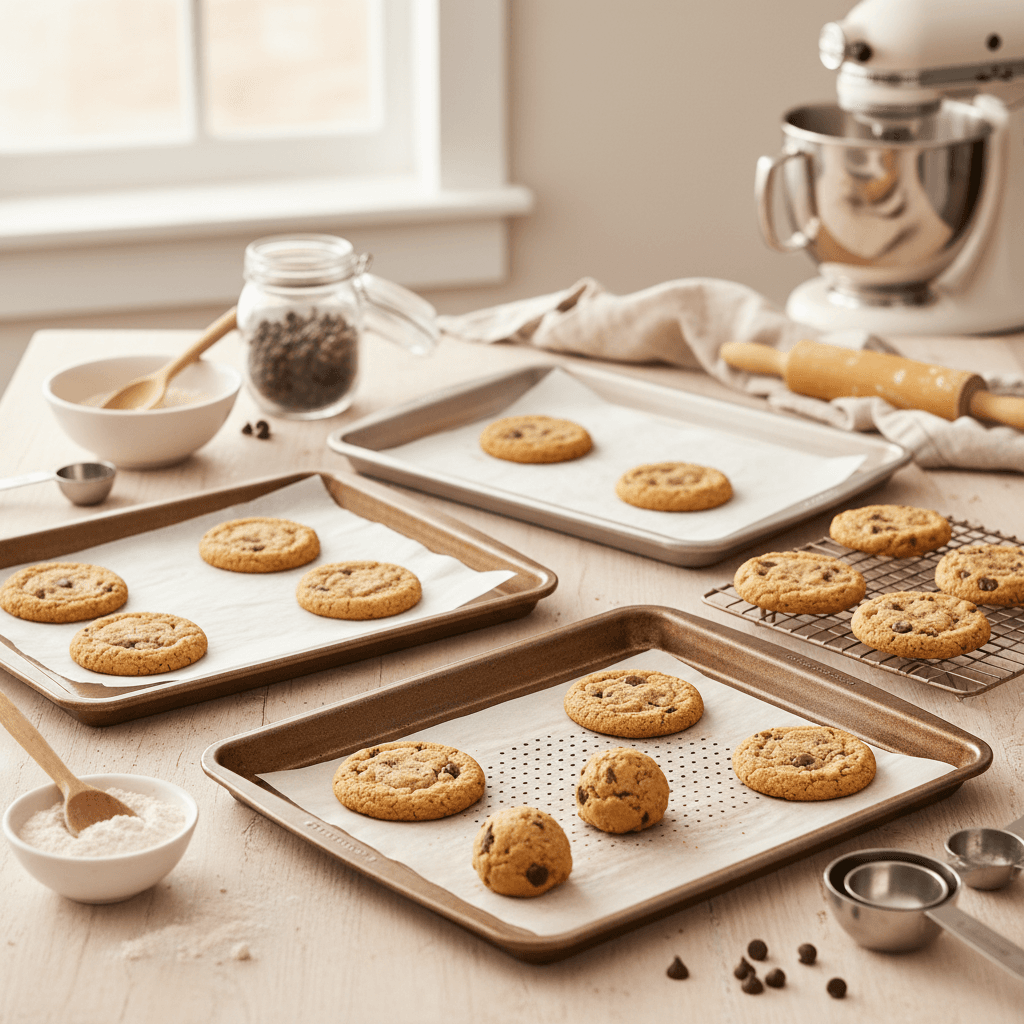
Gluten-free cookie dough spreads faster, browns differently, and sticks more stubbornly than conventional dough — so your cookie sheet matters more than you might think. Here are the best cookie sheets we recommend for gluten-free baking in 2025, with picks for every budget.
Key takeaways
- Gluten-free cookies spread more because they lack the gluten network that holds structure, making a light-colored, heavy-gauge aluminum sheet essential for even heat distribution.
- Dark or nonstick cookie sheets absorb more heat and can overbrown the bottoms of gluten-free cookies before the centers set.
- A rimless or low-rim sheet (also called a cookie sheet vs. a sheet pan) promotes better air circulation and more even baking.
- Parchment paper or silicone mats are non-negotiable partners — gluten-free dough sticks more than wheat-based dough.
- Investing in two identical sheets lets you rotate batches efficiently, which matters when gluten-free cookies have a narrower bake window.
- Heavy-gauge aluminum outperforms insulated sheets for most gluten-free recipes because it delivers consistent, predictable heat.
Why gluten-free cookies need a different cookie sheet
Without gluten providing structural elasticity, gluten-free cookie dough relies entirely on starches, fats, and binders like arrowroot powder or xanthan gum to hold its shape. That means the dough is more sensitive to heat fluctuations. A thin, warped, or dark-colored pan can push too much heat into the bottom of the cookie, causing it to spread flat and brown on the bottom while staying raw in the middle.
The ideal cookie sheet for gluten-free baking is light-colored (to reflect heat), heavy-gauge (to resist warping and distribute heat evenly), and either rimless or with a single raised edge for easy sliding. If you're new to gluten-free baking, understanding what gluten actually does in baking will help you understand why equipment choices matter so much more when you remove it.
If you're building out your gluten-free baking setup and want a structured approach to getting consistently great results, the Confident Gluten-Free Baker Toolkit walks you through ingredient ratios, troubleshooting, and technique — so you're not guessing every time you open the oven.
What to look for in a cookie sheet for gluten-free baking
Before we get to specific picks, here's what actually matters when you're shopping:
Material and color
Light-colored aluminum is the gold standard. It reflects heat rather than absorbing it, which gives gluten-free cookies a gentler, more even bake. Dark nonstick coatings absorb heat and can cause the bottoms to overbrown before the centers are done — a problem that's already amplified in gluten-free baking because of higher starch content.
Gauge (thickness)
Heavier gauge means the pan won't warp at high temperatures and distributes heat more evenly across the surface. Thin sheet pans develop hot spots, which means some cookies spread while others don't. For gluten-free dough, consistency is everything.
Rim style
A true cookie sheet has one raised edge (for gripping) and three flat sides, which allows air to flow freely around the cookies. A half sheet pan with four raised rims traps more heat at the edges. Either works, but rimless designs give you a slight edge for even baking.
Size
Standard half-sheet size (18 x 13 inches) fits most home ovens and gives you enough space to bake a dozen cookies with proper spacing — important because gluten-free dough tends to spread wider.
7 best cookie sheets for gluten-free cookies
We've organized these from budget-friendly to premium so you can find the right fit regardless of what you want to spend.
| Cookie sheet | Material | Size | Best for | Price range |
|---|---|---|---|---|
| Nordic Ware Natural Aluminum Baker's Half Sheet | Uncoated aluminum | 18 x 13 in | Best overall value | $10-15 |
| Vollrath Wear-Ever Half Sheet Pan | Heavy-gauge aluminum | 18 x 13 in | Commercial-grade durability | $12-18 |
| USA Pan Half Sheet Pan | Aluminized steel, silicone coating | 18 x 13 in | Best nonstick that stays light-colored | $15-20 |
| Chicago Metallic Traditional Uncoated Cookie Sheet | Uncoated aluminum | 17 x 12.25 in | Best true rimless cookie sheet | $10-14 |
| Fat Daddio's Half Sheet Pan | Anodized aluminum | 18 x 13 in | Best mid-range all-around | $15-22 |
| Airbake Natural Cookie Sheet | Insulated aluminum | 16 x 14 in | Best for preventing overbrowning | $15-20 |
| Matfer Bourgeat Aluminum Sheet Pan | Heavy-gauge aluminum | 18 x 13 in | Best premium commercial pick | $25-35 |
1. Nordic Ware Natural Aluminum Baker's Half Sheet — best overall value
This is the cookie sheet we recommend to anyone starting out with gluten-free baking. The Nordic Ware Natural Aluminum Baker's Half Sheet is uncoated, light-colored, and heavy enough to resist warping at normal baking temperatures. It delivers even heat distribution at a price that lets you buy two or three without thinking twice.
Pros: Affordable, widely available, excellent heat distribution, light color prevents overbrowning, commercial-grade aluminum.
Cons: Has four rims (not a true cookie sheet), requires parchment or a silicone mat since there's no nonstick coating, can warp at very high temperatures (450F+).
Why it works for gluten-free: The consistent, gentle heat means your gluten-free cookies set at the right pace — no scorched bottoms while the centers stay gooey.
2. Vollrath Wear-Ever Half Sheet Pan — commercial-grade durability
If you're baking in volume — maybe you're selling gluten-free cookies as a home business — the Vollrath Wear-Ever Half Sheet Pan is what commercial bakeries actually use. It's heavier gauge than the Nordic Ware, which means it stays perfectly flat even after hundreds of uses.
Pros: Extremely durable, stays flat, excellent heat distribution, restaurant-industry standard.
Cons: Slightly heavier to handle, no nonstick coating, four-rim design.
Why it works for gluten-free: The extra-heavy gauge eliminates hot spots entirely, which means every cookie on the sheet bakes at the same rate. When you're working with finicky gluten-free dough, that consistency is worth its weight in aluminum.
3. USA Pan Half Sheet Pan — best nonstick that stays light-colored
Most nonstick pans are dark-colored, which is a problem for gluten-free baking. The USA Pan Half Sheet Pan solves this with a unique corrugated surface and light-colored Americoat silicone nonstick coating. You get easy release without the heat absorption issues of dark pans.
Pros: Light-colored nonstick coating, corrugated surface promotes airflow, made in the USA, aluminized steel construction.
Cons: Corrugated surface can leave pattern marks on soft cookies, slightly pricier than basic aluminum, the coating will degrade over time.
Why it works for gluten-free: Gluten-free dough sticks more aggressively than wheat dough. The nonstick surface gives you an insurance policy even if you forget parchment, and the light color keeps heat gentle.
4. Chicago Metallic Traditional Uncoated Cookie Sheet — best true rimless design
This is a proper cookie sheet — one raised edge for gripping, three open sides. The Chicago Metallic Traditional Uncoated Cookie Sheet allows maximum air circulation, which helps gluten-free cookies bake more evenly from edge to center.
Pros: True rimless design, lightweight, affordable, excellent air circulation.
Cons: Thinner gauge than some competitors, can warp at high temperatures, slightly smaller baking surface.
Why it works for gluten-free: The open edges let oven air flow freely around every cookie, reducing the edge-browning-faster-than-center problem that plagues gluten-free batches on rimmed pans.
5. Fat Daddio's Half Sheet Pan — best mid-range all-around
The Fat Daddio's Half Sheet Pan uses anodized aluminum, which is harder and more durable than raw aluminum while still staying light-colored enough for even baking. It's a step up from budget picks without going full premium.
Pros: Anodized surface resists scratching and corrosion, even heat distribution, sturdy construction, reinforced rim.
Cons: Slightly heavier, anodized surface is marginally darker than raw aluminum, four-rim design.
Why it works for gluten-free: The anodized surface is naturally smoother, which means less sticking even without nonstick coating. Combined with parchment paper, it's one of the most reliable setups for gluten-free cookies.
6. Airbake Natural Cookie Sheet — best for preventing overbrowning
If your gluten-free cookies consistently burn on the bottom, the Airbake Natural Cookie Sheet might be your solution. It uses two layers of aluminum with an air pocket between them, which insulates the bottom and prevents direct heat transfer.
Pros: Virtually eliminates bottom browning, light-colored, good for delicate gluten-free recipes that burn easily.
Cons: Cookies take longer to bake, can result in pale, underdone bottoms if your recipe needs more heat, not dishwasher safe, the insulated design means cookies may spread more before they set.
Why it works for gluten-free: This is a specialized pick. It's excellent for almond flour-based cookies and other high-fat gluten-free recipes that tend to burn before they're done. However, for standard gluten-free cookie recipes that already struggle with spreading, the insulated design can make things worse — so use it selectively.
7. Matfer Bourgeat Aluminum Sheet Pan — best premium commercial pick
This is the pan serious bakers and pastry chefs reach for. The Matfer Bourgeat Aluminum Sheet Pan is French-made, extremely heavy-gauge, and delivers the most consistent heat distribution of any pan on this list.
Pros: Exceptional build quality, perfectly even heat, will last decades, professional-grade performance.
Cons: Most expensive option, heavier than other picks, no nonstick coating, can be harder to find.
Why it works for gluten-free: When you're working with expensive gluten-free flour blends and you can't afford a failed batch, this pan gives you the most predictable, consistent results possible. If you're running a gluten-free bakery from home, it pays for itself quickly in fewer wasted batches.
How to get the best results from your cookie sheet
Even the best cookie sheet won't save you if your technique is off. Here are the habits that make the biggest difference for gluten-free cookies:
Always use parchment paper or a silicone mat. Gluten-free dough contains more starch and often more sugar, both of which make it stickier. A good food scale helps you nail your ratios, but parchment is your insurance policy against sticking.
Chill your dough before baking. This is even more important for gluten-free cookies than conventional ones. Cold dough spreads slower, giving the starches time to set before the butter melts and runs. Aim for at least 30 minutes in the fridge.
Don't crowd the sheet. Leave at least 2 inches between gluten-free cookie dough balls. They will spread more than you expect, especially in the first few minutes.
Rotate the sheet halfway through baking. Most home ovens have hot spots. Rotating 180 degrees at the halfway mark ensures even browning — critical when gluten-free cookies have a narrow window between underdone and overdone.
Cool cookies on the sheet for 5 minutes before transferring. Gluten-free cookies are fragile when hot because they don't have gluten holding them together. Letting them cool briefly on the sheet allows the starches to firm up. If your cookies are coming out dry and crumbly, this resting step also helps retain moisture.
Cookie sheet vs. sheet pan: does it matter for gluten-free baking?
A true cookie sheet has one raised edge and three flat sides. A sheet pan (half sheet) has four raised rims. For most gluten-free baking, the difference is minimal. A quality half sheet pan like the Nordic Ware or Vollrath works beautifully for cookies. The slight advantage of a rimless cookie sheet is better air circulation, but we'd take a heavy-gauge half sheet over a flimsy rimless cookie sheet any day.
If you're building your gluten-free baking setup from scratch, our complete beginner's guide to gluten-free baking covers all the essential equipment and ingredients you need beyond just cookie sheets.
Frequently asked questions
Do insulated cookie sheets work for gluten-free cookies?
Insulated cookie sheets like the Airbake can work well for high-fat gluten-free recipes that tend to burn on the bottom, such as almond flour cookies. However, for standard gluten-free cookie recipes that already tend to spread, the insulated design can make spreading worse because the dough stays warm longer before setting. A heavy-gauge aluminum sheet is a more versatile choice for most gluten-free baking.
Should I use dark or light cookie sheets for gluten-free cookies?
Light-colored cookie sheets are almost always better for gluten-free cookies. Dark pans absorb more heat, which causes the bottoms to brown faster — a problem that's amplified with gluten-free dough because of its higher starch content. Light aluminum reflects heat and gives your cookies a gentler, more even bake.
Why do my gluten-free cookies spread so much on the cookie sheet?
Gluten-free cookies spread more because they lack the gluten protein network that provides structural elasticity in conventional dough. To reduce spreading, chill your dough for at least 30 minutes before baking, use a heavy-gauge aluminum sheet (not a thin or dark pan), and make sure your flour blend ratios include enough starch to help with structure. Adding a small amount of xanthan gum also helps if your recipe doesn't already include it.
How many cookie sheets do I need for gluten-free baking?
We recommend owning at least two identical cookie sheets. Gluten-free cookies have a narrower bake window, so having a second sheet ready to go means you can scoop the next batch while the first is in the oven. Always let sheets cool completely between batches — putting dough on a hot sheet causes immediate spreading.
Can I use a silicone baking mat instead of parchment on my cookie sheet?
Yes, silicone baking mats work well for gluten-free cookies and are more eco-friendly than disposable parchment. They provide a consistent nonstick surface and slightly insulate the bottom of the cookie, which can actually help prevent overbrowning. Just be aware that cookies baked on silicone mats may spread slightly more and take a minute or two longer to bake compared to parchment.

Written by
Co-founder, BakingSubs
Co-founder of BakingSubs, where he turns the science of ingredient substitutions into tested, reliable guidance for home bakers.
Related Posts
Bake with Confidence
See all
Confident Gluten-Free Baker Toolkit
The science-based system that replaces gluten's seven invisible jobs so your baking turns out soft, fluffy, and foolproof — every time.

Gluten-Free Recipe Vault
Instant access to our complete library of proven gluten-free recipes — no waiting, no guesswork, just results that work tonight.

Fix Your Gluten-Free Bread
Learn the 3-step formula to make bread rise and stay soft, discover why your loaves collapse, and get a tested sandwich bread recipe that actually works.