

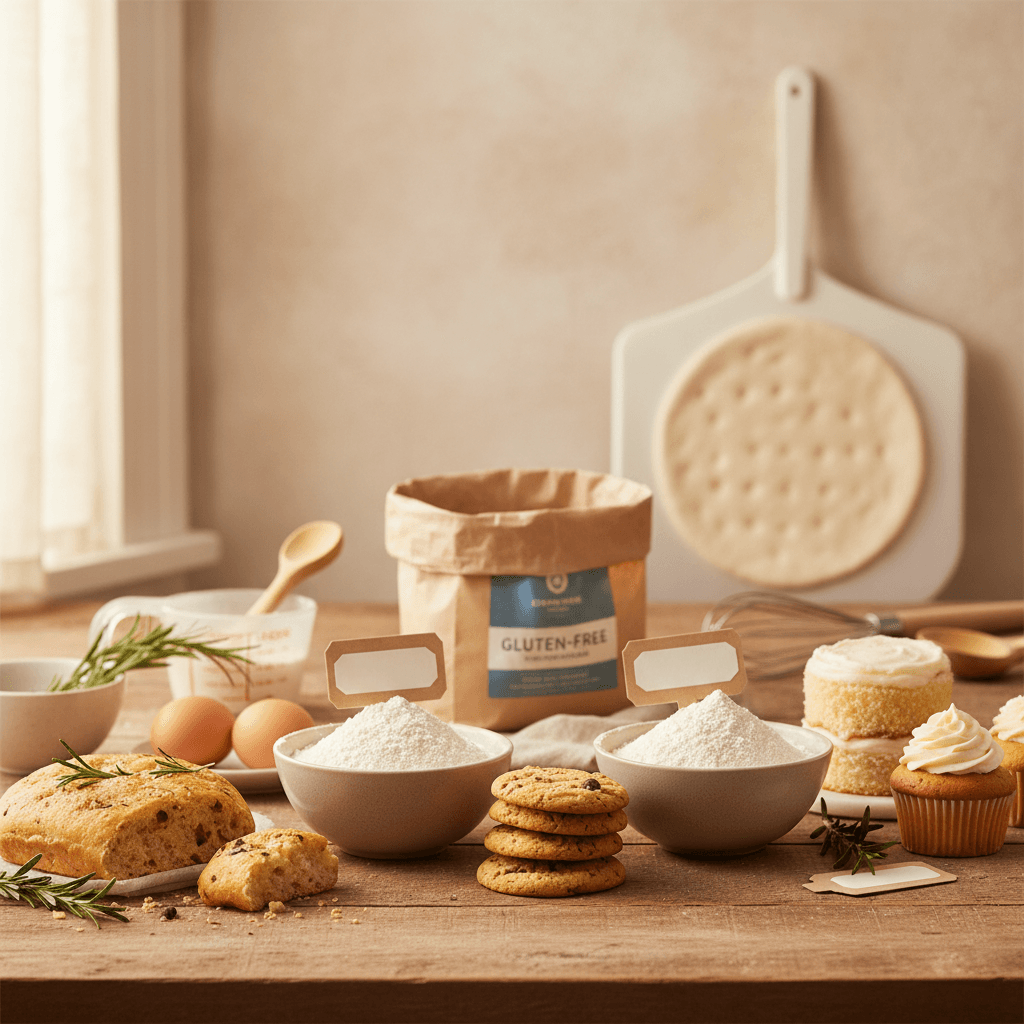
Caputo Fioreglut is a gluten-free wheat-starch-based flour from Italy that performs best in pizza, focaccia, and rustic breads. It is labeled gluten-free under EU and FDA rules (under 20 ppm), but it is not GFCO certified, it contains wheat starch (so it is unsafe for wheat allergy), and Caputo does not describe a dedicated gluten-free facility on its US product page. Below, we break down its ingredients, certification status, how it stacks up against two popular competitors, and who should (and should not) buy it.
Prices checked September 2026 and vary by store.
Key takeaways
- Caputo Fioreglut's first three ingredients are gluten-free wheat starch, dextrose, and corn starch, followed by buckwheat flour, rice starch, psyllium fiber, guar, and flavoring. It is a starch-heavy blend designed for extensibility in pizza and bread doughs.
- The wheat starch is processed to remove gluten and is permitted in gluten-free products under both EU and FDA rules, which makes Fioreglut suitable for celiac disease at the 20 ppm standard but not for anyone with a wheat allergy.
- It does not carry GFCO certification (under 10 ppm). Caputo's US site says it "meets the FDA requirements for gluten-free products" and lists its facility as also handling nuts, milk, eggs, soy, and sesame; it does not state that the plant is dedicated gluten-free.
- At about $12.00 for a 2.2 lb (1 kg) bag direct from Caputo, or roughly $0.34 per ounce, it costs about 50% more per ounce than Bob's Red Mill 1-to-1 or King Arthur Measure for Measure and slightly less than Cup4Cup.
- Fioreglut excels at high-hydration doughs like pizza and focaccia, where its starch ratio creates a chewy, pliable crust that most American blends struggle to match.
- For cakes, cookies, and muffins, King Arthur Measure for Measure or Cup4Cup typically produce better results because they are formulated as 1:1 all-purpose replacements.
What is Caputo Fioreglut?
Caputo is a Neapolitan mill founded in 1924, best known for its Tipo 00 wheat flour used in professional pizzerias worldwide. Fioreglut is its gluten-free line, formulated specifically for pizza and bread. The name refers to replacing gluten's function, not containing it.
The blend leans heavily on starches. Its first three ingredients are gluten-free wheat starch, dextrose, and corn starch, followed by buckwheat flour, rice starch, psyllium seed fiber, guar gum, and flavoring. That starch-forward formula is why it handles high-hydration doughs so well: the starches gelatinize during baking and create a chewy, slightly crisp texture that mimics traditional Neapolitan pizza crust.
If you have ever struggled with gritty texture in gluten-free baking, Fioreglut is notably smooth. The starches are finely milled, and there is no coarse rice flour in the blend.
Certification and safety for celiac disease
This is where Caputo Fioreglut gets complicated, and where we need to be direct.
It contains wheat starch. Gluten-free wheat starch is wheat starch that has been washed and processed to remove the gluten protein. Both EU regulation and the FDA allow it in foods labeled gluten-free as long as the finished product tests below 20 ppm, and it is widely used in European gluten-free breads because it improves texture. Gluten Free Watchdog's advice is to confirm that any wheat-starch product is tested for both intact gluten and gluten fragments, since gluten levels in wheat starch vary by batch. If you have a wheat allergy rather than celiac disease, Fioreglut is not safe for you at all: the allergen is wheat protein, and the label declares wheat.
Fioreglut is not GFCO certified. We could not find it in GFCO's certified-product listings, and Caputo does not claim it. Caputo's US site says the product "meets the FDA requirements for gluten-free products," and Italian retailers note it is registered with Italy's Ministry of Health gluten-free food registry. Both operate at the 20 ppm threshold, not GFCO's 10 ppm.
Caputo does not describe a dedicated gluten-free facility. The allergen statement on Caputo's US product page reads "produced in a facility that manufactures nuts, milk, eggs, soybeans, sesame," and Gluten Free Watchdog's label review adds "may contain traces of milk." Caputo's main mill in Naples processes large volumes of wheat flour, and the company does not say on its product page where or how Fioreglut is segregated. For many celiac bakers, that lack of disclosure is enough to skip it.
If you require GFCO certification, both King Arthur Measure for Measure (GFCO certified, under 10 ppm) and Cup4Cup (GFCO verified, made in an SQF-certified gluten-free facility) are safer choices. For more on navigating gluten-free baking safely, see our learn guide.
Ingredients breakdown
Here is the full ingredient list for Caputo Fioreglut, in order, as printed on the US bag:
- Gluten-free wheat starch
- Dextrose
- Corn (maize) starch
- Buckwheat flour
- Rice starch
- Psyllium seed fiber
- Thickener: guar
- Flavoring
A few things stand out. First, dextrose is the second ingredient, which is unusual for a flour blend. Caputo's nutrition panel lists about 3.5g of sugars per 100g, a small amount, but it contributes to browning and a slightly sweeter crust. Second, guar gum and psyllium fiber rather than xanthan gum do the binding. That combination tends to create a more extensible, less gummy dough than xanthan alone, which is one reason Fioreglut handles pizza dough so well. Third, there is almost no protein: Caputo lists 0.6g per 100g, compared to about 1g per 31g serving (roughly 3g per 100g) for King Arthur Measure for Measure.
The low protein content matters. In recipes where structure comes from protein networks, think sandwich bread, muffins, pancakes, Fioreglut can produce results that are dry and crumbly or that turn gummy in the center. It was not designed for those applications.
Caputo Fioreglut vs King Arthur vs Cup4Cup
The two closest competitors to Fioreglut are King Arthur Measure for Measure and Cup4Cup, both widely available all-purpose gluten-free blends. Here is how they compare on the specs that matter most:
| Feature | Caputo Fioreglut | King Arthur Measure for Measure | Cup4Cup Multipurpose |
|---|---|---|---|
| First 3 ingredients | Gluten-free wheat starch, dextrose, corn starch | Rice flour, whole grain brown rice flour, whole sorghum flour | Cornstarch, white rice flour, brown rice flour |
| Primary binder | Guar + psyllium fiber | Xanthan gum + cellulose | Xanthan gum |
| Protein | 0.6g per 100g (Caputo) | About 1g per 31g serving (King Arthur) | Not published on product page |
| Contains wheat | Yes (gluten-free wheat starch); not for wheat allergy | No | No |
| Certification | Labeled gluten-free (EU and FDA, under 20 ppm); NOT GFCO | GFCO (under 10 ppm) | GFCO verified (under 10 ppm) |
| Dedicated GF facility | Not stated by Caputo; facility also handles nuts, milk, eggs, soy, sesame | Not stated on product page; confirm on package | SQF-certified gluten-free facility, free of tree nuts, peanuts, soy (Cup4Cup) |
| Best use case | Pizza, focaccia, flatbreads | All-purpose (cookies, cakes, quick breads) | Pastry, cakes, delicate bakes |
| Price per oz (approx.) | About $0.34/oz ($11.99 per 2.2 lb, caputoflour.com) | About $0.23/oz ($10.95 per 3 lb, kingarthurbaking.com) | About $0.37/oz ($17.97 per 3 lb, Walmart) |
| Grams per cup (mfr.) | Not published by Caputo; weigh it | 120g (published by King Arthur) | 140g (published by Cup4Cup) |
The weight-per-cup difference matters more than most bakers realize. If you are converting a recipe written for one blend to another, a 20g-per-cup gap changes hydration enough to wreck a pizza dough. For help converting between blends, check our all-purpose flour substitution guide, and weigh your flour with a digital scale rather than scooping.
Who should buy Caputo Fioreglut
Buy Fioreglut if you meet all three of these criteria:
- You bake pizza or flatbreads regularly. This is where Fioreglut genuinely outperforms American blends. The guar and psyllium combination creates a dough you can stretch by hand, something that is nearly impossible with xanthan-only blends.
- You are comfortable with a 20 ppm gluten-free label, wheat starch, and an undisclosed facility. If your doctor or dietitian has confirmed that FDA-standard gluten-free wheat starch is acceptable for your situation, and you do not have a wheat allergy, Fioreglut is a reasonable option.
- You want Neapolitan-style crust characteristics. The slight sweetness from the dextrose, the fine starch texture, and the browning behavior are specifically tuned for high-heat pizza baking at 450-500 degrees F.
Who should skip Caputo Fioreglut
Skip it if any of these apply:
- You have a wheat allergy. Fioreglut contains wheat starch and declares wheat on the label. This is a hard stop, regardless of the gluten-free claim.
- You have celiac disease and require GFCO certification or a disclosed dedicated facility. King Arthur Measure for Measure is the strongest alternative here: GFCO certified and widely available.
- You primarily bake cakes, cookies, or muffins. Fioreglut's starch-heavy, near-zero-protein formula does not provide enough structure for tender baked goods. You will get better results from King Arthur or Cup4Cup.
- You want a true 1-to-1 all-purpose substitute. Fioreglut is a specialty flour, not a general-purpose blend. It does not swap evenly into most American recipes written for wheat AP flour. The dextrose, the guar and psyllium binders, and the starch ratio all behave differently than what those recipes expect.
- You are on a budget. At about $0.34/oz, Fioreglut costs roughly 50% more than Bob's Red Mill 1-to-1 (about $0.23/oz at Walmart) or King Arthur Measure for Measure (about $0.23/oz direct). For pizza once a month, the premium might be worth it. For daily baking, it adds up.
How Fioreglut performs in pizza dough
Pizza is what Fioreglut was built for, and it is where published reviews are most consistent. Gluten-free bakers who have tested it (Gluten Free on a Shoestring, Good For You Gluten Free, and the Caputo recipe community) report a dough that can be stretched and shaped by hand rather than pressed, a crust that blisters and browns at 475-500 degrees F on a preheated stone or steel, and a chew that is closer to wheat Neapolitan crust than any xanthan-based American blend produces. The most common complaint is that the crust goes limp and pale if the oven is not hot enough, and that it stales within hours of cooling.
How Fioreglut performs in bread
Bread results are more mixed. Reviewers report that Fioreglut makes a soft, open-crumbed focaccia and rustic rolls, but that sandwich loaves rise unevenly and dry out or turn gummy in the center if baked in a tall pan. Because the blend is almost entirely starch, loaves stale noticeably by the second day. If you are troubleshooting a Fioreglut loaf, our guide to poor rise in gluten-free baking covers the hydration and pan-size adjustments that help.
Tips for getting the best results with Fioreglut
Based on widely reported baker experiences and the flour's formulation, here are the adjustments that matter most:
- Weigh everything. Fioreglut is finer than most American GF blends, so scooping gives wildly inconsistent results. Use a kitchen scale, such as an OXO Good Grips 11lb Food Scale, for home baking.
- Use high hydration for pizza. Most Fioreglut pizza recipes start at 70-80% hydration (70-80g water per 100g flour). The starches absorb water aggressively, and a dry dough will crack when you stretch it.
- Reduce sugar in sweet recipes. Because Fioreglut already contains dextrose as its second ingredient, sweet recipes may overbrown or taste sweeter than expected. Cut added sugar slightly and monitor browning.
- Let the dough rest. Psyllium and guar both need 15-20 minutes to fully hydrate. Mix the dough, cover it, and wait before shaping. The texture change is dramatic: it goes from shaggy to smooth and pliable.
- Preheat aggressively for pizza. Fioreglut pizza dough performs best at 475-500F with a preheated stone or steel. Lower temperatures produce a pale, doughy crust because the starches need intense heat to set quickly.
Where to buy Caputo Fioreglut
Fioreglut is not as widely stocked as King Arthur or Bob's Red Mill. Here is where you can typically find it:
- Caputo's US web store (caputoflour.com) sells the 2.2 lb (1 kg) bag for about $12.00.
- Amazon is the most common source in the US. It is sold in 2.2 lb (1 kg) bags, sometimes in multi-packs, and in an 11 lb (5 kg) bulk bag. Prices fluctuate, so compare against Caputo's direct price.
- Italian specialty grocers and online importers such as Italian Food Online and Piccolo's carry it, often for $10-16 per 2.2 lb bag depending on sales.
It is rarely found at mainstream US grocery chains like Walmart, Target, or Kroger. You will not find it at rice flour prices; the import markup is significant.
How Fioreglut compares for common baking problems
Every gluten-free flour blend has failure modes. Here is how Fioreglut stacks up on the most common complaints:
| Problem | Fioreglut risk level | Why |
|---|---|---|
| Gritty texture | Low | Fine starch base; no coarse rice flour |
| Gummy center | Medium-High | Starch-heavy; overbakes on outside before center sets in thick loaves |
| Dry, crumbly texture | Medium | Near-zero protein means less moisture retention in cakes and muffins |
| Poor rise | Low-Medium | Psyllium and guar trap gas well, but low protein limits structure in tall loaves |
| Quick staling | High | Starch-based crumbs retrograde faster; bread stales noticeably by day 2 |
| Strange aftertaste | Low | Clean-tasting blend; no bean flours, and the buckwheat is mild |
The quick-staling issue is worth emphasizing. Because Fioreglut is almost entirely starch with minimal protein or whole-grain flour, bread and pizza crust made with it goes stale faster than blends with brown rice flour or sorghum. If you bake bread with Fioreglut, plan to eat it the same day or freeze slices immediately.
A note on the other Fioreglut products
Here is something most reviews will not tell you: the bag sold in the US is Caputo's "Fioreglut Pizza e Pane" (pizza and bread) formula, and it is the only Fioreglut most American shoppers will ever see. In Italy, Caputo also sells "Fioreglut Dolci," a separate blend formulated for pastry, biscuits, and sweet leavened doughs, plus stand-alone gluten-free rice flour and chickpea flour. If you have been disappointed using the standard bag for cakes or cookies, that is expected: it was never formulated for them, and the pastry version is rarely exported.
None of the Fioreglut products carry GFCO certification, and the same facility and wheat-starch caveats apply to all of them.
Frequently asked questions
Is Caputo Fioreglut safe for celiac disease?
Caputo Fioreglut is labeled gluten-free under EU and FDA standards (under 20 ppm) and uses gluten-free wheat starch, which both regulators permit in gluten-free foods. It is not GFCO certified (under 10 ppm), and Caputo does not state that it is made in a dedicated gluten-free facility. Many celiac dietitians recommend choosing flours with third-party certification and a disclosed dedicated facility. If you need the strictest standard, King Arthur Measure for Measure is GFCO certified. If you have a wheat allergy, Fioreglut is not safe for you.
Can you use Caputo Fioreglut as a 1-to-1 substitute for all-purpose flour?
Not reliably. Fioreglut was designed for pizza and bread, not as a universal all-purpose flour replacement. Its starch-heavy formula and added dextrose change how recipes behave, especially in cakes and cookies. For true 1-to-1 substitution across recipe types, King Arthur Measure for Measure or Cup4Cup are more predictable choices.
Why does my Caputo Fioreglut bread go stale so fast?
Fioreglut is almost entirely wheat starch, corn starch, and rice starch, with very little protein or whole-grain flour. Starch molecules retrograde (recrystallize) quickly after baking, which is what causes staling. To slow it down, add 1 tablespoon of psyllium husk per cup of flour, or wrap the bread tightly and freeze slices within 2 hours of cooling. Even with these fixes, expect faster staling than blends containing whole grain flours.
How much does Caputo Fioreglut cost compared to other gluten-free flours?
Fioreglut is about $11.99 for a 2.2 lb bag direct from Caputo, roughly $0.34 per ounce, making it one of the more expensive gluten-free blends. For comparison, King Arthur Measure for Measure costs about $0.23/oz direct ($10.95 for 3 lb), Bob's Red Mill 1-to-1 runs about $0.23/oz at Walmart ($4.97 for 22 oz), and Cup4Cup is about $0.37/oz ($17.97 for 3 lb at Walmart). The import cost from Italy accounts for much of Fioreglut's premium.
Does Caputo Fioreglut contain wheat?
Yes. Its first ingredient is gluten-free wheat starch, and the bag declares wheat. The starch is processed to remove gluten protein and is allowed in gluten-free foods in both the EU and the US when the finished product tests below 20 ppm. That makes it an option for celiac disease at the FDA standard, but it is never appropriate for a wheat allergy.
Checked: September 2026

Written by
Co-founder, BakingSubs
Co-founder of BakingSubs, where he turns the science of ingredient substitutions into tested, reliable guidance for home bakers.
Related Posts

Bake with Confidence
See all
Confident Gluten-Free Baker Toolkit
The science-based system that replaces gluten's seven invisible jobs so your baking turns out soft, fluffy, and foolproof — every time.

Gluten-Free Recipe Vault
Instant access to our complete library of proven gluten-free recipes — no waiting, no guesswork, just results that work tonight.

Fix Your Gluten-Free Bread
Learn the 3-step formula to make bread rise and stay soft, discover why your loaves collapse, and get a tested sandwich bread recipe that actually works.