

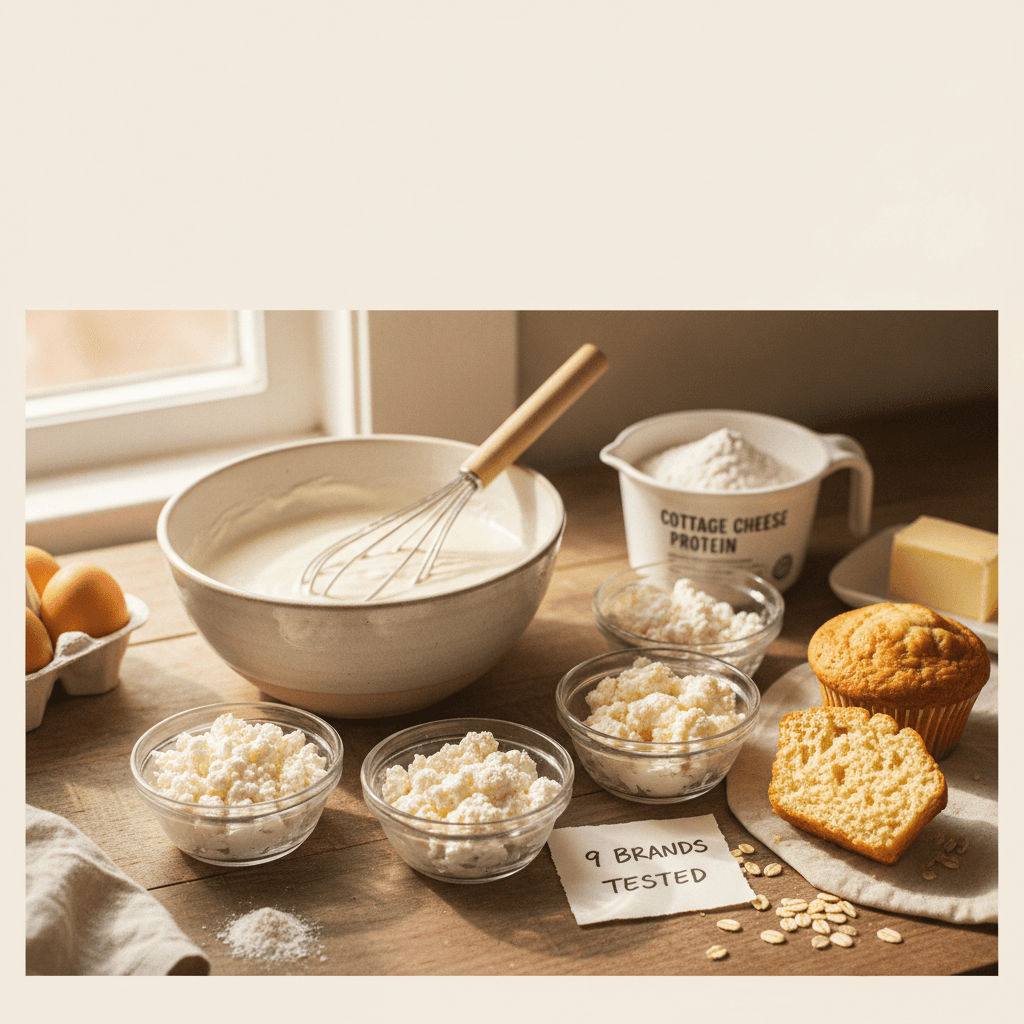
For baking, Good Culture 4% whole milk cottage cheese is our top pick: 11.5g protein per 100g, small curds that blend nearly smooth with an immersion blender, and enough fat (4%) to keep muffins and pancakes tender. If you want the highest protein per dollar, Friendship 1% wins at roughly 12.6g protein per 100g and about $0.18 per ounce at Walmart. Below, we break down nine brands across protein, fat, curd size, moisture, and blendability so you can pick the right one for your next bake.
Key takeaways
Protein per 100g ranges from 9.7g (Trader Joe's full fat) to 12.6g (Friendship 1%), a 30% spread that changes batter structure noticeably.
Fat percentage matters more than protein for tender baked goods. Brands under 2% fat produce drier, chewier results unless you add oil or butter back.
Small-curd brands (Good Culture, Muuna, Nancy's) blend smooth quickly. Large-curd brands (Daisy, Breakstone's) need a full blender cycle or sieving.
Excess whey (the liquid pooling on top) varies from very little (Kirkland) to noticeable pooling (Breakstone's). Draining it changes your recipe's hydration.
Every brand curdles above roughly 175F / 80C when exposed directly, so fold cottage cheese into batters rather than cooking it on a stovetop first.
Why the brand of cottage cheese matters in baking
Cottage cheese is not a uniform product. The protein content, fat ratio, curd structure, and free moisture differ enough between brands that swapping one for another can shift a pancake batter from pourable to paste-thick. Protein alone swings about 30% across common grocery store options. If you are adding protein to baked goods via cottage cheese, picking the wrong brand means recalculating your liquid ratio every time.
The comparison table below covers nine brands you can actually find on shelves in the US. We note retailer availability because some of these are exclusive to Costco or Trader Joe's, and a brand you cannot buy consistently is not worth building a recipe around.
Cottage cheese protein comparison table: 9 brands side by side
Brand | Protein per 100g | Fat % | Curd size | Free moisture | Blends smooth? | Where to buy |
|---|---|---|---|---|---|---|
Good Culture (4% whole milk) | 11.5g | 4% | Small | Low | Yes | Target, Whole Foods, Walmart (select) |
Daisy (4% small curd) | 11.3g | 4% | Medium | Moderate | Mostly | Walmart, Target, Kroger |
Breakstone's (2% small curd) | 11.0g | 2% | Medium-large | High | No, stays slightly grainy | Walmart, Target, most grocery chains |
Nancy's (organic, whole milk) | 10.6g | 4% | Small | Low | Yes | Whole Foods, natural grocers, some Target |
Friendship (1% low fat) | 12.6g | 1% | Small | Moderate | Yes | Walmart, ShopRite, regional East Coast |
Kalona SuperNatural (4%) | 10.9g | 4% | Large | Low-moderate | No, needs full blender | Whole Foods, natural grocers |
Muuna (2% plain) | 11.8g | 2% | Small | Low | Yes | Target, Walmart (limited), some Whole Foods |
Trader Joe's (4% small curd) | 9.7g | 4% | Small | Moderate | Yes | Trader Joe's only |
Kirkland (Costco, 3%) | 11.0g | 3% | Small | Very low | Yes | Costco only |
A few things jump out. Friendship 1% leads on protein density at 12.6g per 100g, but its 1% fat means you will likely need to add a tablespoon of avocado oil or melted butter per cup to avoid dry results. Trader Joe's 4% sits at the bottom for protein (9.7g per 100g) but its small curds blend easily and it brings richness from that fat content. Kirkland at Costco is the best value play if you bake in volume: the 3lb tub runs about $5.49, which works out to roughly $0.11 per ounce.
Best cottage cheese for high-protein baking
If protein is your primary goal, Friendship 1% at 12.6g per 100g is hard to beat. A single cup (about 226g) delivers roughly 28.5g of protein, which is more than a scoop of most whey protein powders. For context, swapping 1 cup of Friendship cottage cheese into a muffin recipe in place of 1 cup of milk adds about 20g of protein to the entire batch.
Muuna 2% is the runner-up at 11.8g per 100g, and it has the advantage of very small curds that practically dissolve during mixing. If you have tried protein powder as a flour replacement and been frustrated by rubbery texture, cottage cheese is a gentler way to boost protein because the casein does not denature as aggressively as whey isolate during baking.
For recipes where you are scaling up, use the recipe scaler to adjust quantities and keep your protein-per-serving math accurate.
Best cottage cheese for smooth batters and blending
Nancy's organic whole milk and Muuna 2% blend the smoothest. Both have small, soft curds and minimal free whey, which means they incorporate into pancake batter, cake batter, or cheesecake filling without leaving grainy pockets. With a Braun MultiQuick immersion blender, both should blend to a ricotta-smooth consistency.
If you are working with a large-curd brand like Kalona or Breakstone's, you will need a countertop blender. A high-powered blender like the Vitamix E310 is the most reliable option, though larger curds can still leave a slight graininess in delicate cakes. For quick breads, muffins, and pancakes, that texture disappears during baking, so it only matters for unbaked or lightly baked applications like cheesecake.
An alternative to blending: push the cottage cheese through a fine mesh sieve with a spatula. This takes about 90 seconds per cup and gives you a texture close to ricotta without any equipment noise. It works well for small batches.
Best cottage cheese for budget baking
Kirkland (Costco) at roughly $0.11 per ounce is the clear winner for anyone baking in volume. The 3lb container costs around $5.49, compared to Good Culture at approximately $0.31 per ounce for a 16oz container at Target. That is nearly a 3x price difference per ounce.
Kirkland's protein sits at 11.0g per 100g, which is solidly mid-range, and the 3% fat strikes a good balance for most baking applications. The curds are small and the container has almost no free whey pooling on top, which makes measuring more consistent.
If you do not have a Costco membership, Friendship 1% at Walmart runs about $0.18 per ounce and gives you the highest protein density in the lineup. Breakstone's is similarly priced but the high free moisture means you are paying for whey you will probably drain off.
How cottage cheese fat percentage changes your bake
Fat in cottage cheese does two things in baking: it keeps the crumb tender and it carries flavor. Dropping from 4% to 1% fat is roughly equivalent to removing 1.5 teaspoons of butter per cup of cottage cheese. That sounds small, but in a 12-muffin recipe that uses 1 cup of cottage cheese, it is enough to shift the crumb from soft to slightly chewy.
Here is a rough guide:
4% fat (Good Culture, Daisy, Nancy's, Trader Joe's): Best for cakes, pancakes, and anything where tenderness matters. No oil adjustment needed.
2-3% fat (Breakstone's, Muuna, Kirkland): Good all-rounders. Add 1 teaspoon of oil per cup if you notice dryness.
1% fat (Friendship): Highest protein, but add 1 tablespoon of oil or melted butter per cup for tender results.
If you are already using cottage cheese as a partial substitute for butter or oil, keep the fat percentage in mind. Swapping in a 1% brand when the recipe was developed with 4% changes two variables at once: more protein and less fat. That combination can push muffins toward the dense, bread-like end of the spectrum.
Troubleshooting cottage cheese in baking
Grainy texture in the finished bake
This almost always comes from insufficiently blended curds. Large-curd brands like Kalona and Breakstone's are the usual culprits. Blend the cottage cheese separately before adding it to your batter. A Cuisinart 8-cup food processor on pulse for 10 seconds works well, or use an immersion blender directly in the measuring cup. If you still get graininess, the curds may be too firm for your recipe. Switch to a small-curd brand like Good Culture or Muuna.
Excess moisture making batter too wet
Some brands (Breakstone's especially) release noticeable free whey. If your batter is too thin, drain the cottage cheese in a fine mesh sieve for 5 minutes before measuring. For high-protein baking where you are combining cottage cheese with other wet protein sources, draining is almost always necessary to keep the batter at the right consistency.
Curdling or separating at high heat
Cottage cheese proteins (primarily casein) begin to curdle and separate above roughly 175F / 80C when exposed directly to heat. This is why cottage cheese pancakes sometimes develop rubbery white spots on the griddle. The fix: fold blended cottage cheese into your batter so it is insulated by flour and other ingredients, and bake at standard oven temperatures (325-375F) rather than using high stovetop heat. If you are making a stovetop recipe, keep the heat at medium-low and stir continuously. Adding a teaspoon of cornstarch per cup of cottage cheese also helps stabilize the proteins against heat separation.
How to pick the right brand for your recipe
Match the brand to the recipe type:
Pancakes and waffles: Good Culture 4% or Trader Joe's 4%. The fat keeps them tender, and the small curds blend into pourable batter without fuss.
Muffins and quick breads: Kirkland 3% for value, or Muuna 2% for a protein bump. Both have low free moisture, which means more consistent results batch to batch.
High-protein meal prep (protein muffins, egg bites): Friendship 1%. Maximum protein, minimal fat. Add oil to compensate. Pairs well with chickpea flour for an extra protein boost.
Cheesecake or no-bake desserts: Nancy's organic whole milk. The small curds and cultured tang mimic ricotta closely, and it blends to a perfectly smooth consistency.
Budget batch baking: Kirkland 3% from Costco. At $0.11 per ounce, nothing else comes close if you are making multiple batches per week.
One more thing: if you are replacing milk in a recipe with cottage cheese for protein, remember that cottage cheese is much thicker. You will usually need to add 2-4 tablespoons of milk or water per cup of cottage cheese to reach the right batter consistency. Start with less liquid and add as needed.
Retailer availability cheat sheet
Retailer | Brands typically in stock |
|---|---|
Costco | Kirkland (3lb tub) |
Trader Joe's | Trader Joe's brand only |
Walmart | Daisy, Breakstone's, Friendship (regional), Good Culture (select locations) |
Target | Good Culture, Daisy, Muuna, Breakstone's |
Whole Foods | Nancy's, Good Culture, Kalona SuperNatural |
Kroger / regional chains | Daisy, Breakstone's, Friendship (East Coast) |
Friendship has the most limited distribution. It is primarily an East Coast brand found at ShopRite, Stop & Shop, and some Walmarts in the Northeast. If you cannot find it locally, Muuna is the closest match in terms of protein density and curd size, and it has broader availability at Target.
Frequently asked questions
Which cottage cheese brand has the most protein per serving for baking?
Friendship 1% low fat cottage cheese has the highest protein at 12.6g per 100g, which works out to roughly 28.5g per cup. It is widely available at Walmart and East Coast grocery chains. Because of its low fat content, add 1 tablespoon of oil or melted butter per cup when using it in baked goods to maintain tenderness.
Can you use cottage cheese instead of ricotta in baking recipes?
Yes, blended cottage cheese works as a ricotta substitute in most baking recipes. Small-curd brands like Nancy's and Good Culture blend to a near-identical texture with an immersion blender. The main difference is that cottage cheese has more moisture and slightly more salt, so drain it for 5 minutes and taste your batter before adding extra salt. See our cottage cheese ingredient page for detailed substitution ratios.
Why does my cottage cheese batter turn out grainy?
Grainy batter comes from large or firm curds that do not break down during mixing. Brands like Kalona SuperNatural and Breakstone's have larger curds that resist hand mixing. Blend the cottage cheese in a food processor or with an immersion blender for 15-30 seconds before adding it to your batter. Alternatively, press it through a fine mesh sieve for a smooth, ricotta-like consistency.
Does cottage cheese curdle in the oven?
Cottage cheese does not typically curdle inside baked goods because the surrounding batter insulates the proteins. Curdling happens when cottage cheese is exposed directly to temperatures above 175F / 80C, which is most common on a stovetop. In an oven, the batter heats gradually and the proteins set gently. If you notice separation, try adding 1 teaspoon of cornstarch per cup of cottage cheese to stabilize the mixture.
Is Costco Kirkland cottage cheese good for baking?
Kirkland cottage cheese from Costco is excellent for baking, especially for budget-conscious bakers. At roughly $0.11 per ounce, it costs about one-third as much as premium brands like Good Culture. It has 11.0g protein per 100g, small curds, very low free moisture, and blends smooth easily. The 3% fat content works well for most recipes without needing oil adjustments.

Written by
Co-founder, BakingSubs
Co-founder of BakingSubs, where he turns the science of ingredient substitutions into tested, reliable guidance for home bakers.
Related Posts
Bake with Confidence
See all
Confident Gluten-Free Baker Toolkit
The science-based system that replaces gluten's seven invisible jobs so your baking turns out soft, fluffy, and foolproof — every time.

Gluten-Free Recipe Vault
Instant access to our complete library of proven gluten-free recipes — no waiting, no guesswork, just results that work tonight.

Fix Your Gluten-Free Bread
Learn the 3-step formula to make bread rise and stay soft, discover why your loaves collapse, and get a tested sandwich bread recipe that actually works.