
Best Bakery Display Case for Farmers Markets: 6 Options Compared on Specs, Not Sales Pitches
Dry vs. refrigerated bakery display cases compared on specs, portability, and price for farmers market vendors. Find the right case for your cottage food booth.

Malik
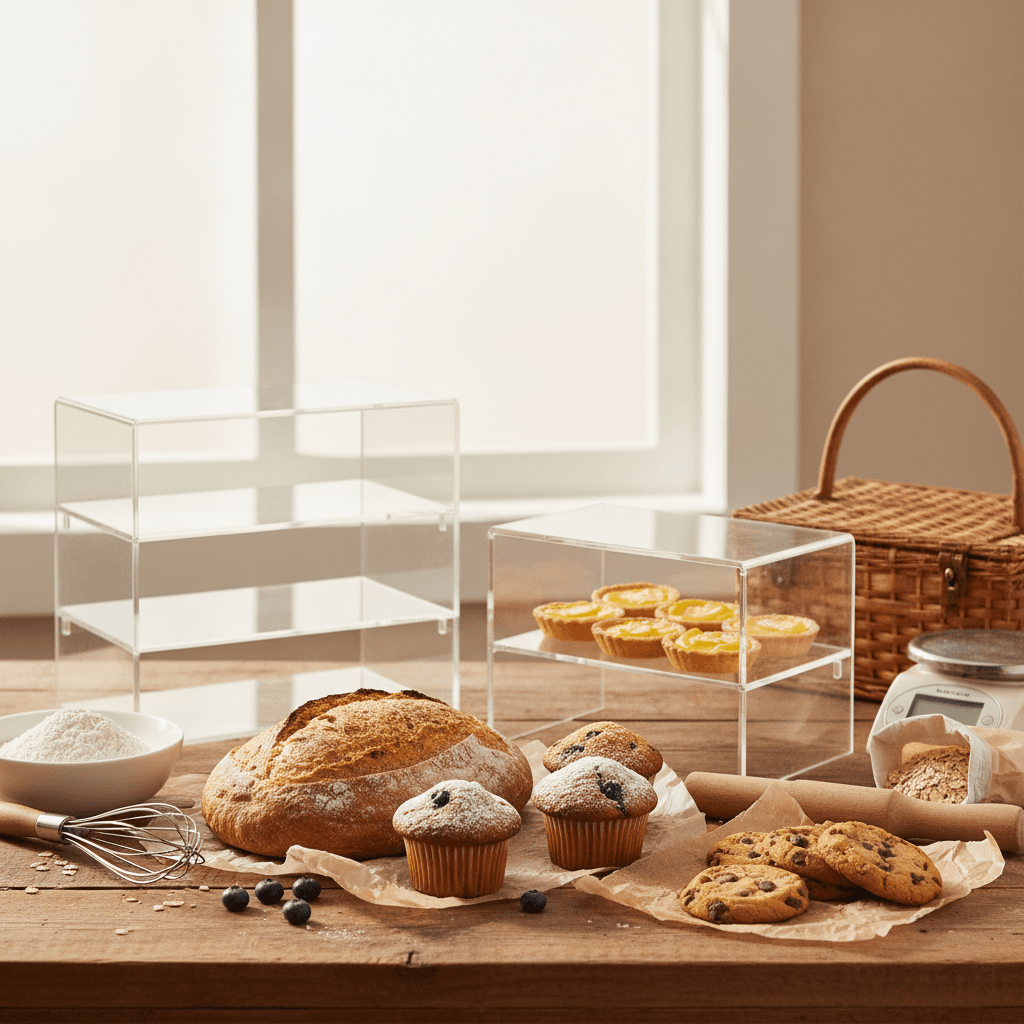
Most cottage food bakers sell cookies, breads, and muffins at farmers markets. For them, the best choice is a dry (non-refrigerated) countertop case between 16–39 inches wide. It needs no power and weighs far less than glass refrigerated units. It is also legally enough, since most states require cottage food items to be shelf-stable anyway. The George & Willy Regular (26.8" wide, $420) hits the sweet spot of display area, portability, and price for a typical 6-foot market table.
Key takeaways
- Dry (room-temperature) display cases are all most cottage food bakers need. Shelf-stable items like cookies, breads, and muffins don't need refrigeration, and most state cottage food laws ban perishable items anyway.
- The George & Willy Regular ($420, 26.8" wide, aluminum and acrylic) is the strongest option for portability. It needs no power, has lightweight acrylic panels, ships flat, and stacks.
- Refrigerated countertop cases like the Avantco BCC-28-HC ($639, 3.1 cu. ft., 36–43°F range) only make sense if you sell cream-filled or custard-based items. You'll also need a 110V outlet at your booth.
- Acrylic is much lighter than tempered glass. It is also far less likely to shatter in transport, which is a real concern when you load and unload every market day.
- Cottage food rules vary by state. Some cap yearly sales (Michigan caps most operations at $50,000). Some allow a much wider range of foods (Texas, as of September 2025). Each farmers market may also add its own vendor rules on top of state law.
- Budget 2-tier acrylic cases sell on eBay and Etsy for well under $340. They're a good way to test the market before you invest more.
Comparison table: bakery display cases ranked for farmers market use
This table compares every case in this post on the specs that matter to a market vendor. Those are width, type, materials, power needs, portability, and price. Cases are listed from most to least portable.
| Product | Type | Width | Materials | Power | Portability | Price tier |
|---|---|---|---|---|---|---|
| Generic 2-tier acrylic (eBay/Etsy) | Dry | Varies | Acrylic | None | High — lightweight, no glass | Budget |
| George & Willy Small | Dry/Ambient | 16.5" | Aluminum frame, acrylic panels | None | High — shatter-resistant acrylic, ships flat | $340 |
| George & Willy Regular | Dry/Ambient | 26.8" | Aluminum frame, acrylic panels | None | High — sliding doors, stackable | $420 |
| George & Willy Large | Dry/Ambient | 38.6" | Aluminum frame, acrylic panels | None | Moderate — wider footprint but still lightweight | $520 |
| Avantco BCC-28-HC | Refrigerated countertop | 27.5" | Curved glass, steel | 110V (1/3 hp compressor) | Low — glass, heavy, needs outlet | $639 |
| Avantco BCC-35-HC | Refrigerated countertop | 34.5" | Curved glass, steel | 110V | Low | $749 |
| Avantco BCC-48-HC | Refrigerated countertop | 48" | Curved glass, steel | 110V | Very low — too wide for most market tables | $999 |
| Avantco BCD-48 | Dry, floor-standing (48" tall, on casters) | 48" | Curved glass, steel | 115V (lighting) | Low — glass, commercial-grade weight | $1,529–$1,649 |
How we ranked these
Every case is ranked on published specs you can check. We did not use taste tests, personal impressions, or made-up user stories. Here are the criteria, from most to least weight for a farmers market vendor:
- Portability: Weight, materials (acrylic vs. glass), whether it needs power, and how easily it breaks down for transport.
- Dimensions and capacity: Will it fit on a standard 6-foot folding table next to your other products?
- Power requirements: Many farmers market booths have no electricity. A case that needs 110V limits where you can sell.
- Materials and durability: Acrylic is lighter and resists shattering. Glass looks more polished but can break in a truck bed.
- Temperature control: This only matters if you sell perishable items, which most cottage food laws don't allow anyway.
- Price: What the maker or a major retailer lists publicly.
We did not rate individual Koolmore models. The sources we reviewed for this post did not give dimensions, capacity, or pricing for each model.
Why most cottage food bakers only need a dry case
For most cottage food bakers, a dry (non-refrigerated) case is all the law requires. That's because most state cottage food laws limit you to shelf-stable foods that are not "potentially hazardous," meaning foods that don't need cold storage to stay safe. In Ohio, for example, the allowed list includes cookies, breads, brownies, fruit pies, cakes, unfilled baked donuts, granola, and pizzelles. All of these sit safely at room temperature. Michigan's law is similar. It covers breads, cookies, cakes, muffins, fruit jams, candies, granola, dry herbs, and popcorn. Michigan also caps yearly gross sales at $50,000, or $75,000 if your products sell for $250 or more per unit. MDARD, the state agriculture department, may adjust that cap for inflation starting October 2026.
The practical takeaway: most states limit you to shelf-stable goods. If yours does, a refrigerated case costing $639 or more is money you could spend on better packaging or smarter pricing instead.
There is one major exception: Texas. As of September 1, 2025, Texas cottage food producers can sell a much wider range of foods straight to customers. That includes items that need refrigeration, with yearly sales up to $150,000. Some foods are still banned: meat, poultry, seafood, frozen desserts, low-acid canned foods, CBD/THC products, and raw milk. Producers must also register with DSHS, the state health department, to sell foods that need temperature control. If you're in Texas selling cream pies or custard tarts, a refrigerated case starts to make sense.
Important: Check your rules before you buy any equipment. Cottage food rules vary by state, and many farmers markets add their own vendor rules on top of state law. So read both your state's cottage food law and your market's vendor guidelines. Under AFDO guidance, cottage food operators don't have to meet NSF standards for equipment. (NSF is a commercial food-equipment certification.) Some markets may set their own rules, though.
Best overall: George & Willy Regular ($420)
If you do weekly farmers markets, the George & Willy Regular is the strongest all-around pick. It measures 26.8" wide by 15" deep by 10.2" high. That takes up less than half of a standard 6-foot folding table. You'll still have room for signs, samples, a cash box, and your other market essentials.
Key specs that matter for market use:
- Materials: Aluminum frame with acrylic panels. Acrylic is much lighter than tempered glass and far less likely to shatter. That's a real plus when you're loading a car at 5:30 AM.
- Shelf capacity: Each shelf holds up to 18 lbs (8 kg), and the top also holds 18 lbs. That's enough for a full batch of sourdough loaves or several dozen cookies.
- Door type: The Regular and Large sizes have sliding doors. The Small has a door that hinges upward.
- Stackable: You can stack two units of the same width with the included hardware. This doubles your display area without using more table space. It's useful if you sell both cookies and bread.
- Power: None needed. With no electrical parts, you can set up anywhere.
- Assembly: Ships flat with instructions and tools included.
- Colors: Black, White, or Brass.
One limit to know about: the maker clearly warns against using it with hot food. Heat can warp the acrylic panels. If you sell fresh-from-the-oven items, let them cool completely before you display them. The case also isn't airtight. It keeps dust and larger flies off your products, but it won't make them last longer.
Which George & Willy size fits your market booth?
Here's a worked example. Say you have a standard 6-foot (72") folding table. The Regular (26.8" wide) leaves about 45" of table for your other items, signs, and a checkout area. The Large (38.6" wide) leaves about 33". The Small (16.5" wide) works best as a second display. It also suits bakers with a very small product line, like one type of bread or a single cookie flavor.
You may sell enough to justify two cases. If so, stacking two Regular units gives you more shelf area than a single Large (two 26.8" cases versus one 38.6" case). It also keeps the footprint at 26.8". That's an $840 investment versus $520 for the Large.
Best budget option: generic acrylic 2-tier cases
If you're starting a home bakery on a tight budget, look at generic 2-tier acrylic display cases. They sell on eBay and Etsy for well below the George & Willy line. Etsy sellers offer collapsible and foldable designs that pack flat for transport.
The tradeoff is build quality and looks. A $340 George & Willy case has an aluminum frame and a polished look that says "professional bakery." A budget acrylic case says "I'm getting started." For your first season, that's fine. Your baked goods are what bring people back, not the case they sit in. But you may be trying to build repeat customers and a known brand at your local market. Then the upgrade pays for itself in how customers see you.
When a refrigerated case actually makes sense
Buy a refrigerated case only if you sell perishable foods your state allows. Under the FDA Food Code, perishable (temperature-controlled) foods must be held at 41°F or below. The Avantco BCC-28-HC is a widely sold countertop refrigerated case. It lists a temperature range of 36–43°F and a 3.1 cubic foot capacity. It has curved front glass with LED lighting.
But here's the contrarian take: for most farmers market bakers, a refrigerated case is an expensive mistake. Here's why:
- Most cottage food items can't go in one anyway. If your state limits you to shelf-stable goods, a refrigerated case is a $639+ fix for a problem you don't have.
- You need a 110V outlet. The Avantco BCC-28-HC uses a standard 5-15P plug and a 1/3 hp compressor. Many farmers market booths have no electricity. Running a generator adds cost, noise, and hassle.
- Glass breaks. Curved glass looks beautiful in a storefront shop. In a truck bed bouncing over potholes to a 7 AM market setup, it's a risk. Acrylic panels resist shattering.
- Reliability concerns. Several reviewers on WebstaurantStore report Avantco BCC-28-HC units that stopped holding their set temperature within months of purchase. If your case dies mid-market while you're selling cream-filled pastries, you have a food safety problem.
The Avantco BCC-28-HC measures 27.5" wide by 22.5" deep by 27" tall. Inside, it's 26 3/16" by 19 5/16" by 16 3/16". It uses R-290 refrigerant, which is propane-based (ODP 0, GWP 3). WebstaurantStore lists it at $639. Larger models are available, but they're even less practical for portable market use. Those are the BCC-35-HC ($749, 34.5" wide) and BCC-48-HC ($999, 48" wide).
You may truly need cold storage at a market, for example if you're in Texas selling custard-filled items. If so, think about a good cooler with ice packs first. It might be simpler and cheaper than hauling a glass-front refrigerated case that needs power.
Dry vs. refrigerated: a cost comparison for a first-year market baker
Here's a made-up example to put the numbers in perspective. Say you sell at one farmers market per week, 30 weekends per year. You average $350 in sales per market day. That's $10,500 in yearly gross sales.
| Expense | Dry case setup | Refrigerated case setup |
|---|---|---|
| Display case | $420 (George & Willy Regular) | $639 (Avantco BCC-28-HC) |
| Power source | $0 | $200–$500 (generator or extension cord fee, if available) |
| Transport risk | Low (acrylic, shatter-resistant) | Higher (curved glass) |
| Case cost as % of year-one revenue | 4.0% | 6.1%–10.8% (including power) |
That gap of 4% vs. 6–11% matters. You're also paying for booth fees, a canopy, table, signage, ingredients, and packaging. You may also need bakery insurance. Every dollar you save on equipment goes toward actual profitability.
What about freestanding bakery cases?
Skip freestanding (floor-standing) cases for market use. Models like the Avantco BC-36-HC ($1,379–$1,499), BC-48-HC ($1,629–$1,749), and BC-72-HC ($2,249–$2,499) are built for storefront shops, not farmers markets. They're heavy and fragile, need 115V power, and won't fit on a folding table. They're worth a look if you're moving from farmers markets into a permanent shop. But that's a different buying decision entirely.
The Avantco BCD-48 dry case ($1,529–$1,649) is not refrigerated. But it is a 48"-tall floor-standing unit on casters. It has curved double-pane glass and LED lighting (115V). It has a 4.6 out of 5 star rating on WebstaurantStore. Still, at 48" wide and made of glass, it suits a permanent location more than a portable market setup.
Cottage food labeling: what goes on the package, not the case
Your display case shows off the product, but your labels keep you legal. All packaged baked goods sold at farmers markets must be labeled to meet your state's cottage food rules. The usual minimum is the product name, business name, address, ingredient list, and allergen statement.
In Texas, cottage food producers must also display a sign reading: "THIS PRODUCT WAS PRODUCED IN A PRIVATE RESIDENCE THAT IS NOT SUBJECT TO GOVERNMENTAL LICENSING OR INSPECTION." Minnesota's law lets you bring bulk containers of baked goods to market. You can then package each customer's order using tongs, deli tissue, or disposable gloves. That changes how you might use your display case (open access vs. pre-packaged).
If you sell gluten-free items at a farmers market, allergen labels matter even more. Depending on your state, cross-contact warnings may be required or strongly recommended.
Frequently asked questions
Do I need a refrigerated display case for a farmers market?
Probably not. Most cottage food laws limit you to shelf-stable foods like cookies, breads, brownies, and muffins. None of these need refrigeration. A dry (room-temperature) case is legally enough in most states. You only need refrigeration if you sell perishable items like cream pies or custard-filled pastries, and your state's cottage food law allows them.
What size bakery display case fits on a standard farmers market table?
A standard folding table is 72" (6 feet) wide. A case in the 16–27" range leaves plenty of room for signs, samples, a cash box, and checkout space. The George & Willy Regular at 26.8" wide takes up about 37% of the table. Cases wider than 38" start crowding out everything else.
Can I use any display case under cottage food laws?
Under AFDO guidance, cottage food operators don't have to meet NSF standards for equipment. But each farmers market may set its own vendor rules beyond state cottage food law. Some may require certain equipment certifications or food establishment licenses. Always check both your state law and your market's vendor rules before you buy.
Is acrylic or glass better for a portable bakery display case?
Acrylic is the better choice for portable market use. It's much lighter than tempered glass and far less likely to shatter in transport. Glass cases look more polished and are standard in storefront bakeries. But the risk of breakage from weekly loading and unloading makes them impractical for most market vendors.
How much should I spend on a bakery display case for my first farmers market season?
For a first season, a budget acrylic case (well under $340) lets you test the market without a big upfront cost. If you're committed to weekly markets and want a professional look, the George & Willy Regular at $420 is a reasonable investment. That's about 4% of a made-up $10,500 first-year income from 30 market weekends at $350 each. Spending $639+ on a refrigerated case rarely makes sense for a cottage food baker selling shelf-stable goods. Factor equipment costs into your per-unit pricing. For more help, see our guide to costing your recipes and understanding your margins.
Sources
- George & Willy — Bakery Display Case product page
- WebstaurantStore — Refrigerated and dry bakery display cases
- WebstaurantStore — Avantco BCC-28-HC product listing
- Avantco Refrigeration — BCC-28-HC specs
- FoodPros — Bakery display case buying guide
- Zanduco — Refrigerated display cases
- Chef's Deal — Non-refrigerated display cases
- AutofillPDFs — Cottage food laws and farmers markets
- Ohio State University Farm Office — Legally selling baked goods at a farmers market
- City of Kentwood — Michigan's Cottage Food Law
- Farm and Ranch Freedom Alliance — Cottage food laws (Texas)
- Minnesota Department of Agriculture — Cottage food law guidance
- AFDO — Cottage Foods Regulatory Guidance for Best Practices
- QuicklyCottage — Sell baked goods at a farmers market

Written by
Co-founder, BakingSubs
Co-founder of BakingSubs, where he turns the science of ingredient substitutions into tested, reliable guidance for home bakers.
Related Posts
Bake with Confidence
See all
Confident Gluten-Free Baker Toolkit
The science-based system that replaces gluten's seven invisible jobs so your baking turns out soft, fluffy, and foolproof — every time.

Gluten-Free Recipe Vault
Instant access to our complete library of proven gluten-free recipes — no waiting, no guesswork, just results that work tonight.

Fix Your Gluten-Free Bread
Learn the 3-step formula to make bread rise and stay soft, discover why your loaves collapse, and get a tested sandwich bread recipe that actually works.