

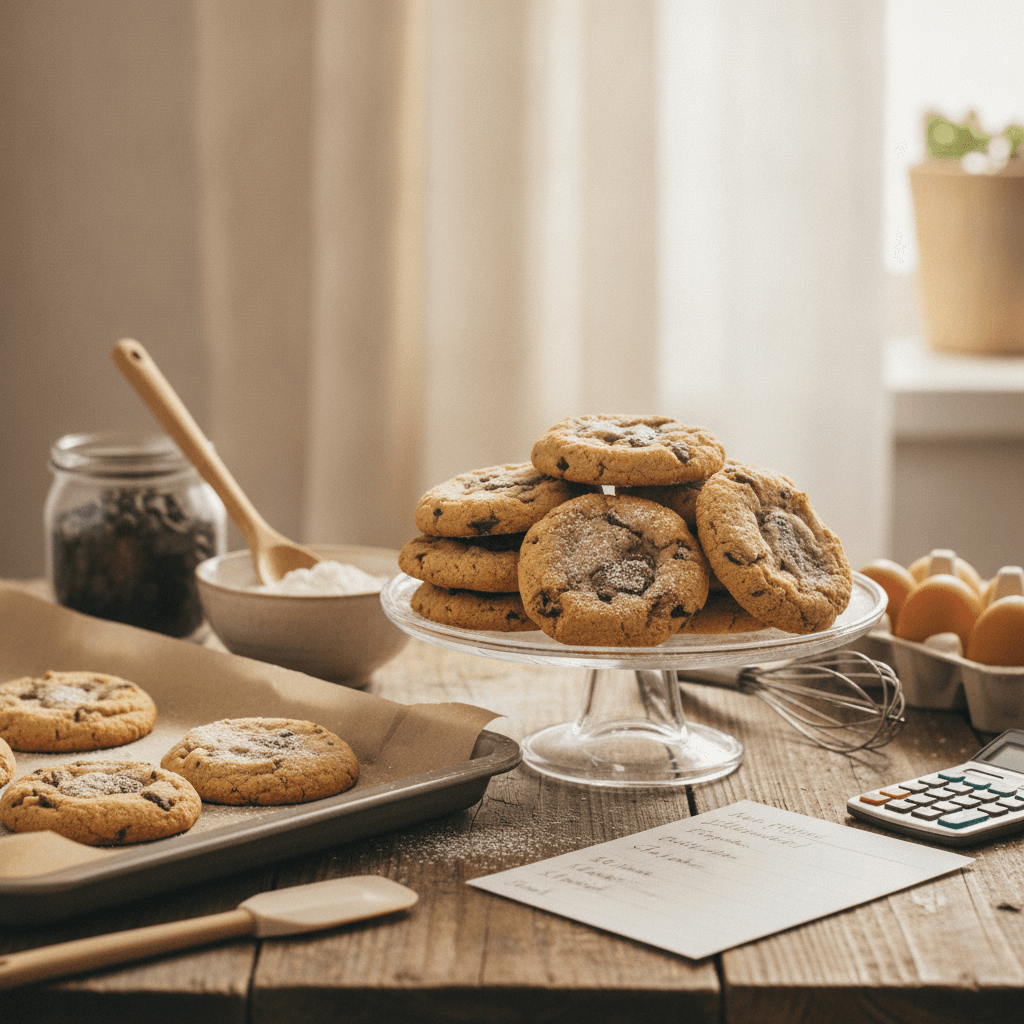
To sell cookies from home, you need to check your state's cottage food law, price each cookie above your ingredient-plus-packaging cost (most home bakers charge $2.50–$4.00 per cookie, more for specialty cookies), and start with direct-to-consumer channels like social media, farmers markets, and local pre-orders. Below is the step-by-step breakdown covering legality, a recipe cost sheet you can copy, packaging, shelf life, and where to land your first paying customers.
Key takeaways
- Most U.S. states allow selling homemade cookies under cottage food laws, but annual sales caps range from $50,000 (New Jersey) to unlimited (Ohio, Missouri) — check yours before you bake a single batch.
- A standard chocolate chip cookie costs $0.24–$0.65 in ingredients depending on butter and chocolate prices; after packaging and a 3x markup, retail price lands at $2.50–$4.00 each or $24–$48 per dozen.
- Shelf-stable cookies (biscotti, shortbread, snickerdoodles) are the safest cottage food bet because they last 2–3 weeks without refrigeration.
- Your first three sales channels should be Instagram/Facebook direct orders, a local farmers market, and word-of-mouth pre-order rounds — no website needed yet.
- Packaging costs $0.35–$0.80 per unit for bags, labels, and stickers; skipping branded labels early saves cash but costs repeat business.
Is it legal to sell cookies from home?
In most U.S. states, yes — under cottage food laws. These laws let you sell certain homemade foods directly to consumers without a commercial kitchen license. As of 2025, all 50 states have some form of cottage food legislation, but the details vary wildly.
Here is what varies by state:
- Annual revenue cap. New Jersey caps you at $50,000, while Ohio and Missouri have no dollar cap at all. Texas allows up to $150,000 a year.
- Allowed sales channels. Some states (Florida, Ohio, and, since March 2026, Michigan) allow online orders shipped within the state. Others (Texas, New Jersey, Utah) let you take orders online but require an in-person handoff, and California's Class A permit limits you to direct-to-consumer sales with no retail stores.
- Labeling requirements. Nearly every state requires a label with your name, address, a state-specific home-kitchen disclaimer (the exact wording is set by each state), and a full ingredient list.
- Permit or registration. Some states require a food handler course (Texas, California) or a simple registration. California's Class A permit uses a self-certification checklist, and its Class B permit requires an actual kitchen inspection.
The single most important step: look up your specific state's cottage food law before you spend a dollar on ingredients. Your county clerk's office or state agriculture department website will have the current rules. If you are in a state that restricts sales to in-person only, that shapes your entire sales strategy.
Recipe cost sheet you can copy
Pricing cookies without knowing your actual cost per batch is guessing. Below is a cost sheet template. Copy this table into a spreadsheet, fill in your own prices, and you will have a real cost-per-cookie number in about 10 minutes.
| Ingredient | Package price | Package size | Amount used per batch | Cost per batch |
|---|---|---|---|---|
| All-purpose flour | $3.49 | 5 lb (2,268 g) | 280 g | $0.43 |
| Butter (unsalted) | $4.99 | 1 lb (454 g) | 227 g (2 sticks) | $2.50 |
| Granulated sugar | $3.29 | 4 lb (1,814 g) | 200 g | $0.36 |
| Brown sugar | $3.49 | 2 lb (907 g) | 220 g | $0.85 |
| Eggs | $3.89 | 12 eggs | 2 eggs | $0.65 |
| Vanilla extract | $8.99 | 8 fl oz (237 ml) | 10 ml | $0.38 |
| Chocolate chips | $3.49 | 12 oz (340 g) | 340 g | $3.49 |
| Baking soda | $1.09 | 16 oz (454 g) | 6 g | $0.01 |
| Salt | $1.29 | 26 oz (737 g) | 5 g | $0.01 |
| Total ingredient cost per batch (approx. 36 cookies) | $8.68 | |||
| Cost per cookie | $0.24 | |||
| Add packaging per cookie ($0.35–$0.80) | $0.59–$1.04 | |||
Butter and chocolate chips are almost always the biggest cost drivers. With premium chocolate (Guittard, Callebaut) the per-cookie ingredient cost can climb to $0.45–$0.65, which is why the range in the key takeaways is so wide. The prices in the table are typical grocery figures — run the sheet with your own receipts.
How to price cookies for profit
The standard formula for home-baked goods is a 3x to 4x markup on your total cost (ingredients + packaging + label). Here is how that math works for a typical chocolate chip cookie:
- Ingredient cost per cookie: $0.24
- Packaging cost per cookie: $0.45 (cellophane bag, label, twist tie)
- Total cost: $0.69
- At 3x markup: $2.07 — round to $2.50
- At 4x markup: $2.76 — round to $3.00
Most home bakers sell individual cookies for $2.50–$4.00, depending on size, ingredients, and local market. Specialty cookies — almond flour-based, gluten-free, or stuffed cookies — command $4.00–$6.00 each because ingredient costs are higher and the perceived value is greater.
Selling by the dozen is more common and easier to produce. A dozen standard cookies typically sells for $24–$48. For example, if you price brown butter chocolate chip cookies at $36 per dozen and your ingredient cost per dozen is $7.20 with $1.80 in packaging, your profit after costs is $27.00 — a 4x markup.
One pricing mistake that costs real money: underpricing to "get customers first." If you sell a dozen for $15, your profit after a $9.00 cost is just $6.00. You would need to sell 50 dozen per month to clear $300 — and at that volume, you are working 15+ hours a week for less than minimum wage.
Packaging that keeps cookies fresh and looks professional
Packaging serves two jobs: keeping cookies intact during transport and making the product look worth the price. Here is what works at each price point.
Budget packaging ($0.35–$0.50 per unit)
- Clear cellophane bags with a heat seal or twist tie
- A printed sticker label with your business name, ingredient list, and the required cottage food disclaimer
- Kraft paper bakery bags for a rustic look
Mid-range packaging ($0.50–$0.80 per unit)
- Windowed kraft boxes (hold 6 or 12 cookies)
- Custom-printed labels from a service like Avery or Canva-printed sticker sheets
- Tissue paper liner inside the box
For example, switching from cellophane bags ($0.18 each) to windowed kraft boxes ($0.52 each) adds $4.08 per dozen. If the upgraded presentation lets you raise your dozen price from $28 to $38, your revenue goes up $10.00 — a net gain of $5.92 per order.
For labels, most states require: your name, home address (or a registered business address), a full ingredient list in descending order by weight, the net weight of the product, and the cottage food disclaimer. Print a test label and check it against your state's specific requirements before ordering 500.
Shelf life of common cookie types
Cottage food laws in most states restrict you to shelf-stable foods — meaning no refrigeration required. That rules out cream-filled or cream-cheese-frosted cookies. Here is a realistic shelf life table for common cookie types stored at room temperature in sealed packaging:
| Cookie type | Shelf life (sealed, room temp) | Cottage food safe? | Notes |
|---|---|---|---|
| Chocolate chip | 7–10 days | Yes | Butter content shortens life vs. oil-based |
| Snickerdoodles | 10–14 days | Yes | Low moisture, holds well |
| Shortbread | 2–3 weeks | Yes | Excellent shelf life due to low moisture |
| Biscotti | 3–4 weeks | Yes | Best shelf life of any cookie |
| Oatmeal raisin | 7–10 days | Yes | Raisins add moisture — watch for mold in humid climates |
| Sugar cookies (decorated) | 10–14 days | Yes | Royal icing acts as a seal |
| Macarons | 1–3 days (room temp) | Usually no | Most fillings need refrigeration — check your state |
| Cream cheese frosted | Requires refrigeration | No | Not allowed under most cottage food laws |
If you want the widest delivery window and the fewest spoilage complaints, start with shortbread, biscotti, or decorated sugar cookies. These give you the most flexibility for farmers market days and pre-order pickups.
Your first 3 places to sell
You do not need a website, an LLC, or a commercial kitchen to start selling. Here are the three channels that generate the fastest first sales for home cookie businesses, in order of ease.
1. Instagram and Facebook direct orders
Post photos of your cookies with a simple caption: what they are, how much they cost, how to order (DM or text). This costs $0 and reaches the people most likely to buy — your existing network.
Post at least 3 times per week. Show the cookies in natural light on a clean surface. Include the price in every post. "Salted brown butter chocolate chip, $36/dozen, DM to order for Friday pickup" is a complete sales post. No hashtag strategy or content calendar needed in month one.
A simple Instagram Stories routine: post once a day, use the "question" sticker to take flavor votes, and open orders every Wednesday for Saturday pickup. Total marketing spend: $0.
2. Farmers markets
A booth at a local farmers market puts your cookies in front of 200–2,000 people in a single morning. Booth fees typically run $25–$75 per market day, depending on your city. Most markets require proof that you are operating under cottage food law (your permit or registration) and a copy of your labels.
Bring 8–12 dozen cookies to your first market. Price individual cookies at $3.00–$4.00 and offer a "3 for $10" or "dozen for $36" deal. Have a sign-up sheet or QR code for a text list so you can reach those customers again next week.
Plan to net $150–$400 on a good market day after your booth fee. That is realistic for a new vendor with a solid product and decent foot traffic.
3. Word-of-mouth pre-order rounds
This is the simplest model: announce a bake date, take orders until you hit your capacity, bake everything in one or two sessions, and schedule a single pickup window. It works especially well for holidays, school events, and office catering.
Send a text or email to 20–30 people you know: "I'm baking (cookie name) this Saturday. $36/dozen, order by Thursday, pickup Sunday 12–3 pm at (your address)." You will be surprised how many people reply. Even 5 orders from your first round is $180 in revenue for roughly 4 hours of work (including baking, cooling, packaging, and pickup).
A note on gluten-free and specialty cookies
If you bake gluten-free cookies, you have a built-in market advantage: people with celiac disease or gluten sensitivity are chronically underserved by local bakeries, and they will pay a premium for safe, good-tasting options.
Gluten-free cookies using almond flour or a rice-flour blend typically cost 30–50% more in ingredients than wheat-based cookies. A dozen gluten-free chocolate chip cookies might cost $11.00–$14.00 to make versus $7.00–$9.00 for conventional. Price accordingly — $42–$54 per dozen is standard for gluten-free cottage bakers.
Cross-contamination is the biggest concern. If you also bake with wheat flour in the same kitchen, you cannot honestly label your cookies as gluten-free. Dedicated gluten-free bakers who can guarantee no cross-contamination have a real competitive edge. For more on avoiding texture issues in gluten-free baking, we have a full guide.
Similarly, cookies made with allulose or other sugar substitutes appeal to keto and diabetic customers. These are niche markets where customers are actively searching for home bakers because commercial options are limited and often taste terrible.
Order form template
Once you start taking pre-orders, you need a simple way to track them. Here is a basic order form layout you can copy into Google Sheets or print out:
| Customer name | Phone / email | Cookie flavor(s) | Quantity (dozens) | Price per dozen | Order total | Deposit paid? | Pickup date / time | Notes (allergies, add-ons) |
|---|---|---|---|---|---|---|---|---|
| Maria G. | 512-555-0142 | Choc chip, Snickerdoodle | 2 | $36 | $72 | Yes ($36) | Sat 12/5, 12–2 pm | Nut-free kitchen requested |
| James T. | james@email.com | Shortbread | 1 | $30 | $30 | No | Sat 12/5, 12–2 pm | Gift box packaging |
Require a 50% deposit for orders over $50. This protects you from no-shows. Venmo, Zelle, and Cash App are the most common payment methods for cottage bakers — no merchant account needed.
Timeline: from idea to first sale
Here is a realistic week-by-week timeline for going from "I want to sell cookies" to your first paying customer:
| Week | Task | Details |
|---|---|---|
| 1 | Research your state's cottage food law | Find revenue cap, labeling rules, allowed sales channels. Apply for food handler's card if required ($10–$15, usually online). |
| 2 | Finalize 2–3 cookie recipes and cost them out | Use the cost sheet above. Bake test batches, weigh everything, calculate cost per cookie. |
| 2 | Order packaging | Start with 50–100 bags or boxes. Order labels or print your own. Budget $25–$50 for initial packaging supplies. |
| 3 | Set prices and create your order form | Use the 3x–4x markup formula. Set up a Google Sheet or printed form. |
| 3 | Take product photos | Natural light, clean background. Shoot 10–15 photos of each cookie type. Use your phone — no professional camera needed. |
| 4 | Announce and take your first orders | Post on Instagram/Facebook. Text 20 friends. Set a bake date and pickup window. |
| 4–5 | Bake, package, and deliver | Bake 1–2 days before pickup. Package the morning of. Collect payment at pickup or require deposit in advance. |
Most people can go from zero to first sale in 3–5 weeks if they do not overthink it. The biggest time sink is usually the legal research, which takes 1–3 hours depending on how clearly your state publishes its rules.
Common mistakes that cost new cookie sellers money
These are the most common mistakes:
- Pricing too low. If your dozen is under $20, you are almost certainly losing money once you factor in packaging, labels, your time, and the gas or electricity to run your oven for 3 hours.
- Offering too many flavors. Start with 2–3. Every new flavor means a new ingredient list on your label, a new cost calculation, and more inventory to manage. A short menu also means you stop buying specialty ingredients that sit unused.
- Skipping the deposit. A 50% deposit on orders over $50 is standard. Without it, expect a 10–15% no-show rate on pickups — and you are stuck with cookies you already baked.
- Not tracking costs. If you are not using a cost sheet, you are guessing. Butter alone has fluctuated between $3.99 and $5.99 per pound in the last 18 months. Your prices need to move with your costs.
- Waiting for a website. You do not need a website to sell your first 100 dozen. Instagram DMs, a Google Form, or even a text thread is enough. Build the website after you have consistent demand.
Frequently asked questions
Do I need a license to sell cookies from home?
In most states, you do not need a traditional food business license. You operate under your state's cottage food law, which typically requires a simple registration or food handler's card (about $10–$15 online). A few states, like California, have a tiered permit system. Check your state agriculture department's website for the exact requirements — the rules change frequently.
How much should I charge for a dozen homemade cookies?
Most home bakers charge $24–$48 per dozen for standard cookies and $42–$54 per dozen for specialty or gluten-free cookies. Use a 3x to 4x markup on your total cost (ingredients plus packaging). If your cost per dozen is $9.00, your price should be $27–$36. Never price below 2.5x your cost — you will burn out before you profit.
Can I sell cookies online and ship them?
It depends on your state. Florida, Ohio, and (as of March 2026) Michigan allow cottage food to be shipped to customers within the state. Texas, New Jersey, and Utah let you take orders online but require you to hand the product over in person. No state allows shipping cottage food across state lines. If your state allows shipping, focus on shelf-stable cookies like shortbread and biscotti that survive 2–3 days in transit. Use rigid boxes with parchment dividers — never ship cookies in bags.
What cookies have the longest shelf life for selling?
Biscotti leads at 3–4 weeks sealed at room temperature, followed by shortbread at 2–3 weeks, and decorated sugar cookies at 10–14 days. These are the safest choices for cottage food sales because they give you the widest window between baking and selling. Avoid anything with cream, custard, or fresh fruit — those require refrigeration and are not allowed under most cottage food laws.
How do I handle food allergies when selling cookies from home?
List every ingredient on your label in descending order by weight. If your kitchen also handles common allergens (nuts, dairy, eggs, wheat), state that clearly: "Made in a home kitchen that also processes tree nuts and wheat." Never claim "nut-free" unless your entire kitchen is nut-free. Allergen transparency protects your customers and protects you from liability. Some states require specific allergen warning language — check your local cottage food labeling rules.

Written by
Co-founder, BakingSubs
Co-founder of BakingSubs, where he turns the science of ingredient substitutions into tested, reliable guidance for home bakers.
Related Posts
Bake with Confidence
See all
Confident Gluten-Free Baker Toolkit
The science-based system that replaces gluten's seven invisible jobs so your baking turns out soft, fluffy, and foolproof — every time.

Gluten-Free Recipe Vault
Instant access to our complete library of proven gluten-free recipes — no waiting, no guesswork, just results that work tonight.

Fix Your Gluten-Free Bread
Learn the 3-step formula to make bread rise and stay soft, discover why your loaves collapse, and get a tested sandwich bread recipe that actually works.