

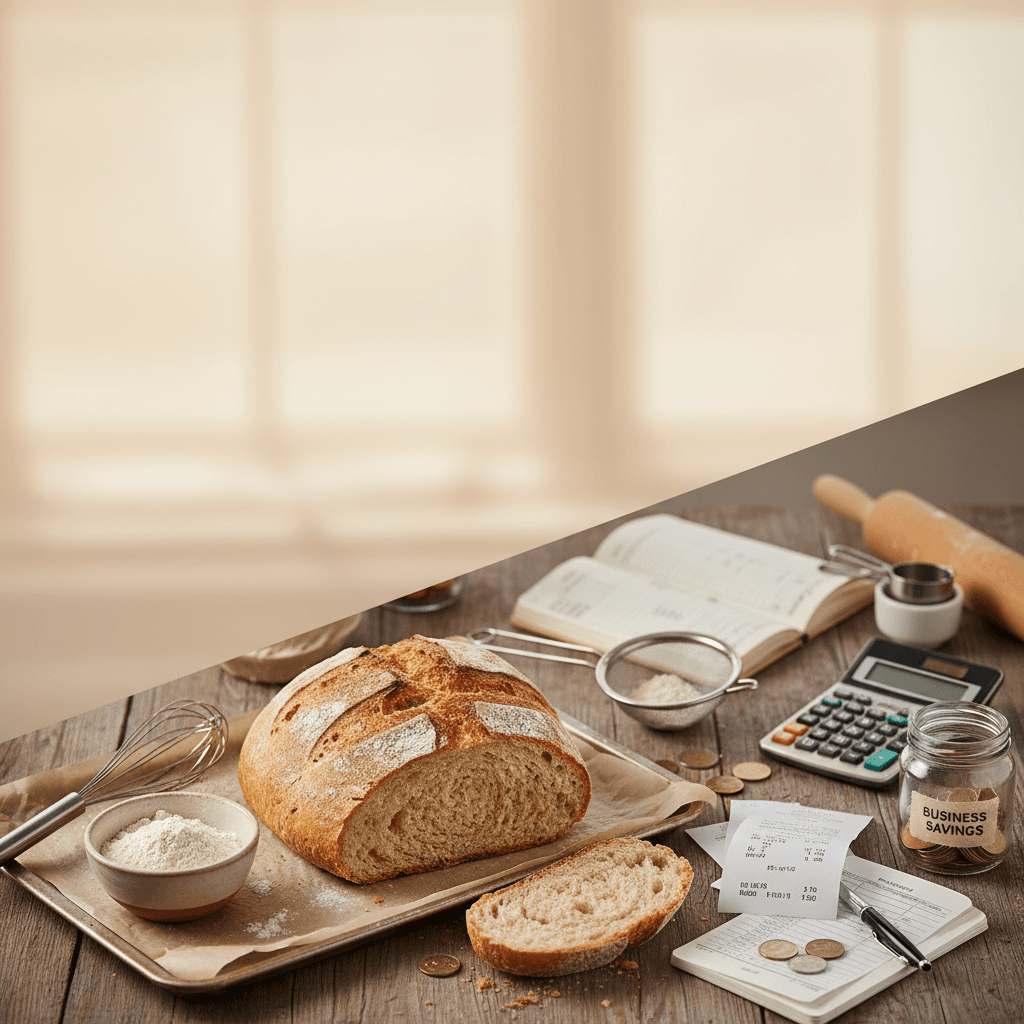
Running a home bakery is exciting until tax season arrives and you realize you have no idea what you owe, what you can deduct, or whether that shoebox of receipts counts as bookkeeping. This guide walks you through exactly how to handle taxes and bookkeeping for your home baking business so you keep more money and avoid surprises.
Key takeaways
- Most home bakeries operate as sole proprietorships and report income on Schedule C of your personal tax return, meaning you owe both income tax and self-employment tax (15.3%) on your profits.
- You can deduct ingredients, packaging, equipment, a portion of your home utilities, and many other legitimate business expenses to significantly reduce your tax bill.
- Quarterly estimated tax payments are required if you expect to owe more than $1,000 in taxes for the year — missing these triggers penalties.
- Separating personal and business finances from day one is the single most important bookkeeping habit you can build.
- Simple, consistent tracking (even 15 minutes a week) prevents the end-of-year panic that leads to missed deductions and overpaying.
- Free and low-cost accounting software designed for small businesses can automate most of the work for under $20 per month.
How home bakery income gets taxed
Your home bakery income is considered self-employment income by the IRS, regardless of whether you operate under cottage food laws or a more formal license. This means two separate taxes apply: regular federal income tax at your marginal rate, and self-employment tax at 15.3% (which covers Social Security and Medicare). You pay both of these on your net profit — that is, your total revenue minus all allowable deductions.
Most home bakers operate as sole proprietors, which means your business income flows directly onto your personal tax return via Schedule C (Form 1040). You do not need to file a separate business tax return unless you have formed an LLC that elected to be taxed as an S-corp or C-corp.
Here is a simplified example of how the math works for a home baker earning $30,000 in annual revenue:
| Line item | Amount |
|---|---|
| Gross revenue | $30,000 |
| Total deductible expenses | $12,000 |
| Net profit (Schedule C) | $18,000 |
| Self-employment tax (15.3% of 92.35% of net profit) | $2,542 |
| Deductible half of SE tax | $1,271 |
| Federal income tax (estimated at 12% bracket after standard deduction) | ~$800 |
| Approximate total federal tax owed | ~$3,342 |
Your state may also tax this income. Some states have no income tax, while others add 3–10% on top. Check your state's department of revenue website for specifics. If you are still figuring out whether your home bakery is even legal in your state, our guide to cottage food laws for home bakers covers the licensing side.
Why you need to separate business and personal finances immediately
Open a dedicated business checking account before you make your first sale. This is not optional if you want clean books — it is the foundation of everything else. When business and personal spending are mixed in one account, tracking expenses becomes a nightmare, and you are far more likely to miss deductions or make errors that could trigger an audit.
You do not need a fancy business bank account. Many banks and credit unions offer free checking accounts for sole proprietors. Pair it with a dedicated debit or credit card for business purchases, and you have created a clean paper trail that makes bookkeeping almost effortless.
If you are also thinking about the bigger picture of planning your business, our home bakery business plan template walks you through the financial planning side in more detail.
If you want to take your home bakery to the next level with consistent orders and sustainable systems, check out the free Home Bakery Pro masterclass. It covers how to build a business that actually supports you financially — which makes the bookkeeping side a lot more motivating.
Every deduction home bakers should be tracking
Deductions are where you save real money. Every legitimate business expense you track and deduct reduces your taxable profit dollar for dollar. Here are the major categories most home bakers can claim:
Ingredients and supplies
Every bag of flour, pound of butter, and bottle of vanilla extract you purchase for your business is deductible. This also includes specialty items like almond flour or xanthan gum if you bake gluten-free. Save every grocery receipt or use a dedicated card so these are automatically tracked.
Packaging and labels
Boxes, bags, stickers, ribbon, tissue paper, and custom labels are all deductible business expenses. If you are spending on packaging supplies or branding and label supplies, track every purchase.
Equipment
Stand mixers, ovens, food scales, sheet pans, and other tools used exclusively or primarily for your business can be deducted. Items under $2,500 can typically be expensed in full the year you buy them (under the de minimis safe harbor election). Larger purchases may need to be depreciated over several years, or you can use the Section 179 deduction to write off the full cost in year one. If you are still building out your kitchen, our home bakery equipment list for beginners covers what you actually need.
Home office and kitchen deduction
If you use a portion of your home regularly and exclusively for your baking business, you can claim the home office deduction. The simplified method allows you to deduct $5 per square foot of dedicated business space, up to 300 square feet ($1,500 max). The regular method lets you deduct the actual percentage of your home expenses (mortgage interest or rent, utilities, insurance, repairs) based on the square footage used for business. The regular method usually yields a larger deduction but requires more record-keeping.
Vehicle and delivery expenses
If you deliver orders, drive to farmers markets, or make supply runs, those miles are deductible. For 2024, the standard mileage rate is 67 cents per mile. Keep a simple mileage log (a notes app on your phone works) recording the date, destination, purpose, and miles driven.
Software and subscriptions
Your website hosting, accounting software, order management apps, point of sale system fees, and even your business phone plan are all deductible. These small monthly charges add up to meaningful deductions over a year.
Marketing and advertising
Business cards, social media ads, website costs, and even the cost of free samples given to potential customers are deductible marketing expenses.
Insurance and permits
Your cottage food permit fees, food handler certification costs, and business insurance premiums are all deductible. If you are not sure whether you need insurance, our guide on home bakery insurance breaks it down.
Common deductions at a glance
| Expense category | Examples | Typical annual range |
|---|---|---|
| Ingredients | Flour, sugar, butter, eggs, specialty items | $2,000–$10,000+ |
| Packaging | Boxes, bags, labels, ribbon | $500–$2,000 |
| Equipment | Mixer, oven, pans, scale | $200–$3,000 (year 1 higher) |
| Home use | Utilities, rent/mortgage portion | $500–$1,500 |
| Vehicle/mileage | Deliveries, supply runs, markets | $300–$2,000 |
| Software | Accounting, POS, website, order management | $200–$600 |
| Marketing | Ads, business cards, samples | $100–$1,000 |
| Insurance and permits | Liability insurance, food permits | $200–$800 |
How to set up a simple bookkeeping system
You do not need to be an accountant to keep clean books. The goal is a system you will actually use consistently, even if it is basic. Here is a straightforward approach that works for most home bakers:
Step 1: Choose your tool
You have three main options, ranging from free to affordable:
- Spreadsheet (free): A Google Sheet or Excel workbook with columns for date, description, category, amount, and whether it is income or expense. This works fine if your volume is low (under ~$15,000/year in revenue).
- Wave (free): A free accounting app that connects to your bank account and auto-categorizes transactions. Great for home bakers who want something more robust without paying.
- QuickBooks Self-Employed or FreshBooks ($10–$20/month): These handle invoicing, mileage tracking, receipt scanning, and tax categorization automatically. Worth it once you are consistently earning and want to save time.
We compared several options in detail in our best accounting software for cottage food business roundup if you want help choosing.
Step 2: Record everything weekly
Set a 15-minute weekly appointment with yourself — same day, same time. During this session, log any income received, categorize expenses, and snap photos of any paper receipts. Consistency matters far more than perfection. If you fall behind a week, catch up the following week. The key is never letting it pile up for months.
Step 3: Track income by source
Record where each payment comes from: direct orders, farmers market sales, Venmo, cash, website orders, etc. This helps you understand which sales channels are most profitable and gives you clean records if the IRS ever asks questions. If customers pay you through a payment processor like Square, those platforms generate 1099-K forms when you cross certain thresholds ($600 in 2024), and the IRS receives a copy.
Step 4: Save receipts digitally
Paper receipts fade. Use your phone camera or an app like Dext, Shoeboxed, or even the built-in receipt capture in QuickBooks to photograph and store receipts digitally. Organize them by month in a cloud folder (Google Drive or Dropbox). The IRS requires you to keep records for at least three years, and up to seven years for certain situations.
Quarterly estimated taxes: what they are and how to pay them
If you expect to owe $1,000 or more in federal taxes for the year, the IRS requires you to make quarterly estimated tax payments. This catches many new home bakers off guard — you do not just settle up once a year like you did as a W-2 employee.
The quarterly due dates are:
| Quarter | Period covered | Payment due date |
|---|---|---|
| Q1 | January 1 – March 31 | April 15 |
| Q2 | April 1 – May 31 | June 15 |
| Q3 | June 1 – August 31 | September 15 |
| Q4 | September 1 – December 31 | January 15 (following year) |
To calculate your quarterly payment, estimate your annual net profit, then figure roughly 25–30% for combined self-employment tax, federal income tax, and state income tax (if applicable). Divide by four. For example, if you expect $20,000 in net profit and estimate a 27% effective tax rate, that is $5,400 for the year, or $1,350 per quarter.
You can pay online through IRS Direct Pay (irs.gov/payments) or the EFTPS system. Many states have their own online payment portals for state estimated taxes. Missing quarterly payments results in an underpayment penalty, which is essentially interest on the amount you should have paid.
A practical tip: open a separate savings account and transfer 25–30% of every payment you receive into it immediately. This way the money is always there when quarterly payments come due.
When to consider forming an LLC or S-corp
Most home bakers start as sole proprietors, and that is perfectly fine. But as your business grows, you may benefit from a different structure:
- LLC (Limited Liability Company): An LLC does not change how you are taxed by default — a single-member LLC is still taxed as a sole proprietorship. The main benefit is liability protection, separating your personal assets from business debts or lawsuits. Formation costs vary by state ($50–$500), and some states charge annual fees.
- S-corp election: Once your net profit consistently exceeds roughly $40,000–$50,000 per year, electing S-corp tax status can save you money on self-employment tax. As an S-corp, you pay yourself a reasonable salary (subject to payroll taxes) and take the remaining profit as a distribution (not subject to self-employment tax). This requires running payroll, filing additional tax forms, and usually hiring an accountant, so it only makes sense at higher income levels.
For most home bakers earning under $40,000 in profit, staying a sole proprietor (with or without an LLC) is the simplest and most cost-effective approach. Revisit this decision annually as your revenue grows.
How to handle sales tax for a home bakery
Sales tax rules for home-baked goods vary dramatically by state. In many states, food sold for home consumption is exempt from sales tax, but prepared food or food sold for immediate consumption may be taxable. Some cottage food laws specifically exempt home bakers from collecting sales tax below certain revenue thresholds.
Here is what you need to figure out for your state:
- Does your state charge sales tax on baked goods?
- Are cottage food products specifically exempt?
- If you must collect sales tax, what is the rate for your county or city?
- How often must you file sales tax returns (monthly, quarterly, or annually)?
Check your state's department of revenue website or call them directly. If you do need to collect sales tax, build it into your pricing from the start. Our guide on how to price baked goods for a home bakery covers pricing strategy in detail, including how to account for taxes and fees without scaring off customers.
Five bookkeeping mistakes that cost home bakers money
These are the errors we see most often, and every one of them either costs you money or increases your audit risk:
- Not tracking cash sales. Cash from farmers markets or local pickups is still taxable income. If a payment processor reports $8,000 but your actual revenue was $12,000 including cash, you need to report all $12,000. The IRS cross-references 1099-K forms, and underreporting income is a red flag.
- Missing the home office deduction. Many home bakers skip this because they think it triggers audits. In reality, if you legitimately use space regularly and exclusively for your business, this deduction is yours to claim. At $5 per square foot for even a modest 150-square-foot kitchen area, that is $750 off your taxable income.
- Forgetting mileage. Delivery runs, market trips, and supply store visits add up fast. At 67 cents per mile, a baker driving 3,000 business miles per year is leaving $2,010 in deductions on the table.
- Mixing personal and business expenses. Buying groceries for dinner and business ingredients in the same transaction on the same card makes it nearly impossible to separate later. Use your business card exclusively for business purchases.
- Waiting until December to start tracking. Reconstructing a year of finances from bank statements and faded receipts is stressful, inaccurate, and guarantees you will miss deductions. Start now, even if your system is imperfect.
When to hire a tax professional
You can absolutely handle your own taxes as a home baker, especially in the early stages. But there are situations where hiring a CPA or enrolled agent pays for itself:
- Your net profit exceeds $30,000–$40,000 and you want to evaluate S-corp election
- You are being audited or received a notice from the IRS
- You have complex situations like multiple income sources, employees, or multi-state sales
- You simply hate dealing with numbers and know you will not do it yourself
A good small-business CPA typically charges $200–$500 for an annual tax return for a sole proprietor. That fee often pays for itself through deductions they catch that you would have missed. Ask other local small business owners or home bakers for referrals — you want someone familiar with small food businesses, not a corporate tax specialist.
Frequently asked questions
Do I have to pay taxes on home bakery income?
Yes. All income from your home bakery is taxable, regardless of the amount. Even if you earn only a few hundred dollars, the IRS requires you to report it. If your net self-employment income exceeds $400 in a year, you must file a tax return and pay self-employment tax. This applies whether customers pay you in cash, Venmo, or any other method.
What is the best accounting software for a home bakery?
For most home bakers just starting out, Wave (free) or QuickBooks Self-Employed ($10–$15/month) are the best options. Wave handles basic bookkeeping and invoicing at no cost, while QuickBooks adds mileage tracking and tax categorization. We compared six options in our best accounting software for cottage food business guide.
Can I deduct ingredients I buy at the grocery store?
Yes, as long as they are purchased for your business. Keep the receipt and note which items were for business use. Using a dedicated business card or account makes this much easier. If you buy ingredients for both personal and business use in the same trip, only the business portion is deductible.
Do I need to collect sales tax on baked goods sold from home?
It depends on your state. Many states exempt food sold for home consumption or cottage food products from sales tax, but rules vary widely. Check your state's department of revenue website or review our cottage food laws guide for state-specific details on what is required.
How much should I set aside for taxes from my home bakery income?
A safe rule of thumb is to set aside 25–30% of your net profit for federal and state taxes combined. This covers self-employment tax (15.3%), federal income tax, and state income tax if applicable. Transfer this percentage into a separate savings account every time you receive a payment so you are never caught short at tax time.

Written by
Co-founder, BakingSubs
Co-founder of BakingSubs, where he turns the science of ingredient substitutions into tested, reliable guidance for home bakers.
Related Posts
Bakery Recipe Cost Sheet: How to Cost a Recipe in 6 Steps (With a Table You Can Copy)

Home Bakery Order Form Template: A Copy-Paste Layout That Cuts Mistakes by Half
Cottage Food Label Requirements and Template: What Every State Demands (With a Copy-Paste Layout)
Bake with Confidence
See all
Confident Gluten-Free Baker Toolkit
The science-based system that replaces gluten's seven invisible jobs so your baking turns out soft, fluffy, and foolproof — every time.

Gluten-Free Recipe Vault
Instant access to our complete library of proven gluten-free recipes — no waiting, no guesswork, just results that work tonight.

Fix Your Gluten-Free Bread
Learn the 3-step formula to make bread rise and stay soft, discover why your loaves collapse, and get a tested sandwich bread recipe that actually works.