

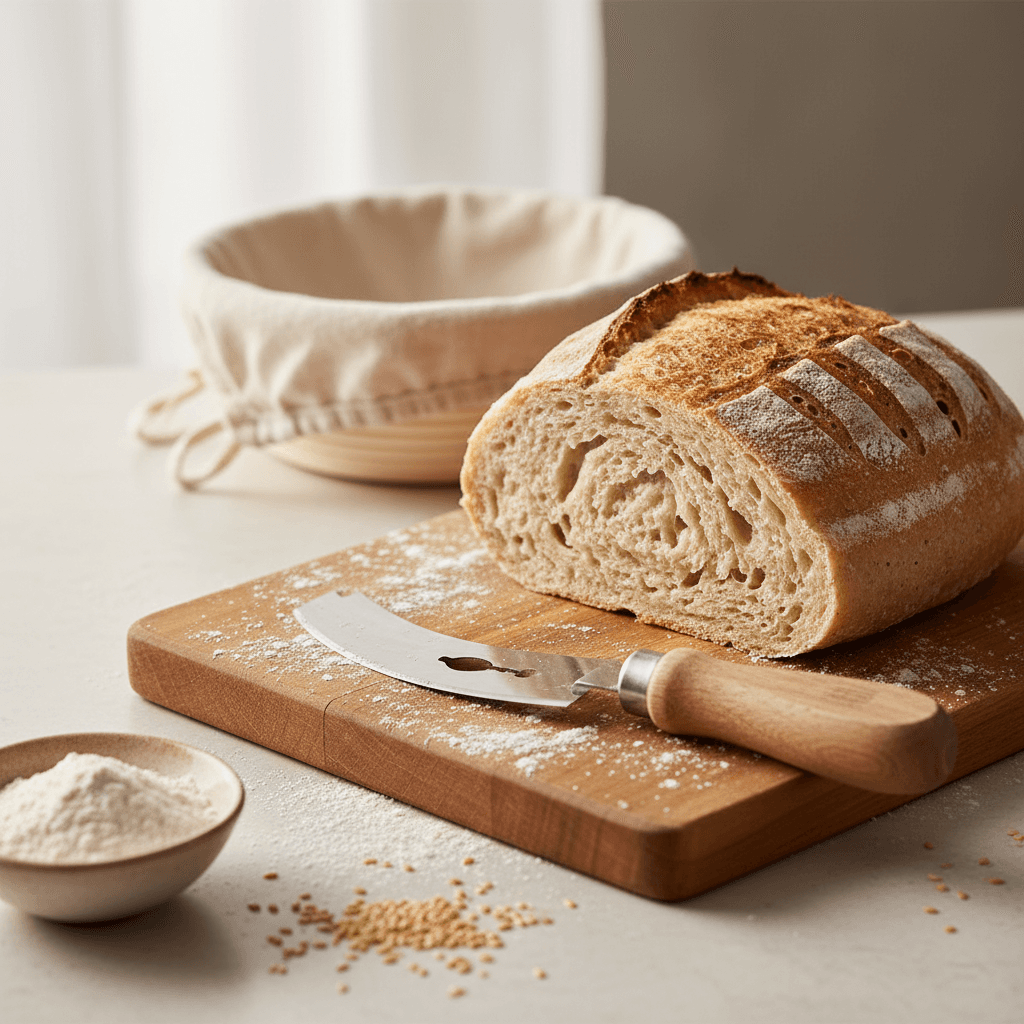
Scoring gluten-free bread is nothing like scoring wheat bread, and using the wrong tool can deflate your loaf before it ever hits the oven. Here are the best bread lames for gluten-free baking, chosen specifically for how they handle soft, sticky, structure-challenged dough.
Key takeaways
- Gluten-free dough lacks the elastic gluten network that holds a score open, so you need an exceptionally sharp blade and a confident, swift motion.
- A curved blade lame works better than a straight blade for most gluten-free loaves because it creates a shallow, angled cut that encourages an ear without dragging through the dough.
- Disposable razor-style blades stay sharper longer and are easier to replace than fixed-blade lames, which matters because GF dough dulls blades faster.
- Oiling or wetting your blade before each score prevents the sticky starches in gluten-free dough from grabbing and tearing.
- Budget lames under $10 work perfectly well for home bakers — you don't need to spend a lot to get clean scores.
- The handle shape matters more than you'd think: a longer handle gives you better control and keeps your hand away from the hot dough surface.
Why scoring gluten-free bread is harder than scoring wheat bread
The short answer: gluten-free dough doesn't have the structural tension that makes scoring easy. When you slash a wheat loaf, the gluten network holds the cut open and allows steam to escape in a controlled way, creating that beautiful ear. Gluten-free bread dough relies on starches, gums, and psyllium husk to hold its shape instead, and those materials behave very differently under a blade.
Gluten-free dough is stickier, softer, and more fragile. A dull or poorly angled blade will drag through the surface rather than slicing it, which can cause the loaf to deflate or create ragged, uneven cuts. That's why the right lame isn't just a nice-to-have — it's the difference between a loaf that opens up beautifully and one that collapses in the oven.
If you're still getting comfortable with gluten-free bread in general, our complete beginner's guide to gluten-free baking covers the fundamentals you'll want to nail before worrying about scoring.
What to look for in a bread lame for gluten-free dough
Not all bread lames are created equal, and the features that matter most shift when you're working with gluten-free dough. Here's what to prioritize:
Blade sharpness and replaceability
This is the single most important factor. Gluten-free dough contains sticky starches like arrowroot and tapioca that gum up blades quickly. You want a lame that uses standard double-edge razor blades so you can swap in a fresh one before every bake session. A fresh blade glides through GF dough; a used one tears it.
Curved vs. straight blade
A curved blade (where the razor bows slightly when mounted) creates a shallower, angled cut that's ideal for scoring soft dough. Straight blades cut deeper and more vertically, which is great for stiff wheat doughs but can cause gluten-free loaves to lose too much gas. For most GF bread, go curved.
Handle length and grip
A longer handle gives you more leverage and control. When you're scoring a delicate GF loaf, you need to move quickly and confidently — a stubby handle makes that harder. Look for handles at least 5 inches long with a comfortable grip.
If you're building out your gluten-free baking toolkit and want a structured approach to getting consistent results, the Confident Gluten-Free Baker Toolkit walks you through everything from flour blends to technique — scoring included.
7 best bread lames for scoring gluten-free bread
We've organized these from budget-friendly to premium so you can find the right fit regardless of how often you bake.
| Lame | Type | Best for | Price range |
|---|---|---|---|
| Matfer Bourgeat Baker's Blade | Curved, replaceable blade | Best overall for GF bread | $8-$12 |
| SAINT GERMAIN Premium Bread Lame | Curved, replaceable blade | Best budget pick | $8-$10 |
| Wire Monkey UFO Lame | Curved, replaceable blade | Best for decorative scoring | $30-$40 |
| Breadtopia Bread Lame | Curved, replaceable blade | Best for beginners | $10-$14 |
| Wire Monkey Lame | Straight, replaceable blade | Best straight blade option | $20-$28 |
| Mure & Peyrot French Lame | Curved, fixed blade | Best premium pick | $25-$35 |
| BakeDeco/Kuchenprofi Bread Lame | Curved, replaceable blade | Best mid-range all-rounder | $12-$18 |
1. Matfer Bourgeat baker's blade — best overall
The Matfer Bourgeat Baker's Blade is the industry standard for a reason. It's the same lame used in professional bakeries across France, and it works beautifully on gluten-free dough. The thin metal handle naturally curves a standard double-edge razor blade, giving you that shallow angle that's perfect for GF loaves.
Pros: Incredibly affordable, creates the ideal blade curve, uses standard razor blades that are cheap to replace, lightweight and easy to control.
Cons: The handle is thin and can feel flimsy if you're used to a chunkier tool. No protective cover included.
Price: $8-$12
Our take: If you only buy one lame, make it this one. It costs a fraction of pricier lames and creates the ideal blade curve for GF dough.
2. SAINT GERMAIN premium bread lame — best budget pick
The SAINT GERMAIN Premium Bread Lame comes with a wooden handle, a leather protective cover, and five replacement blades right in the box. For under $10, it's an absurd amount of value.
Pros: Comfortable wooden handle, includes blades and a cover, great blade curve for GF scoring, very beginner-friendly.
Cons: The wooden handle can absorb moisture over time if not dried properly. Blade mounting can feel slightly loose compared to the Matfer.
Price: $8-$10
Our take: This is the one we recommend to people who are just getting into baking and selling gluten-free bread. It's cheap enough that you won't hesitate to use it, and the included extras make it a great starter kit.
3. Wire Monkey UFO lame — best for decorative scoring
The Wire Monkey UFO Lame is a beautifully designed tool that lets you switch between curved and straight blade positions. Its round, ergonomic shape fits naturally in your palm and gives you exceptional control for detailed score patterns.
Pros: Adjustable blade angle, gorgeous design, extremely precise control, works for both curved and straight cuts.
Cons: Significantly more expensive than basic lames. The unique shape has a learning curve.
Price: $30-$40
Our take: If you're doing Instagram-worthy decorative scores on your GF boules, this is the tool. The ability to adjust the blade angle is especially useful for gluten-free dough because you can dial in exactly the right depth.
4. Breadtopia bread lame — best for beginners
The Breadtopia Bread Lame has a longer wooden handle that gives new bakers a lot of confidence. It holds the blade at a consistent curve and comes with replacement blades.
Pros: Long handle provides excellent control, consistent blade angle, well-made, comes with extra blades.
Cons: Slightly pricier than the Matfer for a similar design. Only available through their website or Amazon.
Price: $10-$14
Our take: The extra handle length makes a real difference when you're scoring a soft GF loaf and need to move quickly. If the Matfer's thin handle intimidates you, start here.
5. Wire Monkey straight lame — best straight blade option
The Wire Monkey Straight Lame is a premium option for bakers who prefer vertical cuts, cross-hatching, or deep slashes. While we generally recommend curved blades for GF bread, there are times — like scoring buckwheat-based loaves or stiffer GF doughs — where a straight blade works better.
Pros: Beautiful craftsmanship, razor-sharp cuts, ideal for geometric patterns and deep scores, replaceable blades.
Cons: Not ideal for the typical soft GF dough. More expensive than budget options.
Price: $20-$28
Our take: This is a specialty tool. If you're already comfortable scoring and want to expand your design options, it's worth adding to your collection.
6. Mure and Peyrot French lame — best premium pick
The Mure and Peyrot is a classic French-made lame with a fixed stainless steel blade. It's the tool you'll see in artisan bakery documentaries, and it feels incredible in your hand.
Pros: Exceptional build quality, perfectly balanced, the fixed blade holds its edge well, beautiful tool you'll keep for years.
Cons: Fixed blade means you can't swap in a fresh razor — you need to sharpen it. More expensive upfront. For GF baking specifically, the inability to swap blades is a real drawback since sticky dough dulls blades faster.
Price: $25-$35
Our take: This is a gorgeous, professional-grade tool. But for dedicated GF bakers, the replaceable-blade options above are more practical for daily use. Consider this one if you bake both wheat and GF bread.
7. BakeDeco/Kuchenprofi bread lame — best mid-range all-rounder
The Kuchenprofi Bread Lame sits right in the sweet spot between budget and premium. It has a sturdy metal handle with a comfortable grip and holds standard double-edge blades at a reliable curve.
Pros: Solid construction, comfortable grip, consistent blade curve, easy blade changes, comes with a protective cover.
Cons: Not as widely available as some options. Handle is heavier than the Matfer, which some bakers find less nimble.
Price: $12-$18
Our take: If you want something more substantial than the Matfer but don't want to splurge on a Wire Monkey, this is your lame. It's a workhorse.
Tips for scoring gluten-free bread without deflating it
Even with the best lame, technique matters enormously with gluten-free dough. Here's how to get clean, beautiful scores:
- Oil or wet the blade. Dip your blade in water or brush it lightly with oil before each cut. This prevents the sticky GF dough from grabbing the blade and tearing.
- Score quickly and confidently. Hesitation is the enemy. A swift, decisive slash creates a clean line. Going slowly lets the blade drag and tear.
- Don't score too deep. Gluten-free dough can't recover from deep cuts the way wheat dough can. Aim for about 1/4 inch deep — just enough to direct the oven spring.
- Score right before baking. Unlike wheat bread, which can sit after scoring, GF dough should go straight into the oven after you score it. The structure is fragile and will start to deflate.
- Chill your dough first. If your GF dough is very soft, a 20-30 minute stint in the fridge firms it up just enough to score cleanly. This is especially helpful if you're dealing with poor rise issues and want to preserve every bit of gas.
Getting your flour blend right also makes a huge difference in how well your dough holds a score. A well-balanced blend with the right ratio of starches to whole grain flours creates a dough that's firm enough to slash cleanly. Our homemade gluten-free flour blend recipe is a great starting point.
Curved vs. straight bread lame for gluten-free dough
For most gluten-free bread, a curved blade is the better choice. Here's why:
A curved blade naturally creates an angled, shallow cut called a "grigne." This angled cut lifts a flap of dough that becomes the ear — that crispy ridge along the score line. Because GF dough is softer and more prone to spreading, the shallow angle of a curved blade disturbs less of the loaf's structure.
A straight blade cuts vertically and deeper, which is useful for decorative patterns like cross-hatching, leaf designs, or wheat stalk motifs. But on a typical GF boule or batard, that deeper cut can release too much gas from a dough that doesn't have the gluten network to bounce back.
The exception: If you're making a stiffer GF dough — like one with a high proportion of almond flour or a dense seeded loaf — a straight blade can work well because the dough has enough body to hold a deeper cut.
How often should you replace your bread lame blade?
Replace your blade every 2-4 baking sessions when working with gluten-free dough. That's more frequently than wheat bakers typically need, and here's why: the combination of sticky starches (tapioca, potato, arrowroot) and gums (xanthan, psyllium) in GF dough coats and dulls the blade edge faster than wheat flour does.
Standard double-edge razor blades cost only a few cents each, so there's no reason to stretch them. A fresh blade is the single easiest upgrade you can make to your scoring game. A box of Astra razor blades costs a few dollars for 100 blades, and they fit every lame on this list except the Mure and Peyrot.
Frequently asked questions
Can you score gluten-free bread the same way as wheat bread?
Not quite. Gluten-free bread dough is softer, stickier, and more fragile than wheat dough, so you need to score shallower (about 1/4 inch), move faster, and use a freshly oiled or wetted blade. Deep or slow cuts can deflate the loaf because GF dough lacks the elastic gluten network that holds wheat bread together after scoring. For more on how gluten affects dough structure, see our guide on what gluten does in baking.
What is the best bread lame for beginners baking gluten-free?
The SAINT GERMAIN Premium Bread Lame is the best starter option because it comes with a comfortable wooden handle, five replacement blades, and a protective cover — all for under $10. The Breadtopia Bread Lame is another excellent beginner choice thanks to its longer handle, which gives you more control when scoring soft GF dough.
Do you need a bread lame or can you use a razor blade or knife?
You can technically use a standalone razor blade or a very sharp serrated knife, but a lame gives you much better control and the correct blade angle. This matters more for gluten-free bread than wheat bread because GF dough tears easily if the blade catches or drags. A lame's handle keeps the blade at the right angle and lets you move with the speed and confidence that clean scoring requires.
Why does my gluten-free bread deflate when I score it?
The most common causes are scoring too deep, using a dull blade, or scoring dough that's too warm and soft. Try chilling your shaped loaf for 20-30 minutes before scoring, use a freshly replaced blade, and keep your cuts to about 1/4 inch deep. Also make sure your dough has the right structure — if it's not rising well before scoring, the issue may be in your recipe rather than your technique.
How do you clean a bread lame after scoring gluten-free dough?
Wipe the blade with a damp cloth immediately after scoring, before the sticky GF dough dries and hardens on it. If you're using a replaceable-blade lame, you can simply swap in a fresh blade for your next session. For the handle, a quick wipe-down is usually all it needs. Avoid submerging wooden handles in water.

Written by
Co-founder, BakingSubs
Co-founder of BakingSubs, where he turns the science of ingredient substitutions into tested, reliable guidance for home bakers.
Related Posts
Bake with Confidence
See all
Confident Gluten-Free Baker Toolkit
The science-based system that replaces gluten's seven invisible jobs so your baking turns out soft, fluffy, and foolproof — every time.

Gluten-Free Recipe Vault
Instant access to our complete library of proven gluten-free recipes — no waiting, no guesswork, just results that work tonight.

Fix Your Gluten-Free Bread
Learn the 3-step formula to make bread rise and stay soft, discover why your loaves collapse, and get a tested sandwich bread recipe that actually works.