

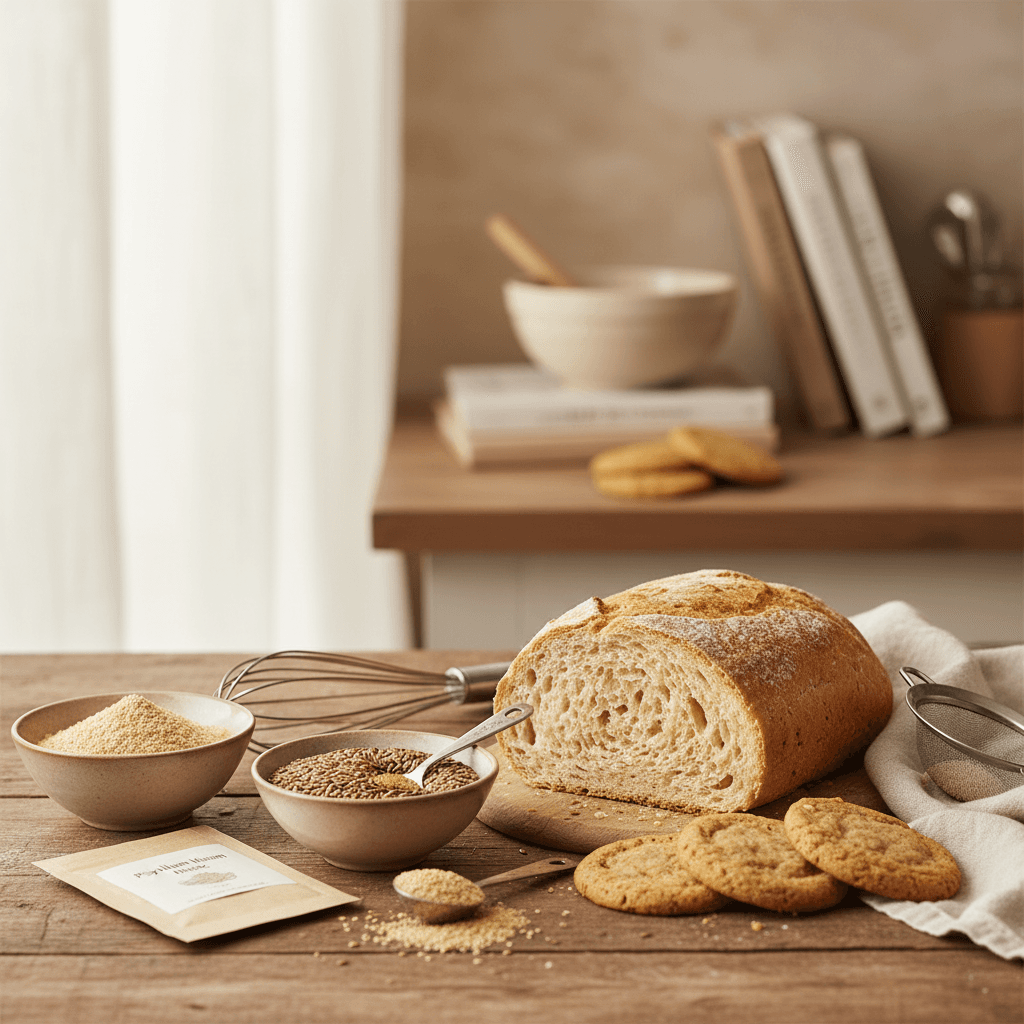
Psyllium husk and flaxseed are two of the most popular binders in gluten-free and vegan baking, but they work in fundamentally different ways and produce very different results. Here's a detailed breakdown of when to reach for each one so you stop guessing and start getting consistent bakes.
Key takeaways
- Psyllium husk creates a stretchy, elastic gel that mimics gluten structure, making it the better choice for bread and anything that needs rise and chew.
- Ground flaxseed (flax eggs) works best as an egg replacer in cookies, muffins, and quick breads where binding matters more than structure.
- Psyllium husk absorbs 10-15 times its weight in water; flaxseed absorbs about 3-4 times — so they require very different hydration adjustments.
- The two can be combined in the same recipe for both structure and binding, especially in gluten-free sandwich bread.
- Whole psyllium husk and psyllium husk powder are not interchangeable — powder is roughly twice as concentrated.
- Flaxseed adds a mild nutty flavor and visible specks; psyllium husk is essentially flavorless and invisible when used correctly.
How psyllium husk and flaxseed actually work in baking
Both psyllium husk and flaxseed form gels when mixed with water, but the type of gel they create is completely different — and that difference determines which baked goods they're suited for.
Psyllium husk is the outer coating of Plantago ovata seeds. When it absorbs water, it forms a viscous, stretchy mucilage that behaves a lot like a gluten network. It traps gas from leaveners, holds dough together during shaping, and gives bread that characteristic chew. This is why nearly every serious gluten-free bread recipe calls for it.
Ground flaxseed (also called flax meal) contains soluble fiber and mucilage too, but its gel is softer, slippier, and less elastic. Mixed with water, it creates what bakers call a "flax egg" — a goopy mixture that binds ingredients together the way a real egg would. It's excellent at holding cookies and muffins together, but it doesn't provide the structural backbone that bread needs.
If you're new to gluten-free baking and trying to understand why structure matters so much, our guide on what gluten actually does in baking explains the seven jobs you need to replace.
Side-by-side comparison of psyllium husk and flaxseed
| Property | Psyllium husk | Ground flaxseed |
|---|---|---|
| Primary function | Structure and elasticity | Binding and moisture |
| Gel type | Stretchy, elastic mucilage | Soft, slippery mucilage |
| Water absorption | 10-15x its weight | 3-4x its weight |
| Flavor | Essentially none | Mild nutty flavor |
| Color impact | Can add slight purple tint (whole husk) | Adds brown specks |
| Best for | Bread, pizza dough, rolls, tortillas | Cookies, muffins, pancakes, quick breads |
| Typical amount | 1-3 tsp per cup of flour | 1 flax egg (1 tbsp + 3 tbsp water) per egg replaced |
| Vegan egg replacer? | Not typically used this way | Yes, a standard vegan egg sub |
| Nutritional bonus | High soluble fiber | Omega-3 fatty acids, fiber, lignans |
| Shelf life concern | Very stable | Goes rancid quickly; store in freezer |
If you're building your own homemade gluten-free flour blend, understanding these differences helps you choose the right binder for the job.
If you want a structured system for making these decisions across all your baking — not just binders, but flours, starches, leaveners, and hydration — the Confident Gluten-Free Baker Toolkit walks you through it step by step so you stop guessing and start getting consistent results.
When to use psyllium husk in baking
Psyllium husk is your go-to when a recipe needs structure, stretch, and rise. It's the closest thing to a gluten replacement we have in the gluten-free world.

Anthony's Organic Psyllium Husk Powder, 1.5 lb, Gluten Free, Non GMO, Finely Ground, Keto Friendly
Check price on Amazon →Gluten-free bread
This is where psyllium husk truly shines. It allows gluten-free bread dough to hold its shape, trap gas bubbles, and develop that slightly chewy crumb you'd expect from wheat bread. Without it, most gluten-free bread recipes produce a crumbly, dense loaf that stales within hours. If your bread is coming out dry and crumbly, adding or increasing psyllium husk is often the fix.
Pizza dough and flatbreads
Psyllium husk makes gluten-free pizza dough rollable and pliable. You can actually stretch it, shape it, and transfer it to a pizza stone without it falling apart. Flaxseed simply can't do this.
Rolls and buns
Any recipe where you need to shape dough by hand benefits from psyllium husk's elasticity. Dinner rolls, hamburger buns, and bagels all rely on it.
How much to use
For whole psyllium husk, start with 2-3 teaspoons per cup of gluten-free flour blend. For psyllium husk powder, use roughly half that amount — about 1 to 1.5 teaspoons per cup. The powder is much finer and absorbs water faster, so using the same amount as whole husk will give you a gummy, dense result.
Our pick is the Anthony's Organic Psyllium Husk Powder — it's finely ground and dissolves well. If you prefer whole husks for bread where you want more visible texture, Viva Naturals Organic Whole Psyllium Husk is a solid option.
When to use flaxseed in baking
Ground flaxseed is your best friend when you need to replace eggs or add gentle binding without changing the texture of your bake.

64oz Organic Whole Ground Golden Flaxseed Meal Bob's Red Mill (4 Pounds Total)
Check price on Amazon →Flax eggs for vegan and egg-free baking
The classic flax egg — 1 tablespoon of ground flaxseed mixed with 3 tablespoons of water, rested for 5 minutes — replaces one egg in most recipes. It works beautifully in cookies, muffins, pancakes, and quick breads. For more on egg substitution strategies, check out our vegan egg substitutes guide.
Cookies and bars
Flax eggs hold cookie dough together without making it chewy or elastic. This is exactly what you want — cookies should be tender, not bready. The slight nutty flavor actually complements oatmeal cookies, chocolate chip cookies, and granola bars.
Muffins and quick breads
In muffins and banana bread, flax eggs provide enough binding to keep the crumb together while letting the bake stay soft and moist. They also add a small amount of healthy fat, which helps with moisture retention.
How much to use
One flax egg per egg replaced is the standard. For recipes calling for 3+ eggs, flax eggs start to struggle — the bake may feel heavy or dense. In those cases, consider splitting between flax eggs and another egg replacer like aquafaba for lift.
We recommend Bob's Red Mill Golden Flaxseed Meal for baking. Golden flax has a milder flavor than brown flax and blends in more easily with lighter-colored batters. Store it in the freezer — ground flaxseed goes rancid surprisingly fast at room temperature.
Can you use psyllium husk and flaxseed together?
Yes, and in fact this is one of the best-kept secrets in gluten-free bread baking. Using both gives you the structural elasticity of psyllium husk and the binding and moisture retention of flaxseed.
A common approach for a gluten-free sandwich bread: use 2 teaspoons of psyllium husk powder for structure, plus one flax egg for binding and added moisture. The psyllium builds the gluten-like network, while the flax egg helps the crumb stay soft and holds everything together as it cools.
This combination is especially useful if your bread is getting stale too quickly — the flaxseed's fat content and moisture-trapping ability extends freshness by a day or so.
Common mistakes when using psyllium husk or flaxseed
These errors are common, and they're almost always the reason a recipe fails.
Not adjusting hydration for psyllium husk
Psyllium husk absorbs an enormous amount of water. If you add it to a recipe without increasing the liquid, your dough will be impossibly stiff and your bread will come out dense and dry. A good rule of thumb: for every teaspoon of psyllium husk powder you add, increase liquid by about 2 tablespoons.
Confusing whole husk with powder
Psyllium husk powder is roughly twice as absorbent as whole husks by volume. Swapping one for the other at the same measurement is a recipe for disaster. Always check which form your recipe calls for.
Using old or rancid flaxseed
Ground flaxseed oxidizes quickly. If it smells bitter or painty, it's rancid and will ruin the flavor of your bake. Buy in small quantities and store in the freezer. Whole flaxseeds last longer, but they need to be ground before use — your body (and your batter) can't break down the whole seed.
Expecting flaxseed to work in bread
Flax eggs are great binders, but they don't create structure. Using flaxseed as your only binder in a yeasted bread recipe will give you a loaf that rises and then collapses, because there's nothing holding the gas bubbles in place. Bread needs psyllium husk, xanthan gum, or another structural binder.
Skipping the rest time
Both psyllium husk and flaxseed need time to hydrate. Psyllium husk gel should rest for at least 5 minutes (10 is better) before mixing into dough. Flax eggs need a full 5 minutes to thicken. Rushing this step means the gel hasn't fully formed, and your binder won't do its job.
Best brands for baking
Not all psyllium husk and flaxseed products are created equal. Some are too coarse, some have off flavors, and some aren't fine enough to blend into batter smoothly.
Psyllium husk picks
- Anthony's Organic Psyllium Husk Powder — Our top pick. Finely ground, consistent, and affordable in bulk. Works perfectly in bread and pizza dough.
- NOW Psyllium Husk Powder — Widely available and reliable. Slightly coarser grind than Anthony's but still works well.
Ground flaxseed picks
- Bob's Red Mill Golden Flaxseed Meal — Mild flavor, fine grind, and widely available. The golden variety blends into light batters better than brown.
- Spectrum Essentials Organic Ground Flaxseed — Very finely milled, which makes a smoother flax egg. Good option if you want minimal visible specks.
Quick reference: which binder for which bake
| Baked good | Best binder | Why |
|---|---|---|
| Sandwich bread | Psyllium husk (or both) | Needs elastic structure to hold rise |
| Pizza dough | Psyllium husk | Needs stretch and shapeability |
| Dinner rolls | Psyllium husk | Must hold shape during proofing |
| Tortillas/flatbreads | Psyllium husk | Needs pliability without cracking |
| Cookies | Flaxseed | Binding without chewiness |
| Muffins | Flaxseed | Gentle binding, moist crumb |
| Banana bread | Flaxseed | Soft binding, complements flavor |
| Pancakes/waffles | Flaxseed | Light binding, no structural need |
| Cake | Neither (use xanthan gum or eggs) | Cakes need lift more than binding |
| Pie crust | Psyllium husk (small amount) | Helps dough roll without crumbling |
For a deeper dive into building recipes that work, our guide on how to convert any recipe to gluten-free covers binder selection alongside flour blends and hydration adjustments.
Frequently asked questions
Can I substitute flaxseed for psyllium husk in gluten-free bread?
Not as a direct swap. Flaxseed doesn't provide the elastic, stretchy structure that bread needs to hold its rise. If a bread recipe calls for psyllium husk and you only have flaxseed, the loaf will likely collapse or come out very dense. You'd need to add xanthan gum alongside the flaxseed to compensate for the missing structure.
How much psyllium husk powder equals one flax egg?
They aren't really interchangeable in this way because they serve different purposes. However, if you need a binding substitute in a cookie or muffin recipe, 1 teaspoon of psyllium husk powder mixed with 2-3 tablespoons of water can provide similar binding to a flax egg. Just know it will absorb more liquid from your batter, so you may need to add a splash more milk or water.
Does psyllium husk make gluten-free bread gummy?
It can if you use too much or use powder when the recipe calls for whole husk. Start with the amount specified in your recipe and don't increase it hoping for more structure — too much psyllium creates a gummy, dense crumb. If your bread is coming out with gummy centers, the issue is more likely underbaking or too much moisture rather than the psyllium itself.
Is chia seed a good alternative to both psyllium husk and flaxseed?
Chia seeds form a gel similar to flaxseed and work well as an egg replacer in cookies and muffins. However, like flaxseed, chia doesn't provide the elastic structure that psyllium husk does. Think of chia as a flaxseed alternative, not a psyllium husk alternative. Chia eggs (1 tablespoon chia seeds + 3 tablespoons water) are a solid option if you dislike the flavor of flax.
Do I need to use psyllium husk if my flour blend already contains xanthan gum?
It depends on what you're baking. For cookies, muffins, and cakes, xanthan gum in your flour blend is usually enough. For bread, many bakers find that adding psyllium husk on top of xanthan gum produces a significantly better crumb and rise. The two work differently — xanthan gum provides viscosity and binding, while psyllium husk provides elasticity and water management. They complement each other rather than duplicate each other.

Written by
Co-founder, BakingSubs
Co-founder of BakingSubs, where he turns the science of ingredient substitutions into tested, reliable guidance for home bakers.
Related Posts
Bake with Confidence
See all
Confident Gluten-Free Baker Toolkit
The science-based system that replaces gluten's seven invisible jobs so your baking turns out soft, fluffy, and foolproof — every time.

Gluten-Free Recipe Vault
Instant access to our complete library of proven gluten-free recipes — no waiting, no guesswork, just results that work tonight.

Fix Your Gluten-Free Bread
Learn the 3-step formula to make bread rise and stay soft, discover why your loaves collapse, and get a tested sandwich bread recipe that actually works.