

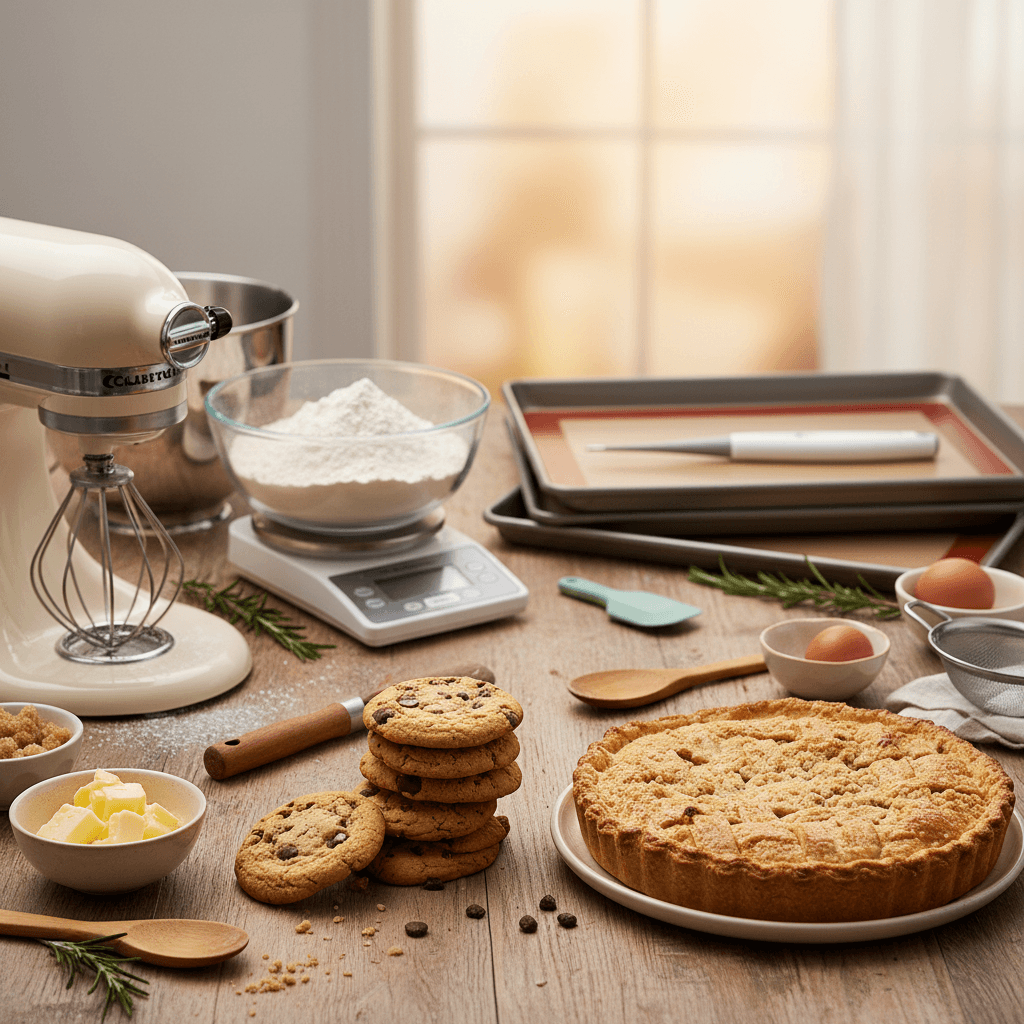
Building a well-equipped baking kitchen doesn't require spending thousands of dollars upfront, but knowing where to invest and where to save makes a real difference in your results. This guide breaks down the essential baking equipment across three price tiers so you can make smart decisions no matter your budget.
Key takeaways
- A reliable digital scale is the single most important piece of baking equipment you can buy, and a great one costs under $15.
- Budget mixing bowls and measuring tools perform nearly as well as premium versions for most home bakers.
- Stand mixers are where spending more delivers the biggest performance leap, especially for gluten-free doughs that need extended mixing times.
- Oven thermometers and instant-read thermometers are inexpensive upgrades that dramatically improve consistency.
- Silicone baking mats and quality sheet pans will outlast cheap alternatives by years, making them better long-term values.
Why equipment matters more in gluten-free baking
Gluten-free baking is less forgiving than conventional baking. Without gluten's structural network, precision becomes critical. An inaccurate oven, inconsistent measurements, or a weak mixer can be the difference between a beautifully risen loaf and a gummy-centered disappointment. That's why investing in the right tools, even at the budget level, pays off so quickly.
The good news is that you don't need to buy everything at once. We recommend starting with the essentials (a scale, good sheet pans, and an oven thermometer) and building from there as your baking ambitions grow. If you want a structured approach to stocking your gluten-free kitchen, our Confident Gluten-Free Baker Toolkit walks you through exactly what you need and in what order.
Best digital kitchen scales: budget to professional
A digital scale is the single best investment you can make as a baker. Measuring flour by weight instead of volume eliminates the biggest source of inconsistency in baking, and it's especially critical for gluten-free recipes where the ratio of starches to whole-grain flours matters enormously.
Budget tier ($10 to $15)
The OXO Good Grips 5 lb Food Scale (around $14) is our pick for the best budget scale. It reads in 1-gram increments, has a pull-out display so large bowls don't block the screen, and runs on standard batteries. For basic home baking, cakes, cookies, muffins, and quick breads, this is genuinely all you need. It handles up to 5 pounds, which covers most single-batch recipes.
The Etekcity Kitchen Scale (around $10) is another solid option if you want to spend even less. It's accurate and responsive, though the display is easier to block with wide bowls. For typical recipe quantities, either one is all most home bakers need.
Mid-range tier ($25 to $50)
The OXO Good Grips 11 lb Precision Scale (around $40) is our best overall value pick in this category. It offers 0.1-gram precision at low weights (under 5 lb) and handles up to 11 pounds, which matters when you're scaling up recipes or weighing large batches of bread flour. The backlit display and easy-clean surface are genuinely useful features, not gimmicks.
The Escali Primo P115C (around $28) is a popular choice with a simple interface and 11-pound capacity. It reads in 1-gram increments (not 0.1g), which is fine for most baking but slightly less precise for small quantities of ingredients like baking powder or xanthan gum.
Professional tier ($50 to $100+)
The My Weigh KD-8000 (around $50) is the scale serious bakers obsess over, and for good reason. It has baker's percentage mode built in, meaning you can set your flour weight as 100% and it automatically calculates percentages for every subsequent ingredient. For anyone developing or adapting gluten-free recipes, this feature alone is worth the price. It also reads in 1-gram increments up to 17.6 pounds and plugs into the wall so you never deal with dead batteries mid-recipe.
The Ohaus Scout STX (around $150+) is a lab-grade scale that reads to 0.01 grams. It's overkill for most home bakers but invaluable if you're developing recipes professionally or working with very small quantities of leaveners and binders.
When the budget option is good enough
If you bake once or twice a week and follow existing recipes without scaling, a $14 scale does the job beautifully. You only need to step up when you're regularly doubling or tripling batches, developing your own recipes, or working with ingredients where a tenth of a gram matters.
| Scale | Price | Capacity | Precision | Best for |
|---|---|---|---|---|
| OXO Good Grips 5 lb | ~$14 | 5 lb | 1 g | Everyday home baking |
| OXO Good Grips 11 lb | ~$40 | 11 lb | 0.1 g (under 5 lb) | Best overall value |
| Escali Primo P115C | ~$28 | 11 lb | 1 g | Simple, reliable mid-range |
| My Weigh KD-8000 | ~$50 | 17.6 lb | 1 g | Recipe development, baker's math |
| Ohaus Scout STX | ~$150+ | Varies | 0.01 g | Professional/lab precision |
Best stand mixers for baking: budget to professional
Stand mixers are where the gap between budget and premium is most dramatic. Gluten-free bread doughs in particular need sustained mixing at medium-high speed to properly hydrate starches and activate binders like xanthan gum or guar gum, and a weak motor will struggle or overheat.
Budget tier ($50 to $150)
The Hamilton Beach Eclectrics Stand Mixer (around $90) is a reasonable entry point. It has a 4.5-quart bowl and 400-watt motor, which handles cookie doughs and cake batters without issue. For thick gluten-free bread doughs, you'll need to mix in shorter bursts to avoid overheating the motor.
Hand mixers are also worth mentioning here. The KitchenAid 5-Speed Hand Mixer (around $35) is capable enough for cake batters, whipping egg whites, and mixing muffin batters. It won't handle stiff doughs, but for a beginner building their toolkit, it's a smart starting point.
Mid-range tier ($250 to $400)
The KitchenAid Artisan 5-Quart Stand Mixer (around $350) is the best overall value in stand mixers, period. Its 325-watt motor handles everything from delicate meringues to dense cookie doughs. The planetary mixing action is genuinely superior to cheaper mixers with fixed beaters, meaning ingredients incorporate more evenly with less scraping. The attachment ecosystem (pasta rollers, grain mills, food processors) means this machine grows with you.
For gluten-free bakers, the Artisan handles most bread doughs well, though very large batches of stiff dough can make it walk across the counter. If you're regularly making bread, consider the KitchenAid Professional 600 Series (around $400) with its 575-watt motor and 6-quart bowl.
Professional tier ($400 to $800+)
The KitchenAid Pro Line 7-Quart (around $550) is built for serious bakers who mix large batches regularly. Its 1.3 HP motor doesn't flinch at double batches of bread dough, and the bowl-lift design provides more stability than the tilt-head Artisan.
The Ankarsrum Original (around $700) takes a completely different approach with its rotating bowl and roller/scraper system. It excels at bread doughs specifically because the gentle stretching action mimics hand kneading. For dedicated bread bakers, especially those working with gluten-free sourdough or high-hydration doughs, it's in a class of its own.
When the budget option is good enough
If you primarily make cakes, cookies, and quick breads, a hand mixer or entry-level stand mixer handles those batters just fine. The moment you start making bread regularly, especially gluten-free bread that needs 5-8 minutes of sustained mixing, that's when upgrading to at least a mid-range stand mixer becomes genuinely important.
Best sheet pans and baking pans: budget to professional
Sheet pans are the workhorses of any baking kitchen. They affect heat distribution, browning, and how evenly your cookies, biscuits, and sheet cakes bake. Cheap pans warp in the oven, creating hot spots that lead to uneven results.
Budget tier ($8 to $15 per pan)
The Nordic Ware Natural Aluminum Half Sheet Pan (around $12) is our best overall value pick across all price tiers. These are the same pans used in commercial bakeries. They're made from uncoated natural aluminum, which conducts heat evenly and won't warp at high temperatures. They develop a patina over time that actually improves their nonstick properties.
Nordic Ware half sheets hold their own against pans costing two or three times as much. They're not pretty, but they're dependable. Pair them with a Silpat silicone baking mat (around $15) or parchment paper and you have a setup that rivals anything in a professional kitchen.
Mid-range tier ($20 to $40 per pan)
The USA Pan Bakeware Half Sheet Pan (around $20) adds a corrugated surface and silicone coating that promotes airflow and easier release. The corrugation is meant to help with items like cookies where you want even air circulation underneath. These pans are also dishwasher safe, which the uncoated Nordic Ware technically isn't.
Professional tier ($40 to $80+ per pan)
The Vollrath Wear-Ever Sheet Pans (around $20-25 each, but typically bought in sets) are heavy-gauge commercial pans that will literally last a lifetime. They're thicker than Nordic Ware, which means even less warping and more consistent heat distribution. The difference is subtle but real if you're baking at high volumes.
For specialty pans, the Fat Daddio's Anodized Aluminum Cake Pans (around $15-25 each) are the gold standard. The anodized surface heats evenly and releases cleanly, which matters enormously for delicate gluten-free cakes that can stick and tear more easily than wheat-based ones.
When the budget option is good enough
Honestly? For sheet pans, the budget option is almost always good enough. A $12 Nordic Ware half sheet performs at a professional level. Save your money here and invest it in your mixer or scale.
Best oven thermometers and instant-read thermometers
Most home ovens are off by 25-50 degrees from what the dial says. For gluten-free baking, where the difference between 350 and 375 degrees can mean the difference between a perfectly baked loaf and one with a gummy center, an oven thermometer is non-negotiable.
Budget tier ($5 to $15)
The Rubbermaid Stainless Steel Oven Thermometer (around $7) hangs from your oven rack and gives you an accurate reading. It's not fancy, but it works. Pair it with the ThermoPro TP03 Digital Instant-Read Thermometer (around $12) for checking internal bread temperatures, and you've spent under $20 for tools that will transform your baking consistency.
Mid-range tier ($20 to $60)
The ThermoWorks DOT (around $43) is an oven probe thermometer that sits outside your oven with a probe inside, alerting you when your target temperature is reached. It's brilliant for bread baking where you want to pull the loaf at exactly 205-210 degrees internal temperature.
Professional tier ($70 to $100+)
The ThermoWorks Classic Thermapen (around $95 list) gives a full reading in 1-2 seconds with ±0.7°F accuracy, and each one ships with a NIST-traceable calibration certificate. Is it worth eight times the price of a $12 ThermoPro for occasional baking? No. But if you bake frequently and value speed and precision, the Classic Thermapen earns its price.
When the budget option is good enough
For oven thermometers, the budget option is always good enough. A $7 oven thermometer gives you the same information as a $50 one. For instant-read thermometers, the budget option works well for occasional use, but frequent bakers will appreciate the speed and durability of the Thermapen.
| Thermometer | Price | Type | Speed | Best for |
|---|---|---|---|---|
| Rubbermaid Oven Thermometer | ~$7 | Oven | N/A | Every baker (essential) |
| ThermoPro TP03 | ~$12 | Instant-read | 3-5 sec | Budget instant-read |
| ThermoWorks DOT | ~$43 | Probe/alarm | Continuous | Bread baking, leave-in monitoring |
| ThermoWorks Classic Thermapen | ~$95 | Instant-read | 1-2 sec | Professional precision |
Best mixing bowls and measuring tools
Mixing bowls and measuring tools are where you can safely spend less without sacrificing results. The performance gap between a $15 set of mixing bowls and a $60 set is minimal in actual baking scenarios.
Budget tier ($10 to $25)
A set of Pyrex Glass Mixing Bowls (around $15 for a 3-piece set) is a classic choice. Glass is nonreactive, microwave safe, and lets you see your batter from the side. For measuring cups, the KitchenAid Measuring Cups and Spoons Set (around $12) is sturdy and accurate.
That said, if you're using a digital scale (and you should be), you'll reach for measuring cups far less often. Most experienced gluten-free bakers measure everything by weight.
Mid-range tier ($25 to $60)
The Vollrath Stainless Steel Mixing Bowls (around $30-45 for a set) are lightweight, nearly indestructible, and nest for easy storage. Stainless steel is better than glass for whipping cream or egg whites because the metal stays cold longer.
Professional tier ($60+)
The Mason Cash Cane Mixing Bowls (around $30-50 each) are heavy ceramic bowls that stay put on the counter during vigorous mixing. They're beautiful and functional, but honestly, a set of Vollrath stainless bowls does the same job for less money.
When the budget option is good enough
Almost always. Mixing bowls are mixing bowls. Spend your money on a good scale and quality pans instead.
How to prioritize your baking equipment purchases
If you're building a baking kitchen from scratch, here's the order we recommend purchasing equipment, based on what delivers the biggest improvement to your results per dollar spent:
- Digital kitchen scale ($14) — the single biggest upgrade you can make
- Oven thermometer ($7) — fixes the hidden problem most bakers don't know they have
- Quality half sheet pans ($24 for two) — even baking, no warping
- Silicone baking mats or parchment paper ($15) — consistent release, easy cleanup
- Instant-read thermometer ($12) — know when bread and cakes are actually done
- Stand mixer ($90-350) — essential for bread, very helpful for everything else
For under $75, you can equip yourself with tools that perform at a near-professional level. The stand mixer is the big-ticket item, and we'd recommend saving for a KitchenAid Artisan rather than buying a cheap stand mixer you'll outgrow in a year.
If you're shopping for gluten-free baking supplies alongside your equipment, our guide to the best gluten-free baking products on Amazon covers everything from flours to mixes that pair well with a properly equipped kitchen.
Frequently asked questions
What is the most important piece of baking equipment for beginners?
A digital kitchen scale is the most important piece of baking equipment for beginners. Measuring ingredients by weight instead of volume eliminates the biggest source of recipe failures, especially in gluten-free baking where flour density varies widely between brands. A reliable scale costs under $15 and will improve every recipe you make.
Is a KitchenAid stand mixer worth the money for gluten-free baking?
Yes, a KitchenAid stand mixer is worth the investment if you bake bread regularly. Gluten-free bread doughs need 5-8 minutes of sustained mixing to properly hydrate starches and activate binders, which is exhausting by hand and risky with a cheap mixer that might overheat. For cakes and cookies, a hand mixer works fine, but for bread the KitchenAid Artisan is our recommended best value.
Do expensive baking pans make a difference?
For sheet pans, expensive options offer minimal improvement over budget picks like the Nordic Ware Natural Aluminum Half Sheet Pan. For specialty pans like cake pans, higher-quality options from brands like Fat Daddio's do make a noticeable difference in even heating and clean release, which matters more for delicate gluten-free cakes that tend to stick.
What baking equipment should I buy first on a tight budget?
Start with a digital scale ($14), an oven thermometer ($7), and two Nordic Ware half sheet pans ($24). These three purchases, totaling under $50, will improve your baking results more than any single expensive gadget. Add an instant-read thermometer ($12) next, then save for a quality stand mixer when your budget allows.
Do I need a proofing box for gluten-free bread?
A dedicated proofing box isn't essential but can significantly improve consistency, especially in cold kitchens. Gluten-free doughs are more sensitive to temperature fluctuations than wheat doughs. You can improvise with your oven's light or a warm water bath, but if you bake bread frequently, a proofing box is a worthwhile mid-range investment.

Written by
Co-founder, BakingSubs
Co-founder of BakingSubs, where he turns the science of ingredient substitutions into tested, reliable guidance for home bakers.
Related Posts
Bake with Confidence
See all
Confident Gluten-Free Baker Toolkit
The science-based system that replaces gluten's seven invisible jobs so your baking turns out soft, fluffy, and foolproof — every time.

Gluten-Free Recipe Vault
Instant access to our complete library of proven gluten-free recipes — no waiting, no guesswork, just results that work tonight.

Fix Your Gluten-Free Bread
Learn the 3-step formula to make bread rise and stay soft, discover why your loaves collapse, and get a tested sandwich bread recipe that actually works.