

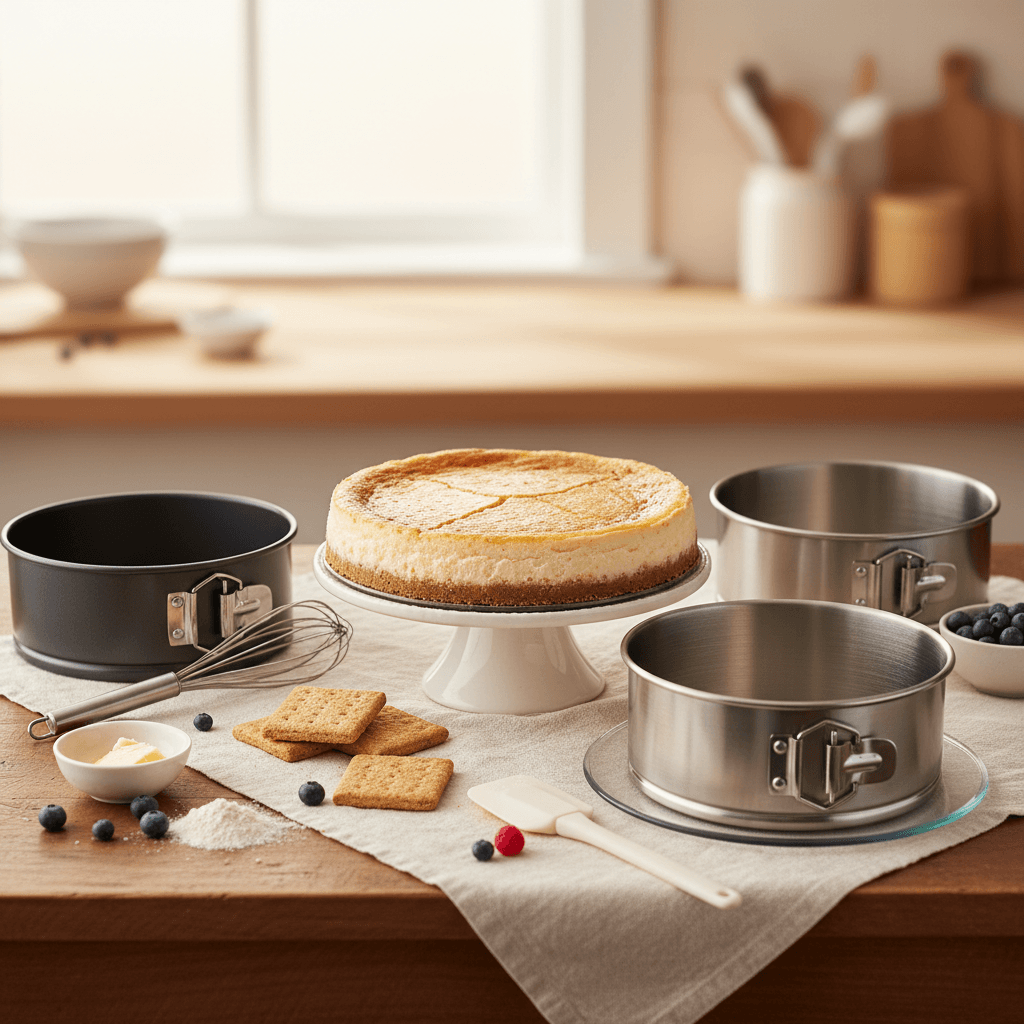
A good springform pan is the difference between a perfect gluten-free cheesecake and one that cracks, sticks, or falls apart when you try to unmold it. Gluten-free crusts are more fragile and crumbly than their wheat-based counterparts, which makes your pan choice even more critical. Here are our top 7 picks across every budget, plus what to look for when you're baking without gluten.
Key takeaways
- Gluten-free cheesecake crusts lack the binding power of gluten, so a tight-sealing springform pan with a flat, non-warped base is essential to prevent crumbling and leaking.
- Nonstick coating matters more for gluten-free baking because GF crusts stick more aggressively than traditional graham cracker crusts.
- A pan with a removable glass or flat metal base makes it easier to slide fragile GF cheesecakes onto a serving plate without breakage.
- Leakproof designs prevent water bath disasters, which are especially important because gluten-free cheesecakes benefit from gentle, even baking to avoid cracks.
- Budget-friendly options under $15 can work well, but investing in a mid-range pan ($20-$35) often pays for itself in fewer failed bakes.
- Size matters: 9-inch pans are the standard for most cheesecake recipes, but 10-inch pans work better for shallower New York-style cheesecakes.
Why gluten-free cheesecakes need a better springform pan
If you've ever watched a gluten-free cheesecake crust disintegrate the moment you released the springform latch, you know the frustration. Traditional cheesecake crusts made with graham crackers have a small amount of gluten helping them hold together. When you swap in gluten-free graham crackers, almond flour, or other GF alternatives, the crust becomes significantly more delicate.
This means your pan needs to do more of the structural work. A warped base creates uneven crust thickness that leads to thin spots cracking during unmolding. A loose seal lets butter from the crust leak out during baking, leaving you with a dry, crumbly mess. And poor nonstick coating means you'll tear the crust trying to separate it from the pan walls.
Gluten-free cheesecake batters also tend to be slightly more sensitive to temperature changes. Many experienced GF bakers use a water bath to prevent cracking, which means your springform pan needs to be leakproof or compatible with a foil wrap that actually stays put. The pans below were chosen with all of these gluten-free-specific challenges in mind.
If you're working on perfecting your gluten-free baking overall, the Confident Gluten-Free Baker Toolkit covers the science behind why GF batters and doughs behave differently and how to adapt any recipe with confidence.
Our 7 best springform pan picks for cheesecake
We evaluated these pans based on seal quality, nonstick performance, base flatness, durability, and how well they handle the specific demands of gluten-free crusts. Here's the full comparison at a glance:
| Pan | Size | Key feature | Price range | Best for |
|---|---|---|---|---|
| Hiware 9-Inch Non-Stick Springform Pan | 9" | Leakproof seal | $12-$15 | Best budget pick |
| Fat Daddio's ProSeries Anodized Aluminum | 9" | Commercial-grade construction | $18-$22 | Best overall value |
| USA Pan Bakeware Springform Pan | 9" | Americoat nonstick | $22-$28 | Best nonstick for GF crusts |
| Nordic Ware Leakproof Springform Pan | 9" | Silicone gasket seal | $20-$25 | Best for water baths |
| Zenker Tin-Plated Springform Pan | 9" | German engineering, glass base option | $25-$30 | Best for presentation |
| Wilton Excelle Elite Springform Pan | 9" | Heavy-gauge steel, extra-wide latch | $15-$20 | Best mid-range all-rounder |
| Frieling Glass Bottom Springform Pan | 9" | Tempered glass base | $35-$45 | Best premium pick |
1. Hiware 9-inch non-stick springform pan (best budget pick)
The Hiware 9-Inch Non-Stick Springform Pan is an excellent entry point if you're new to cheesecake baking or don't want to invest heavily upfront. It features a leakproof flat base and a sturdy latch that creates a solid seal.
Pros:
- Extremely affordable at under $15
- Flat base with minimal warping out of the box
- Decent nonstick coating that handles GF almond flour crusts well
- Leakproof design works for water baths with minimal fuss
Cons:
- Nonstick coating may degrade after 50+ uses
- Slightly thinner gauge steel than premium options
- Latch mechanism isn't as smooth as higher-end pans
For the price, this pan punches well above its weight. If you're baking cheesecakes a few times a year, it's all you need.
2. Fat Daddio's ProSeries anodized aluminum (best overall value)
The Fat Daddio's ProSeries 9-Inch Springform Pan is our best overall value pick. The anodized aluminum construction heats evenly, which is critical for gluten-free cheesecakes that can develop gummy centers with uneven baking.
Pros:
- Commercial-grade anodized aluminum distributes heat beautifully
- No chemical nonstick coating (the anodized surface is naturally stick-resistant)
- Perfectly flat base that doesn't warp over time
- Tight seal with minimal leaking
- Trusted by professional bakeries
Cons:
- Not technically nonstick, so you'll still want to grease and line with parchment
- Silver color makes it harder to judge browning visually
- Requires hand washing
If you're serious about avoiding gummy centers in your gluten-free bakes, the even heat distribution alone makes this worth the upgrade from a budget pan.
3. USA Pan Bakeware springform pan (best nonstick for GF crusts)
The USA Pan Bakeware Springform Pan features their proprietary Americoat nonstick coating, which is one of the best commercial-grade nonstick surfaces available. For gluten-free crusts that love to stick, this is a game-changer.
Pros:
- Americoat nonstick is silicone-based, PTFE- and BPA-free
- GF crusts release cleanly without excessive greasing
- Corrugated surface promotes airflow for even baking
- Heavy-gauge aluminized steel resists warping
- Made in the USA with a limited lifetime warranty
Cons:
- Corrugated sides leave a textured pattern on the cheesecake exterior
- Slightly more expensive than basic options
- The tight seal can be stiff to open initially
If your biggest frustration is GF crusts sticking to the pan walls, this is the pick to solve that problem permanently.
4. Nordic Ware leakproof springform pan (best for water baths)
The Nordic Ware Leakproof Springform Pan was designed specifically for water bath baking, with a silicone gasket built into the base that creates a watertight seal. No more wrapping the outside in foil and praying.
Pros:
- Built-in silicone gasket eliminates water bath leaking
- Heavy cast aluminum for excellent heat distribution
- No need for foil wrapping, saving time and frustration
- Sturdy latch with clean release
Cons:
- Silicone gasket needs to be checked periodically for wear
- Heavier than standard springform pans
- Slightly smaller interior diameter due to gasket thickness
Water baths are one of the best ways to get a crack-free gluten-free cheesecake, and this pan makes the process foolproof.
5. Zenker tin-plated springform pan (best for presentation)
The Zenker Tin-Plated Springform Pan is a German-made classic that comes with a flat metal base and an optional glass base insert. The glass base is a standout feature for gluten-free bakers because you can serve the cheesecake directly on it without trying to slide a fragile GF crust onto a separate plate.
Pros:
- Glass base doubles as a serving plate, protecting delicate GF crusts
- German engineering with a precise, tight-fitting latch
- Tin-plated steel is durable and conducts heat well
- Elegant presentation without transferring the cheesecake
Cons:
- Tin plating can rust if not dried thoroughly after washing
- Not inherently nonstick, so greasing and parchment are essential
- Glass base is heavier and not compatible with all oven racks
If you're selling cheesecakes through a home bakery or bringing them to events, the glass base presentation is hard to beat.
6. Wilton Excelle Elite springform pan (best mid-range all-rounder)
The Wilton Excelle Elite Springform Pan hits a sweet spot between affordability and quality. The extra-wide latch makes it easy to open without jostling the cheesecake, and the heavy-gauge steel base stays flat bake after bake.
Pros:
- Extra-wide latch reduces the risk of bumping or cracking during release
- Heavy-gauge steel resists warping
- Good nonstick coating at a reasonable price
- Widely available and easy to replace if needed
Cons:
- Nonstick coating isn't as durable as USA Pan's Americoat
- Seal is good but not truly leakproof for water baths
- Can discolor over time with heavy use
This is a reliable workhorse pan. If you want something better than budget without going premium, the Excelle Elite delivers.
7. Frieling glass bottom springform pan (best premium pick)
The Frieling Glass Bottom Springform Pan is the gold standard for serious cheesecake bakers. The tempered glass base lets you see the bottom of your crust during baking and serves as an elegant presentation surface.
Pros:
- Tempered glass base is oven-safe, scratch-resistant, and beautiful for serving
- Heavy-duty tinned steel ring with an exceptionally tight seal
- No need to transfer the cheesecake, protecting fragile GF crusts
- German-made with outstanding build quality
- Glass base won't react with acidic ingredients
Cons:
- Most expensive option on this list at $35-$45
- Glass base adds weight
- Requires careful handling to avoid thermal shock
- Hand wash only
If you bake cheesecakes regularly, whether for your family or as part of a farmers market lineup, this is the pan that will last for years and make every cheesecake look professional.
How to choose the right springform pan for gluten-free cheesecake
With seven solid options above, here's how to narrow it down based on your specific needs.
Seal quality and leakproofing
Gluten-free cheesecakes benefit enormously from water bath baking. The gentle, even heat prevents the cracking that GF batters are especially prone to. If you plan to use a water bath regularly, prioritize the Nordic Ware with its built-in gasket, or plan to wrap your pan tightly in heavy-duty aluminum foil.
Nonstick performance
Gluten-free crusts made with almond flour or crushed GF cookies tend to stick more than traditional crusts. A strong nonstick coating like USA Pan's Americoat can save you from heartbreak. Even with good nonstick, we always recommend lining the base with parchment and lightly greasing the sides.
Base flatness and material
A warped base creates thin spots in your crust that crack during unmolding. Heavier pans with thicker bases (like Fat Daddio's anodized aluminum) resist warping better over time. Glass bases from Frieling and Zenker eliminate warping entirely and add the bonus of serving directly from the pan.
Size considerations
Most gluten-free cheesecake recipes are written for 9-inch pans, which is the standard. If you're scaling recipes up for a home bakery, having both a 9-inch and a 10-inch pan gives you flexibility. Accurate measuring is key when scaling, so a reliable food scale is your best friend here.
Tips for getting the best results with your springform pan
Even the best pan won't save a cheesecake if your technique is off. Here are a few gluten-free-specific tips:
- Pre-bake your GF crust. Most gluten-free crusts need 8-10 minutes in the oven before adding the filling. This sets the structure and prevents a soggy bottom.
- Cool slowly. Turn off the oven and crack the door when the cheesecake is done. Let it cool gradually for at least an hour before moving to the fridge. GF cheesecakes crack more easily with sudden temperature changes.
- Run a thin knife around the edge before releasing. Even with great nonstick, this step prevents any stuck spots from tearing your fragile GF crust.
- Chill completely before unmolding. A minimum of 4 hours, ideally overnight. The filling and crust need to be fully set for a clean release.
- Use parchment on the base. Cut a circle of parchment for the bottom of the pan. This makes sliding the cheesecake off the base onto a serving plate much easier, especially with crumbly GF crusts.
If your gluten-free bakes are coming out dry and crumbly, the issue might not be your pan at all. It's worth checking your flour blend ratios and hydration levels.
Which springform pan should you buy?
Here's our quick recommendation based on your situation:
- On a tight budget: Go with the Hiware. It's under $15 and gets the job done for occasional baking.
- Best bang for your buck: The Fat Daddio's ProSeries is our top overall recommendation. Commercial quality at a home baker price.
- Sticky GF crusts driving you crazy: The USA Pan with Americoat nonstick will solve that problem.
- Water bath baker: The Nordic Ware leakproof pan eliminates the foil-wrapping hassle entirely.
- Selling cheesecakes or entertaining: The Frieling glass bottom pan makes every cheesecake look bakery-professional and protects fragile GF crusts during serving.
If you're building out a home bakery equipment list, we'd suggest starting with the Fat Daddio's and adding a Frieling later when presentation becomes a priority.
Frequently asked questions
Can I use a regular cake pan instead of a springform pan for cheesecake?
You can, but it's much harder to unmold the cheesecake cleanly, especially with a gluten-free crust. Springform pans let you release the sides without flipping the cake, which is critical for fragile GF crusts that would break apart during inversion. If you must use a regular pan, line it completely with parchment and use the overhang to lift the cheesecake out.
Do springform pans leak in a water bath?
Most springform pans will leak at least a little in a water bath. The Nordic Ware leakproof pan with its silicone gasket is the exception. For other pans, wrap the outside tightly with two layers of heavy-duty aluminum foil, pressing it up the sides. Some bakers also place the springform inside a slightly larger regular cake pan as an extra precaution.
What size springform pan is best for gluten-free cheesecake?
A 9-inch springform pan is the standard size that most cheesecake recipes are written for, including gluten-free versions. If you prefer a thinner, wider cheesecake (like a classic New York-style), a 10-inch pan works well. Just note that baking time will be shorter with a larger pan since the cheesecake will be shallower.
How do I prevent my gluten-free cheesecake crust from sticking to the springform pan?
Start by greasing the pan base and sides with butter or coconut oil, then line the base with a parchment circle. Pre-bake the crust for 8-10 minutes to set it before adding the filling. After the cheesecake has chilled completely, run a thin knife or offset spatula around the inside edge before releasing the latch. Using a pan with strong nonstick coating, like the USA Pan Americoat, also helps significantly.
Is it worth spending more on a premium springform pan?
If you bake cheesecakes more than a few times a year, yes. Premium pans like the Frieling and Fat Daddio's have better heat distribution (which helps prevent gummy centers), more durable construction that resists warping, and tighter seals. For occasional bakers, a budget option like the Hiware works perfectly well. The real cost of a cheap pan isn't the pan itself but the wasted ingredients from a failed bake.

Written by
Co-founder, BakingSubs
Co-founder of BakingSubs, where he turns the science of ingredient substitutions into tested, reliable guidance for home bakers.
Related Posts
Bake with Confidence
See all
Confident Gluten-Free Baker Toolkit
The science-based system that replaces gluten's seven invisible jobs so your baking turns out soft, fluffy, and foolproof — every time.

Gluten-Free Recipe Vault
Instant access to our complete library of proven gluten-free recipes — no waiting, no guesswork, just results that work tonight.

Fix Your Gluten-Free Bread
Learn the 3-step formula to make bread rise and stay soft, discover why your loaves collapse, and get a tested sandwich bread recipe that actually works.