

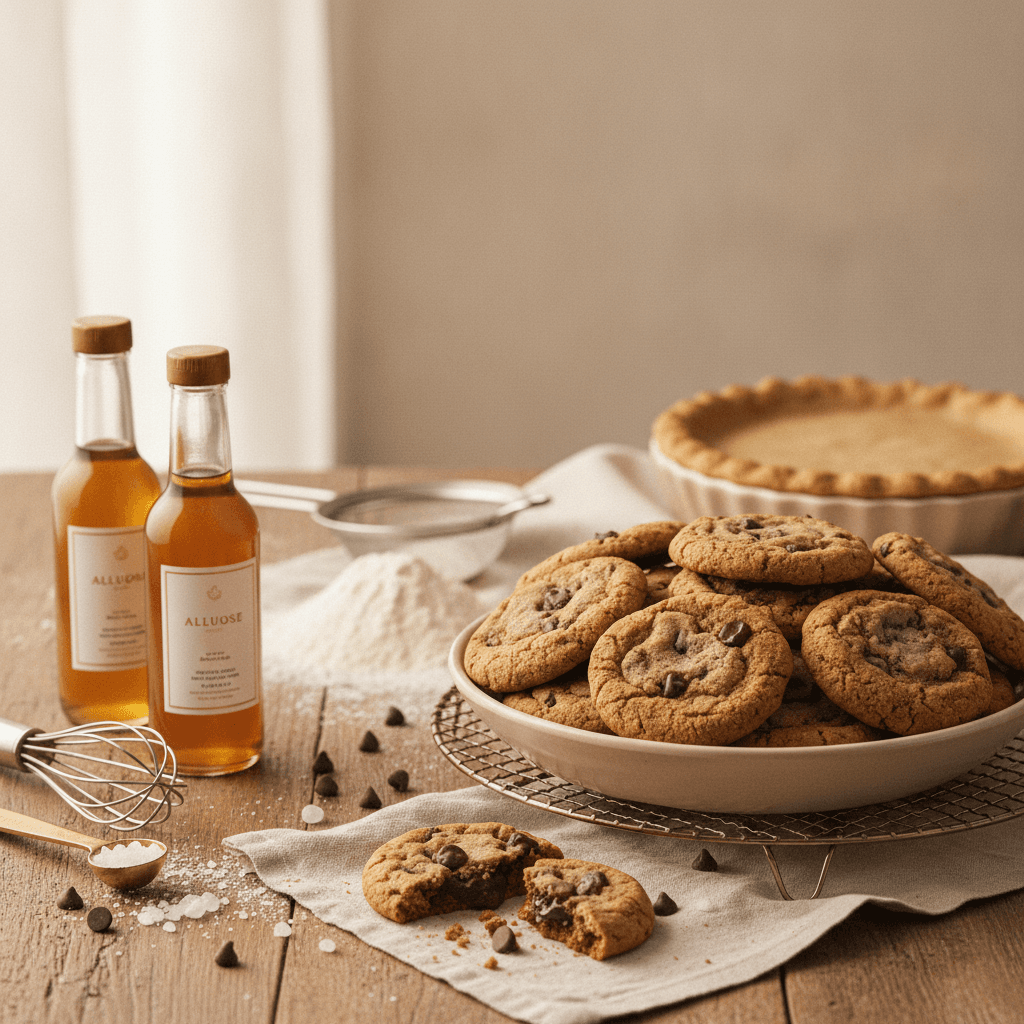
Wholesome Yum and Wholesome Sweeteners are the two strongest single-ingredient allulose syrups for baking. Both list 0 net carbs and 0 calories per serving. RxSugar wins on certifications because it is USDA Organic. But it is often hard to find. Below, we break down every brand using label data you can check. That way you can pick the right bottle for your pantry.
Key takeaways
- All three single-ingredient allulose syrups (Wholesome Sweeteners, Wholesome Yum, and RxSugar Organic Liquid Sugar) list 0 net carbs, 0 sugar, and 0 calories per serving.
- RxSugar is the only USDA Organic option. But the maker's site currently lists it as sold out.
- My Normal Keto is not pure allulose. It blends in monk fruit and stevia, which may affect flavor in delicate recipes.
- Pure allulose is about 70% as sweet as sugar. So Wholesome Sweeteners says 1⅓ cups of allulose sweetens like 1 cup of sugar.
- The FDA lets makers leave allulose out of "Total Sugars" and "Added Sugars" on labels. It still shows up under "Total Carbohydrates." So the total-carb number on a bottle will look higher than the net-carb number.
- Allulose browns and caramelizes like regular sugar. That makes it very useful for glazes, caramels, and syrups, where erythritol would turn back into crystals.
Allulose syrup comparison table
| Brand | Size | Ingredient(s) | Net carbs / serving | Calories / serving | Sugar alcohols | Key certifications | Price tier |
|---|---|---|---|---|---|---|---|
| Wholesome Sweeteners Allulose Liquid | 11.5 oz | Allulose (single) | 0 g | 0 | 0 g | Non-GMO Project, Keto Certified, Kosher, Gluten Free, Vegan | ~$0.52–$0.83/oz at retail |
| Wholesome Yum Liquid Allulose | 16.7 oz | Allulose (single) | 0 g | 0 | 0 g | Manufacturer claims: Non-GMO, Gluten Free, Zero Glycemic | Mid-range (~$0.84/oz direct) |
| RxSugar Organic Liquid Sugar | 16 fl oz | Organic Allulose (single) | 0 g | 0 | 0 g | USDA Organic, Non-GMO Project, Keto Certified, FODMAP Friendly, Kosher, Halal, Vegan | Mid-range |
| RxSugar Organic Pancake Syrup | Not specified | Organic Allulose, Organic Natural Flavor, Organic Caramel Color | 0 g | 0 | 0 g | USDA Organic, Non-GMO Project, Keto Certified, FODMAP Friendly, Gluten Free | Mid-range |
| My Normal Keto Thin Syrup | 17.10 oz | Allulose (99.52%), Monk Fruit, Stevia | 0 g (claimed) | 0 (claimed) | 0 g | Gluten Free, Keto (per listing) | Mid-range |
How we ranked these
We ranked these allulose syrups on five criteria you can check. They are listed from most to least weight:
- Ingredient purity: Single-ingredient (pure allulose) products rank higher than blends. Monk fruit and stevia are very strong sweeteners. Based on their chemistry, blends with them may leave an aftertaste that allulose alone avoids.
- Label nutrition: Net carbs, calories, and sugar alcohols per serving. These come from maker or retailer label data.
- Certifications: Outside certifications add trust you can verify. These include USDA Organic, Non-GMO Project Verified, Keto Certified, FODMAP Friendly, Kosher, and Halal.
- Format and size: Larger bottles give better value per ounce. Brands that list the exact bottle weight rank higher than those that don't.
- Price per ounce: We figured cost per ounce where we found a reliable store or maker price. We did not state prices as fixed facts, because they change from store to store.
We did not taste, bake with, or test any of these products. Every claim in this post comes from maker product pages, store listings, or FDA guidance.
Wholesome Sweeteners allulose liquid: best for wide availability
This is the easiest one to find in stores. Albertsons-family grocery chains carry it, such as Safeway, Jewel-Osco, Acme, and Tom Thumb. The ingredient list is a single word: allulose. It has no sugar alcohols, no stevia, no monk fruit, and no additives.
The label shows 0 calories, 0 g sugars, and 5 g total carbohydrates per serving. All 5 g are allulose, so net carbs come out to 0 g. This math works because of the FDA's October 2020 guidance. It lets makers leave allulose off the "Total Sugars" and "Added Sugars" lines. It also lets them count allulose at 0.4 calories per gram. Most carbs count at 4 calories per gram.
The 11.5 oz bottle is the smallest of the group. If you bake often, you'll run through it faster. Grocery listings we found ranged from $5.99 to $9.49 a bottle. That's about $0.52–$0.83/oz. So it can cost less per ounce than Wholesome Yum, even though the bottle is smaller.
Know that liquid allulose can form crystals in the bottle, as the store listings note. If that happens, set the bottle in warm water to turn it liquid again. Allulose does this at cooler temperatures. It's not a defect.
Wholesome Sweeteners says 1⅓ cups of allulose sweetens like 1 cup of table sugar. That's because allulose is about 70% as sweet. If you use the syrup that way, cut back other liquids a little to make up for it. Our detailed substitution guide covers how allulose changes baking behavior, including moisture, browning, and spread.

Wholesome Sweeteners 11.5-Ounce Allulose, Zero Calorie Sweetener, Keto Friendly, Non GMO, Non-Erythritol, Gluten Free & Vegan Liquid Sweetener, 1 Pack
Check price on Amazon →Wholesome Yum liquid allulose: best large single-ingredient bottle
Pick this one if you want a big bottle of pure allulose. Wholesome Yum's 16.7 oz bottle is 45% larger than Wholesome Sweeteners' 11.5 oz bottle. The per-ounce price is nearly the same, at about $0.84/oz from the maker's own site. The 2-pack drops that to about $0.81/oz. Still, grocery prices for Wholesome Sweeteners can be even lower.
Like Wholesome Sweeteners, this is a single-ingredient product: just allulose. The maker claims 0 calories, 0 net carbs, and no erythritol. It markets the syrup as non-GMO, gluten-free, keto friendly, and zero glycemic.
The maker sells it as a direct swap for corn syrup, agave, cane syrup, honey, or maple syrup. Maybe you use corn syrup in pecan pies or caramels and want a zero-net-carb option. Liquid allulose is a good fit, based on its chemistry. Allulose caramelizes and browns like table sugar (sucrose). Erythritol is different. It tends to turn back into crystals as it cools. That can leave a gritty texture in frostings and caramels.
It is also sold on Amazon, at Walmart, and at Target.
RxSugar Organic liquid sugar: best certifications
Choose RxSugar if certifications matter to your customers or your household. It has the longest certification list of any allulose syrup we found. The list includes USDA Organic, Non-GMO Project Verified, Keto Certified, FODMAP Friendly Certified, Grain-Free/Gluten-Free Certified, Kosher, Halal, and Vegan.
The single ingredient is non-GMO, USDA Organic allulose. The maker claims zero calories, zero net carbs, and zero sugar alcohols. It also clearly states there is no stevia, no monk fruit, and no erythritol.
RxSugar gives a 1:1 swap ratio for liquid sugar. That means 1 cup of RxSugar Organic Liquid Sugar replaces 1 cup of refined liquid sugar. This differs from the Wholesome Sweeteners advice of 1⅓ cups of allulose per cup of granulated sugar. The difference matters. Liquid sugar is sucrose that is already dissolved. So its sweetness per cup is not the same as dry sugar measured by volume.
The big downside is stock. The official RxSugar website listed the product as "Sold out" when we did our research. Other sellers, including Amazon and Kroger, list the 16 oz bottle, so stock varies by store. If you can find it in stock, it's a strong pick. If you can't, try Wholesome Sweeteners or Wholesome Yum. They give you the same single-ingredient purity without the organic label.
RxSugar Organic pancake syrup: best flavored option
Buy this one for pancakes and waffles, not for general baking. It is not a pure allulose product. The ingredient list includes organic allulose, organic natural flavor, and organic caramel color. That makes it a poor choice as an all-purpose baking syrup. But it's a solid pick if you want a sugar-free pancake or waffle syrup. Like the plain liquid sugar, RxSugar's site listed it as sold out when we did our research.
The label shows 0 net carbs. It has the same certifications as RxSugar's plain liquid sugar: USDA Organic, Non-GMO Project Verified, Keto Certified, FODMAP Friendly, and Gluten Free.
It has added flavor and color. So it will change the taste of anything you bake with it. It could work well in maple syrup swaps where you want that caramel-maple note. For neutral bakes, stick with a single-ingredient option. Think sugar cookies, vanilla cakes, or meringues.
My Normal Keto thin syrup: best 1:1 blend (but not pure allulose)
Pick this one if you want to swap cup for cup with sugar. My Normal Keto's 17.10 oz thin syrup is 99.52% allulose. It also has small amounts of monk fruit and stevia. The blend is made to match sugar's sweetness 1:1. Pure allulose can't do that alone, because it is only about 70% as sweet as sucrose.
The tradeoff is ingredient purity. Monk fruit extract and stevia leaf extract are both very strong sweeteners. Based on how they are known to taste, they can leave a lingering aftertaste in some uses. Whether that matters depends on the recipe. In a heavily spiced pumpkin bread, you probably won't notice. In a delicate vanilla panna cotta, you might.
The listing claims zero calories, zero net carbs, and zero sugar. It does not mention sugar alcohols. It's marketed as gluten free and keto friendly. But we could not confirm any outside certifications beyond the claims on the Amazon listing.
At 17.10 oz, this is the largest bottle in the roundup. It suits you if easy measuring comes first and you don't mind a blend. If ingredient purity matters more, look at Wholesome Yum. Its 16.7 oz bottle is nearly the same size, with a single ingredient.
Why allulose labels look confusing (and how to read them)
Read the net-carb line, not the total-carb line. Every allulose syrup in this roundup shows total carbohydrates on the label, often 4–5 g per serving. Yet each claims 0 net carbs. That's not a mistake. Here's the math, using Wholesome Sweeteners as the example:
- Total carbohydrates per serving: 5 g
- Allulose: 5 g
- Net carbs: 5 g − 5 g allulose = 0 g
This works because of the FDA's October 2020 final guidance. It lets makers leave allulose out of "Total Sugars" and "Added Sugars" on the Nutrition Facts panel. The FDA also lets makers count allulose at 0.4 calories per gram. Most carbs count at 4 calories per gram. At 0.4 calories per gram, 5 g of allulose works out to 2 calories. FDA rounding rules let a serving under 5 calories be labeled 0.
One key detail: this is enforcement discretion, not a final rule. In other words, the FDA has said it will not object to makers labeling allulose this way while it works on a formal rule. In practice, every major brand already labels this way.
If you track macros for keto, the net-carb number is what matters. Our guide to sugar alternatives walks through the major types. It covers how each one affects your carb count and baking results.
Allulose syrup vs. erythritol and monk fruit in baking
Use allulose syrup when browning matters. It solves problems that erythritol and monk fruit sweeteners struggle with. The biggest one is caramelization. Erythritol does not caramelize. It also tends to turn back into crystals as it cools. That creates a gritty texture in frostings, caramels, and glazes. Allulose browns and caramelizes much like sucrose. It does this through Maillard reactions, the same browning that colors a crust. That makes it the better choice for caramel sauce, crème brûlée tops, or sticky buns.
Liquid allulose also doesn't have erythritol's cooling feel on the tongue. Some people find that cooling distracting in baked goods. The body absorbs allulose but passes most of it out unchanged. So it tends to cause less stomach upset than sugar alcohols in moderate amounts. Too much can still have a laxative effect.
The weak spot of allulose is sweetness. It's about 70% as sweet as sugar, so you need more of it. Wholesome Sweeteners says to use about 1⅓ cups per cup of granulated sugar. That adds liquid to your recipe. So you'll need to cut other wet ingredients or accept a slightly different texture. For a full walkthrough of what changes, see our post on allulose as a sugar substitute for baking.
Who should buy single-ingredient allulose syrup
Good fit
- Keto and low-carb bakers who need a liquid sweetener for caramels, glazes, syrups, or any recipe that calls for corn syrup, golden syrup, or honey
- Anyone who can't stand erythritol's cooling effect or its re-crystallizing
- Bakers who want browning and Maillard reactions without the sugar or calories
- People managing blood sugar who want a zero-glycemic liquid sweetener (allulose has a zero glycemic index because of how the body processes it)
Skip it if
- You need a 1:1 sweetness match with sugar and don't want to do ratio math. Pure allulose is only 70% as sweet, so you'll always need more of it.
- You live outside the US. Allulose is not approved as a food ingredient in the EU. Its status in other countries varies, so check your local rules.
- You want a dry sweetener for cookies or cakes. Those need the bulk and creaming power of granulated sugar, and liquid allulose won't give that structure. Check our best sugar substitutes for baking roundup for granulated options.
- Budget comes first and you bake in high volume. Even at the lowest shelf price we found (~$0.52/oz), allulose syrup costs more than twice as much per ounce as corn syrup.
A worked cost comparison: allulose syrup vs. corn syrup per batch
Expect allulose syrup to cost a lot more per batch than corn syrup. Say you make pecan pie filling that calls for 1 cup (11.5 oz) of corn syrup. Here's how the cost compares if you swap in liquid allulose:
- Corn syrup (Karo brand, approximate): A 16 oz bottle runs about $3.50 at most grocery stores. That's about $0.22/oz, so 11.5 oz costs roughly $2.53 per batch.
- Wholesome Sweeteners liquid allulose: At ~$0.52–$0.83/oz depending on the store, 11.5 oz costs roughly $6.00–$9.55 per batch.
- Wholesome Yum liquid allulose (2-pack pricing): At ~$0.81/oz, 11.5 oz costs roughly $9.32 per batch.
That's about 2.4× to 3.8× the cost of corn syrup per batch. Maybe you run a home bakery and price sugar-free items. Then this cost needs to be baked into your prices, literally. Picture a baker who sells sugar-free pecan tarts at $6 each. This is a made-up example. Say they use $9.50 of allulose syrup per batch of 8 tarts. They spend $1.19 per tart on sweetener alone. That's before flour, butter, eggs, or pecans.
Frequently asked questions
Is allulose syrup the same as liquid allulose?
Yes. "Allulose syrup" and "liquid allulose" are the same product. It's allulose dissolved in water to make a pourable syrup. Some brands call it "liquid sugar" (RxSugar) or "liquid sweetener" (Wholesome Sweeteners). The ingredient is the same: allulose, also known as D-psicose. Check the ingredient list to make sure no other sweeteners are blended in.
Does allulose syrup have calories or net carbs?
Pure allulose syrup has 0 net carbs and 0 calories per serving on every label we reviewed. The FDA lets makers count allulose at 0.4 calories per gram instead of the usual 4. It also lets them leave it out of "Total Sugars" and "Added Sugars." Allulose still shows up under "Total Carbohydrates." But all those carbs are allulose, so the net carb count is 0 g.
Can I substitute allulose syrup for corn syrup in baking?
Often, yes. Wholesome Yum markets its liquid allulose as a corn syrup replacement. Allulose also browns and caramelizes. So it's a reasonable swap to try in pecan pies, caramels, and glazes. We have not tested it, so expect to make some changes. The result will be less sweet, because allulose is about 70% as sweet as sugar. Think about whether the recipe needs extra sweetness from another source. Our guide explains the functional roles sugar plays in baking beyond sweetness.
What is the best allulose syrup brand for keto baking?
Wholesome Sweeteners and Wholesome Yum are the strongest picks for pure ingredients and wide availability. Both are single-ingredient allulose with 0 net carbs. If USDA Organic matters to you, RxSugar Organic Liquid Sugar is the only certified organic option. It has been out of stock at times, though. All three fit keto at 0 g net carbs per serving.
Does liquid allulose crystallize in the bottle?
It can. Allulose tends to form crystals at cooler temperatures. Wholesome Sweeteners notes this on its product listing. If your bottle gets crystals, set it in warm water for several minutes. The syrup will turn liquid again. This is normal for allulose. It doesn't mean the syrup has spoiled or is defective.
Sources
- Amazon: Wholesome Sweeteners Allulose Liquid Sweetener listing
- PureFormulas: Wholesome Sweeteners nutrition label
- Acme Markets: Wholesome Sweeteners product listing and price
- Wholesome Sweeteners official product page
- Wholesome Yum: Liquid Allulose product page
- RxSugar: Organic Liquid Sugar product page
- RxSugar: Organic Pancake Syrup product page
- ASINsight: Allulose syrup Amazon market report
- FDA: Final guidance on allulose labeling (October 2020)
- Hanson Bridgett: FDA guidance on allulose analysis
- Global Resources Direct: Allulose regulatory and properties guide
- iHerb: Wholesome Sweeteners crystallization note
- Cherry Picks Reviews: Allulose overview
- WhatSugar: Allulose guide
- Wikipedia: Psicose (D-allulose)

Written by
Co-founder, BakingSubs
Co-founder of BakingSubs, where he turns the science of ingredient substitutions into tested, reliable guidance for home bakers.
Related Posts

Bake with Confidence
See all
Confident Gluten-Free Baker Toolkit
The science-based system that replaces gluten's seven invisible jobs so your baking turns out soft, fluffy, and foolproof — every time.

Gluten-Free Recipe Vault
Instant access to our complete library of proven gluten-free recipes — no waiting, no guesswork, just results that work tonight.

Fix Your Gluten-Free Bread
Learn the 3-step formula to make bread rise and stay soft, discover why your loaves collapse, and get a tested sandwich bread recipe that actually works.