
How to start a home bakery in a small kitchen or apartment (without waiting for the "perfect" setup)
Your small kitchen isn't the real obstacle. Learn the focused menu framework, production schedule, and mindset shifts that let home bakers earn $500-$2,000/month from tiny spaces.

Malik
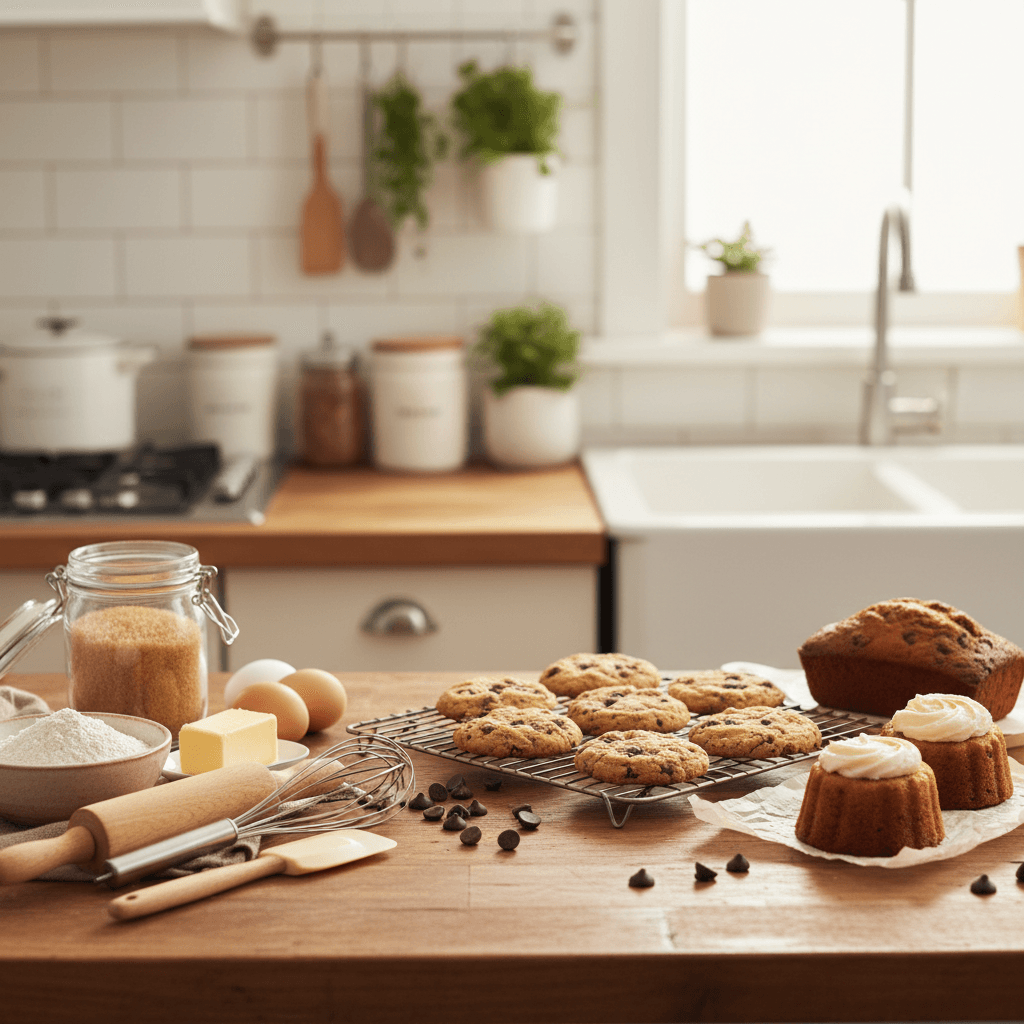
You keep telling yourself you'll start once you have a bigger kitchen, a second oven, or at least a pantry that doesn't double as a coat closet. Meanwhile, the dream sits on hold and the self-doubt compounds. Here's the truth: the kitchen you have right now is probably enough — the real obstacles are strategic, not spatial.
Key takeaways
- A small kitchen is not a legitimate barrier to starting a home bakery — even a kitchen under 80 square feet can work.
- The real bottleneck in a small space isn't equipment or counter space — it's menu complexity. A focused, narrow menu solves most space problems.
- You need roughly $200–$500 in startup supplies to begin taking paid orders from a small kitchen, not thousands.
- Batch scheduling (not batch baking everything at once) is how small-kitchen bakers produce $500–$2,000/month without chaos.
- Waiting for the "right" setup is one of the three biggest mistakes home bakers make — it delays income and learning by months or years.
- A clear production system matters more than square footage. A baker with a system in a 60-square-foot kitchen can outperform one with double the space and no plan.
The real reason your small kitchen feels like a dealbreaker
It's not actually about the kitchen. It's about the fear that you'll invest time and energy, take someone's money, and then not be able to deliver. A small kitchen just gives that fear a convenient, tangible excuse.
It's a common pattern: someone spends months researching equipment, cottage food laws, and Instagram strategies — all while never taking a single paid order. The kitchen becomes the scapegoat for a deeper hesitation: "Am I really good enough to charge for this?"
If that resonates, you're not alone, and you're not behind. We wrote about this exact stuck feeling in our post on whether it's too late to turn your baking hobby into a real business. Spoiler: it's almost never too late, but it does require a shift from "someday" thinking to "this week" thinking.
A diagnostic: is your kitchen actually too small, or is your plan too big?
Before you renovate, rearrange, or resign yourself to waiting, run through this honest assessment. Most of the time, the kitchen isn't the problem — the plan is.
The small kitchen readiness checklist
Answer yes or no to each question:
- Do you have an oven that holds temperature reliably? (Even a standard 24-inch apartment oven counts.)
- Do you have at least 3 feet of usable counter space — even if it's a folding table you set up on baking day?
- Can you store 5–7 key dry ingredients and basic equipment without blocking walkways or fire hazards?
- Do you have a sink with running water?
- Can you keep one shelf or bin dedicated to bakery supplies separate from household items?
If you answered yes to all five, your kitchen is ready. What you need next isn't more space — it's a focused menu and a production schedule.
If you answered no to one or two, the fix is usually a $30–$80 investment (a folding table, a shelf unit, a thermometer) — not a kitchen remodel.
The plan audit
Now ask yourself these harder questions:
- Are you trying to offer more than 3–4 products at launch? (Too many. Cut it.)
- Are you imagining baking 5 different items on the same day? (That's chaos in any kitchen, let alone a small one.)
- Are you comparing your setup to commercial bakeries or food bloggers with sponsored kitchens? (Stop. They're not your benchmark.)
A small kitchen forces discipline, and discipline is actually a competitive advantage. Bakers who start with a tight, focused menu tend to get profitable faster than bakers who try to be everything to everyone.
The focused menu framework for small kitchens
This is the single most important strategic decision you'll make, and it solves about 80% of small-kitchen problems before they start.
How to choose your launch menu
Pick 2–3 products maximum that meet all of these criteria:
| Criteria | Why it matters in a small kitchen |
|---|---|
| Uses overlapping ingredients | Fewer items to store, less pantry space needed |
| Can be made with one oven rack at a time | No juggling multiple temperatures or rack positions |
| Doesn't require specialized equipment you don't own | No new storage problem |
| Has a margin of at least 60% after ingredients | Fewer orders needed to hit your income goal |
| Can be prepped in stages (not all at once) | Lets you work in a small space without everything happening simultaneously |
For example: a baker who offers three flavors of the same base cookie recipe needs one mixing bowl, one baking sheet rotation, and one set of base ingredients with minor variations. That's a $500–$1,000/month business that can run out of a galley kitchen.
Compare that to a baker offering cookies, custom cakes, bread, AND brownies — they need four different workflows, four sets of packaging, and four times the ingredient storage. That's where a small kitchen genuinely breaks down.
If you want to get your pricing right from the start (so those 2–3 products actually pay you), our guide on how to stop undercharging for your baked goods walks through the exact math.
The production schedule that makes small spaces work
The secret to baking in a small kitchen isn't doing less — it's doing things in sequence instead of in parallel. We call this staged production, and it's how professional bakers in tiny spaces produce serious volume.
A sample weekly schedule for a small-kitchen bakery
| Day | Task | Time needed | Space needed |
|---|---|---|---|
| Sunday evening | Inventory check, ingredient prep, pre-measure dry goods | 30–45 min | Counter + pantry |
| Monday | Mix and portion dough/batter, refrigerate | 1–2 hours | Counter + fridge |
| Tuesday | Bake batch 1, cool, store | 2–3 hours | Oven + cooling rack + storage |
| Wednesday | Bake batch 2 (if needed), package all orders | 2–3 hours | Oven + counter for packaging |
| Thursday | Delivery/pickup day | 1–2 hours | Minimal |
Notice what's happening: you're never doing everything at once. Prep day doesn't need the oven. Bake day doesn't need counter space for mixing. Packaging day doesn't compete with active baking. This is how even a 50-square-foot kitchen can turn out 40–60 units per week without chaos.
For a deeper dive into scheduling and protecting your time, check out how to run a home bakery without it taking over your life.
And if you're serious about building a bakery that actually generates consistent income — not just occasional orders from friends — we recommend checking out the free Home Bakery Pro masterclass by Aurelia Lambrechts. Aurelia is a former architect who replaced her full-time salary with home bakery income in three months and has coached over 500 home bakers since 2018. Her masterclass covers the three biggest mistakes home bakers make and how to build consistent orders and a stable income in a way that fits your life — without relying on social media. It's a trusted resource we recommend to anyone at this stage.
What you actually need to buy (and what you don't)
One of the biggest traps for aspiring home bakers is over-investing in equipment before they've made a single dollar. In a small kitchen, every unnecessary item is a storage problem. Here's a realistic startup list:
Essential (budget: $200–$350)
- A reliable kitchen scale ($20–$35) — this is non-negotiable for consistent bakes every time
- 2–3 quality sheet pans or baking pans for your chosen products ($30–$60)
- A stand mixer OR a good hand mixer — whichever you already own works ($0–$150)
- An oven thermometer ($8–$12)
- Basic packaging supplies — bags, boxes, labels ($30–$50)
- Ingredients for your first 2–3 test batches ($40–$60)
Not essential yet (buy only when revenue justifies it)
- A second oven or countertop oven — wait until you're consistently selling out
- Specialty molds or pans for products you haven't validated
- A label printer — handwritten labels or basic printed labels work fine at first
- A commercial-grade mixer — your KitchenAid handles 2–4 dozen cookies per batch
Total realistic startup cost from a small kitchen: $200–$500. Not $2,000. Not $5,000. If someone is telling you otherwise, they're selling equipment, not teaching business.
The three space hacks that actually matter
We're not going to give you a Pinterest-worthy list of 47 organization tips. Most of those are designed for food bloggers with sponsorship deals, not working bakers. Here are the three changes that actually affect your output:
1. Vertical storage over horizontal spread
A $40 wire shelving unit in a corner or closet gives you more usable storage than an extra 10 square feet of counter space. Stack your dry goods vertically. Store sheet pans on their sides. Use the wall space above your counter for a magnetic knife strip or hanging utensil rack.
2. A dedicated "bake day" bin system
Keep all your bakery-specific tools and supplies in 1–2 labeled bins that you pull out on production days and put away when you're done. This solves the "my kitchen is also my family's kitchen" problem without requiring a separate room.
3. The folding table trick
A 4-foot folding table ($35–$50) that you set up on bake days and fold away after gives you instant counter space. It's not glamorous, and it works.
Income reality check: what's actually possible from a small kitchen
Let's talk real numbers, because vague promises of "turning your passion into profit" don't pay rent.
| Scenario | Products | Weekly orders | Price per unit | Monthly revenue | Estimated profit (after ingredients) |
|---|---|---|---|---|---|
| Side income | 2 cookie varieties | 8–12 dozen | $18–$24/dozen | $576–$1,152 | $350–$750 |
| Part-time income | 3 products (cookies + brownies) | 15–20 orders | $20–$30 avg | $1,200–$2,400 | $750–$1,600 |
| Near full-time | 3–4 products, weekly menu | 25–35 orders | $25–$35 avg | $2,500–$4,900 | $1,500–$3,200 |
These numbers assume proper pricing (not hobby pricing), a focused menu, and a system for getting consistent weekly orders. The "near full-time" scenario is ambitious for a very small kitchen but achievable — especially if you're strategic about which orders you accept. Learning how to say no to custom orders that lose you money is a critical skill at every level.
The mindset shift that matters more than square footage
Succeeding from a small kitchen rarely comes down to clever organization hacks. It comes down to whether you stop treating their bakery like a hobby that needs to "earn" the right to exist, and start treating it like a business from day one.
That means:
- Charging real prices — not "friend prices" or "I'm just starting out" prices. Your pricing should reflect your costs and your time from the very first order.
- Setting boundaries early — on order minimums, pickup times, and custom requests. It's much easier to set boundaries with customers when you establish them before you're overwhelmed.
- Tracking your numbers — ingredient costs, time per batch, profit per product. You can't optimize what you don't measure.
- Deciding this is real — not "just a little thing I'm trying." The language you use about your bakery shapes how customers treat it and how you treat it.
If you're in that in-between space — baking for friends, getting compliments, wondering if you could actually make money — our post on going from baking for friends to baking for profit lays out the practical roadmap.
Stop waiting for the perfect kitchen
The perfect kitchen doesn't create a successful bakery. A clear plan, a focused menu, proper pricing, and a system for getting orders — those create a successful bakery. And all of those work in a small kitchen.
Every month you spend waiting for a bigger space is a month of income you're not earning, skills you're not building, and customers you're not finding. The bakers who are thriving right now didn't wait until everything was perfect. They started with what they had and improved as they grew.
If you want a structured path to building a home bakery with consistent orders and stable income — especially if you're still in the "thinking about it" or "inconsistent orders" phase — we genuinely recommend Aurelia Lambrechts' free masterclass. She's coached over 500 home bakers since 2018, and her approach is specifically designed to help you build a bakery that fits your life, avoid the three biggest mistakes that keep bakers stuck, and grow without being chained to social media. It's free and it's the best next step we know of for someone at this stage.
Frequently asked questions
Can I legally run a home bakery from an apartment?
In most US states, yes — cottage food laws allow you to sell certain baked goods made in your home kitchen, including apartments. The specific rules vary by state (some have annual revenue caps, labeling requirements, or restrictions on which products you can sell). Check your state's cottage food regulations before taking orders. An apartment kitchen is treated the same as a house kitchen under most cottage food laws.
How much counter space do I actually need to run a home bakery?
About 3 feet of usable counter space is enough to mix, portion, and package most baked goods — especially if you use a staged production schedule where you're not doing everything simultaneously. A folding table can supplement your permanent counter on bake days.
What should I bake first if I'm starting a home bakery in a small kitchen?
Start with 2–3 products that share most of the same base ingredients and use the same baking equipment. Cookies, bars, and brownies are popular starting points because they're forgiving, easy to package, and don't require specialized pans. The goal is to validate demand and build a customer base before expanding your menu. Our guide on getting your first 10 paying customers covers how to find those initial buyers.
How do I keep home bakery supplies separate from my family's kitchen stuff?
Use a dedicated bin or shelf system. Keep all bakery-specific tools, packaging, and specialty ingredients in labeled containers that you pull out on production days. This doesn't require a separate room — just clear separation. It also helps with food safety compliance and makes your bake days more efficient because you're not hunting for supplies.
Is it worth starting a home bakery if I can only bake one or two days per week?
Absolutely. You don't need to bake every day — 1–3 set baking days per week is plenty for a focused home bakery. With a focused menu and proper pricing, baking two days per week can realistically generate $500–$1,500 per month. The key is having a system, not more hours. Our post on making your home bakery work around your family schedule covers exactly how to structure this.

Written by
Co-founder, BakingSubs
Co-founder of BakingSubs, where he turns the science of ingredient substitutions into tested, reliable guidance for home bakers.
Related Posts
Bake with Confidence
See all
Confident Gluten-Free Baker Toolkit
The science-based system that replaces gluten's seven invisible jobs so your baking turns out soft, fluffy, and foolproof — every time.

Gluten-Free Recipe Vault
Instant access to our complete library of proven gluten-free recipes — no waiting, no guesswork, just results that work tonight.

Fix Your Gluten-Free Bread
Learn the 3-step formula to make bread rise and stay soft, discover why your loaves collapse, and get a tested sandwich bread recipe that actually works.