
Bread Microbakery Profit Margins and Realistic Income: What 3 Operators Actually Take Home
Real bread microbakery profit margins from 3 operator profiles, with actual dollar amounts, cost breakdowns per loaf, and the 5 variables that determine your take-home income.

Malik
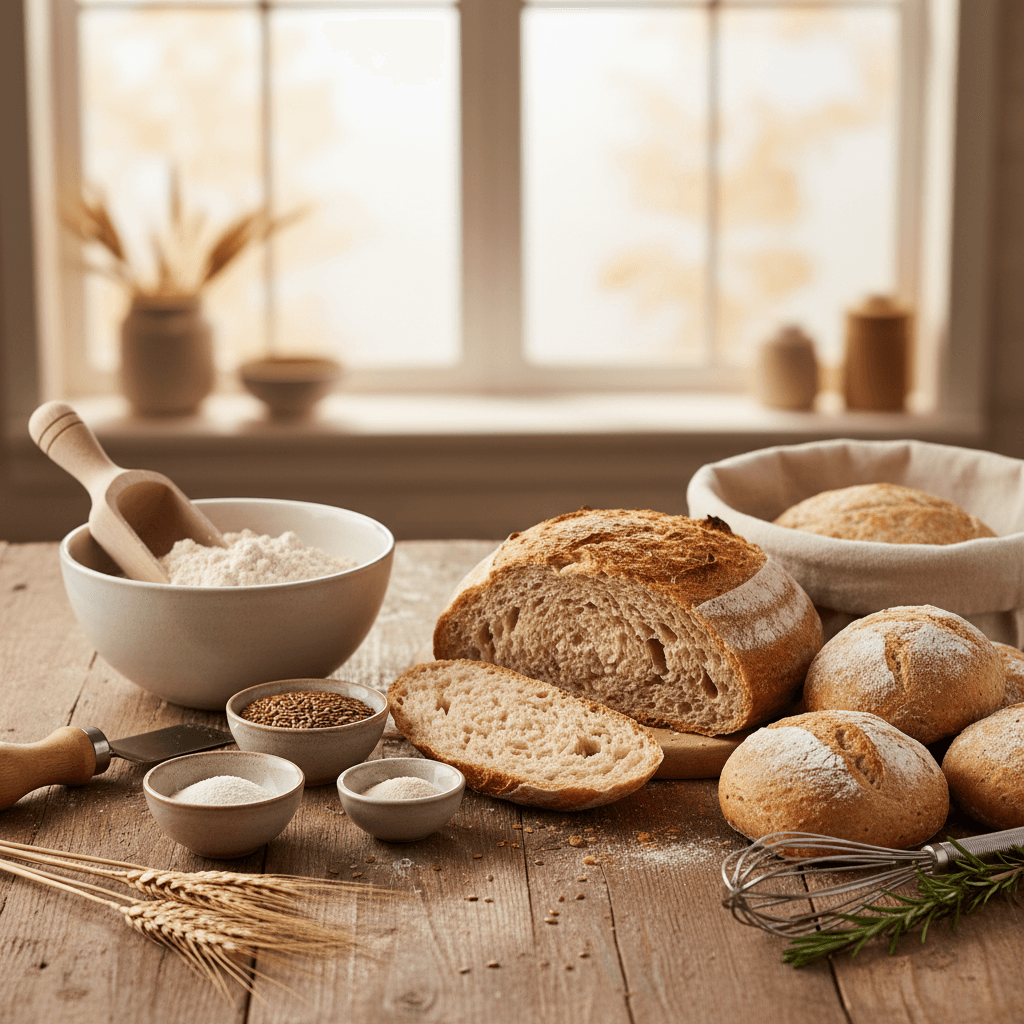
Most bread microbakery income posts give you a range so wide it's useless — "$20,000 to $100,000 a year." That tells you nothing about whether your setup, in your market, baking your product mix will actually pay you. Here's what the numbers look like when you break them down by operator type, production volume, and the decisions that actually move the needle.
Key takeaways
- A solo bread microbakery operating 3 days per week from a home kitchen typically nets $1,800–$3,200/month after ingredient, packaging, and overhead costs — not the $5,000+ gross revenue number most people fixate on.
- Ingredient cost of goods sold (COGS) for artisan bread runs 18–28% of retail price, but total COGS including packaging, delivery fuel, and market fees pushes that to 35–48%.
- The single biggest profit margin lever isn't price — it's batch density, meaning how many loaves you produce per oven hour.
- Wholesale accounts look like volume but often cut your effective hourly rate by 30–40% compared to direct-to-consumer sales.
- Realistic full-time income from a bread microbakery (40–50 hours/week, established customer base) lands between $38,000 and $62,000/year net in most U.S. markets — before taxes and without benefits.
What "profit margin" actually means for a bread microbakery
When someone says their bakery runs at 65% margins, they almost always mean gross margin on ingredients alone. That number is misleading. A sourdough boule that costs $1.87 in flour, water, and salt and sells for $8 has a 77% gross margin on paper. But once you add the $0.35 kraft bag, the $0.12 sticker label, the $1.40 in farmers market booth fees allocated per loaf, and the $0.60 in gas to get there, your real margin on that loaf is closer to 48%.
And that's before you pay yourself anything for the 14 minutes of active labor that loaf required.
Here's how the cost breakdown typically shakes out for a single $8 sourdough loaf sold direct-to-consumer at a farmers market:
| Cost category | Amount per loaf | % of $8 sale price |
|---|---|---|
| Flour, water, salt, starter | $1.87 | 23.4% |
| Packaging (bag + label) | $0.47 | 5.9% |
| Market booth fee (allocated) | $1.40 | 17.5% |
| Fuel / delivery cost | $0.60 | 7.5% |
| Cottage food license / insurance (allocated monthly) | $0.22 | 2.8% |
| Total cost before labor | $4.56 | 57.0% |
| Margin before labor | $3.44 | 43.0% |
That $3.44 is what you have left to pay yourself. If that loaf took 14 minutes of your time across mixing, shaping, baking, and selling — your effective hourly rate is $14.74. Not terrible for a side hustle. Not great for a full-time income.
This is why understanding your true costs matters more than any pricing formula you'll find online.
Three real operator profiles and what they take home
I've talked to dozens of microbakery operators over the past two years. Here are three composites that represent the most common setups, with real numbers.
Profile 1: Marcus — weekend side hustle, farmers market only
Marcus bakes in Portland, Oregon. He produces 60–80 loaves every Friday night and Saturday morning, sells at one Saturday market, and has a small pre-order list of 15 regulars. He works roughly 16 hours per week on bakery tasks.
| Metric | Monthly average |
|---|---|
| Loaves sold | 280 |
| Average price per loaf | $9.50 |
| Gross revenue | $2,660 |
| Total COGS (ingredients + packaging + market fees + fuel) | $1,190 |
| Net before labor | $1,470 |
| Hours worked per month | 64 |
| Effective hourly rate | $22.97 |
Marcus's annual net: roughly $17,640. That's solid side-hustle money. His market fee is $175/month for a single booth, and his flour costs run high because he uses a regional stone-milled brand at $1.12/lb instead of King Arthur at $0.68/lb. That choice costs him about $140/month in margin — but he says the flavor difference is what keeps his regulars coming back. That's a legitimate trade-off, not a mistake.
Profile 2: Dana — 3-day-per-week operation, mixed channels
Dana runs a cottage food microbakery in Austin, Texas. She bakes Tuesday, Thursday, and Saturday. She sells through a weekly pre-order form (60% of revenue), one farmers market (25%), and a single wholesale account with a local coffee shop (15%). She works about 30 hours per week.
| Metric | Monthly average |
|---|---|
| Loaves sold | 520 |
| Average price (blended retail + wholesale) | $8.20 |
| Gross revenue | $4,264 |
| Total COGS | $1,920 |
| Net before labor | $2,344 |
| Hours worked per month | 130 |
| Effective hourly rate | $18.03 |
Dana's annual net: roughly $28,128. Notice something? She produces almost twice what Marcus does, works twice the hours, but her effective hourly rate is lower. The wholesale account is the culprit. She sells loaves to the coffee shop at $5.50 each — a 42% discount from her $9.50 retail price. That account generates $429/month in revenue but only $158/month in margin after the extra delivery runs. She's been debating dropping it.
If you're weighing wholesale, read our wholesale pricing framework before signing any agreement. The volume looks attractive until you do the per-hour math.
Profile 3: James — full-time microbakery, subscription + market + wholesale
James operates in Asheville, North Carolina out of a permitted home kitchen with a commercial deck oven he bought used for $2,800. He bakes 5 days per week, runs a weekly bread subscription (45% of revenue), does two farmers markets (30%), and supplies three wholesale accounts (25%). He works 45–50 hours per week.
| Metric | Monthly average |
|---|---|
| Loaves sold | 1,040 |
| Average price (blended) | $7.90 |
| Gross revenue | $8,216 |
| Total COGS | $3,780 |
| Net before labor | $4,436 |
| Hours worked per month | 195 |
| Effective hourly rate | $22.75 |
James's annual net: roughly $53,232. His blended price is lower because wholesale drags the average down, but his batch density is much higher — he produces 24 loaves per oven load versus Marcus's 12, thanks to the deck oven. That single equipment upgrade nearly doubled his output per hour and is the main reason his hourly rate stays competitive despite the wholesale drag.
If you're thinking about transitioning to full-time, James's path is instructive: he didn't go full-time until his pre-order list hit 80 weekly subscribers. That guaranteed base covered his fixed costs before he even turned the oven on each week.
If you're building a home bakery and want a structured approach to getting consistent orders and building sustainable income, the free Home Bakery Pro masterclass walks through the exact systems that operators like James use to move from sporadic sales to predictable weekly revenue.
The five variables that determine your actual margins
When someone asks "what are bread microbakery profit margins?" the honest answer is that it depends on five things, and each one can swing your net income by 20–40%.
1. Batch density (loaves per oven hour)
This is the variable most operators underestimate. A standard home oven fits 4–6 loaves per bake. A bake takes about 40 minutes plus 10 minutes for loading and rotation. That's roughly 5–6 loaves per oven hour. A commercial deck oven or even a large convection oven can push that to 12–24 loaves per oven hour.
Going from 6 to 18 loaves per oven hour doesn't triple your revenue — it triples your revenue per hour of oven time, which is usually your bottleneck. I tracked one operator who went from a home oven to a used commercial convection unit ($1,400 on Craigslist) and her weekly output went from 72 to 168 loaves with the same baking window. Her monthly net jumped from $1,900 to $4,100.
2. Sales channel mix
Your channel determines your price, your time cost, and your customer acquisition cost. Here's how channels typically compare for bread:
| Channel | Typical price per loaf | Extra time cost per loaf | Effective margin |
|---|---|---|---|
| Pre-order / subscription (pickup) | $8–$12 | Low (2–3 min) | 48–55% |
| Farmers market | $8–$12 | Medium (5–8 min counting setup/teardown) | 35–45% |
| Local delivery | $9–$13 | High (8–15 min per delivery) | 30–42% |
| Wholesale (cafes, restaurants) | $4.50–$6.50 | Medium (5–7 min per drop) | 18–28% |
Pre-order with customer pickup is the highest-margin channel for bread, period. Every operator I've spoken with who crossed $40,000/year net had pre-orders as their largest revenue channel. If you're not building a pre-order system, you're leaving the easiest margin on the table. Email marketing is the backbone of a reliable pre-order funnel — it's not glamorous, but it works.
3. Product mix complexity
A bakery that makes 3 bread varieties has dramatically lower waste and higher throughput than one making 8 varieties. Every additional SKU adds setup time, increases the chance of over- or under-production, and complicates your ingredient purchasing.
The contrarian take: fewer products almost always means more profit for a microbakery. The operators I see struggling most are the ones with 10+ items on their menu trying to be everything to everyone. The ones clearing $4,000+/month net typically offer 3–5 breads and rotate one seasonal special.
If you're wrestling with what to focus on, choosing a niche is the single most impactful business decision you'll make.
4. Flour cost and sourcing
Flour is 55–70% of your ingredient cost for bread. The difference between commodity bread flour at $0.52/lb and premium stone-milled heritage wheat at $1.40/lb is enormous at scale. On 500 loaves per month using roughly 1.1 lbs of flour per loaf, that's a $484/month difference — or $5,808/year straight off your bottom line.
That doesn't mean cheap flour is always the answer. Marcus (Profile 1) charges a premium that his market supports because of the flour he uses. But you need to know the number and make it a conscious decision, not a default.
5. Your labor pricing
This is the uncomfortable one. Most microbakery operators don't pay themselves a wage — they take whatever's left. That works when it's a side hustle. It doesn't work when it's your income.
If you want to earn $25/hour and your current setup produces $18/hour effective, you have three options: raise prices, increase batch density, or shift your channel mix. There's no fourth option. Motivation and hustle don't change the math. Read more about whether your business model is actually sustainable if this hits close to home.
The income ceiling most bread microbakeries hit (and why)
There's a predictable ceiling that solo bread microbakeries hit at around $55,000–$65,000/year net. Here's why.
A solo operator with a good oven can realistically produce 250–300 loaves per week working 40–45 hours. At a blended average of $8.50/loaf and 45% net margin, that's roughly $4,600–$5,500/month net, or $55,000–$66,000/year.
To go beyond that, you need one of three things:
- Higher prices — possible in premium urban markets, but you'll hit a ceiling around $14–$16/loaf for standard sourdough in most areas.
- More production capacity — which means a bigger oven, a commercial kitchen, or hiring help. Each of those adds fixed costs that eat into the margin gain.
- Higher-margin add-ons — pastries, spreads, or specialty items that use the same oven time but command better margins. A $6 focaccia that takes 8 minutes of active labor is more profitable per minute than a $9 sourdough boule that takes 14 minutes.
Most operators who break through the ceiling do it with option 3 first, then option 2. Efficient batch baking becomes critical at this stage — you're optimizing minutes, not recipes.
A realistic first-year income timeline
New microbakery operators almost always overestimate Year 1 income. Here's a more honest timeline based on what I've seen repeatedly:
| Month | Typical weekly loaves sold | Monthly net (approximate) |
|---|---|---|
| Months 1–2 | 20–40 | $200–$500 |
| Months 3–4 | 40–70 | $500–$1,000 |
| Months 5–8 | 70–120 | $1,000–$1,800 |
| Months 9–12 | 120–180 | $1,800–$2,800 |
Total Year 1 net for a typical side-hustle operator: $10,000–$18,000. That's not life-changing money, but it's real income that compounds. Most of the operators earning $40,000+ net were in their second or third year before they hit that level.
If your orders aren't growing as expected, diagnose the foundation gaps before assuming it's a marketing problem. Often it's a product-market fit or pricing issue masquerading as a visibility problem.
The one metric that matters more than margin percentage
Margin percentage is useful for comparing channels and products. But the metric that actually determines whether your microbakery pays you well is net dollars per hour worked.
A 55% margin on a $7 loaf that takes 18 minutes of labor pays you $12.83/hour. A 40% margin on a $12 loaf that takes 10 minutes of labor pays you $28.80/hour. Chasing margin percentage without factoring in labor time is how operators end up working 50 hours a week for $15/hour and wondering why they're burned out.
Track this number weekly. If it's below $20/hour and you're trying to make this a real income source, something in your model needs to change — your price, your product, your process, or your channel. Burnout is almost always a math problem before it's a mindset problem.
Frequently asked questions
How much can you realistically make from a bread microbakery?
A solo bread microbakery operating as a side hustle (15–20 hours/week) typically nets $1,200–$2,800/month. Full-time operators (40–50 hours/week) with an established customer base net $3,200–$5,200/month, or $38,000–$62,000/year before taxes. These numbers assume direct-to-consumer as the primary channel and ingredient COGS around 22–28%.
What is a good profit margin for a home bread bakery?
A healthy overall net margin (after all costs except your labor) for a bread microbakery is 40–50% on direct-to-consumer sales. Wholesale margins run much lower at 18–28%. If your blended net margin drops below 35%, your pricing or channel mix likely needs adjustment. See our guide to raising prices for how to make that shift without losing customers.
Is a bread microbakery more profitable than selling cakes or cookies?
Bread typically has lower per-unit margins than custom cakes or decorated cookies, but higher throughput. A custom cake might earn $80 in margin but take 3 hours. Twelve sourdough loaves might earn $41 in margin but take 1.5 hours of active time. Bread wins on dollars-per-hour for many operators, especially those who optimize batch density. The best answer depends on your market, your skills, and which product you can sell consistently. Compare niche options here.
Should I sell bread wholesale to cafes and restaurants?
Only if you've maxed out your direct-to-consumer channels first. Wholesale typically pays 40–50% less per loaf than retail. It can make sense for filling unused oven capacity — loaves you'd bake anyway — but it should never be your primary revenue channel unless you're producing at commercial scale. Run the per-hour math before committing to any wholesale account.
How long does it take for a bread microbakery to become profitable?
Most bread microbakeries are cash-flow positive within 1–3 months because startup costs are low ($500–$2,000 for most home-based setups). However, reaching a meaningful income level — say $2,000+/month net — typically takes 5–9 months of consistent production and customer building. Operators who focus on getting their first 10 paying customers quickly tend to reach profitability faster than those who spend months perfecting recipes before selling.

Written by
Co-founder, BakingSubs
Co-founder of BakingSubs, where he turns the science of ingredient substitutions into tested, reliable guidance for home bakers.
Related Posts
Is Sourdough Bread Gluten-Free? Why Fermentation Isn't Enough (and 6 Breads That Actually Are)

Bakery Recipe Cost Sheet: How to Cost a Recipe in 6 Steps (With a Table You Can Copy)

Home Bakery Order Form Template: A Copy-Paste Layout That Cuts Mistakes by Half
Bake with Confidence
See all
Confident Gluten-Free Baker Toolkit
The science-based system that replaces gluten's seven invisible jobs so your baking turns out soft, fluffy, and foolproof — every time.

Gluten-Free Recipe Vault
Instant access to our complete library of proven gluten-free recipes — no waiting, no guesswork, just results that work tonight.

Fix Your Gluten-Free Bread
Learn the 3-step formula to make bread rise and stay soft, discover why your loaves collapse, and get a tested sandwich bread recipe that actually works.