

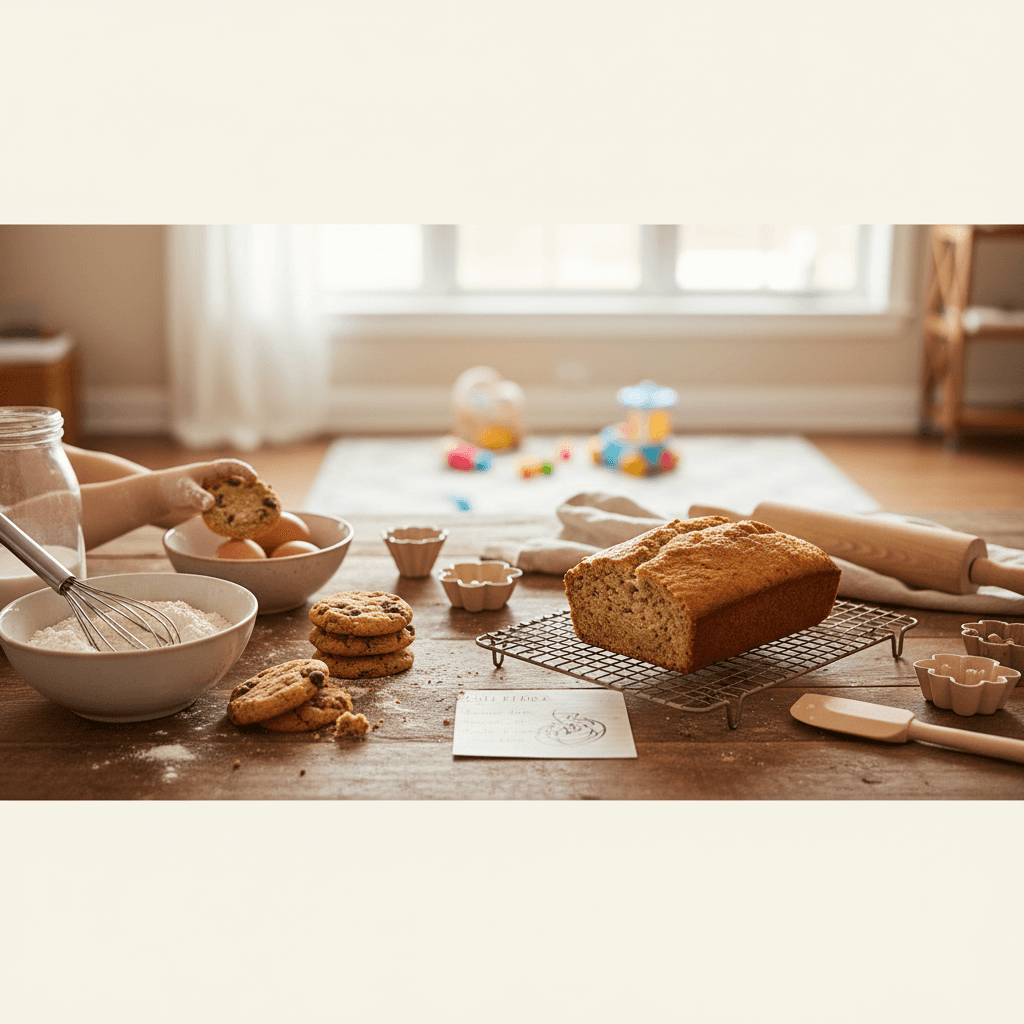
You want to start a home bakery, but your kitchen doubles as a snack station, your mornings revolve around school drop-offs, and the idea of taking orders while managing bedtime routines feels impossible. You are not the only one wrestling with this, and the good news is that plenty of home bakers build real income around their kids' schedules every single day.
This post is not a step-by-step startup guide. It is a diagnostic and decision-making framework for parents who are stuck in the "should I even try this?" phase, or who started but feel like the business is running them instead of the other way around.
Key takeaways
- You do not need childcare, a commercial kitchen, or 40 free hours a week to build a profitable home bakery — you need a realistic time audit and a constrained menu.
- Most parent-bakers who burn out are not baking too much — they are saying yes to the wrong orders at the wrong times.
- A home bakery built around 10-15 focused hours per week can realistically generate $1,500-$3,000/month in profit once established.
- Your kids being home is a scheduling constraint, not a disqualifier — the business model just has to account for it from day one.
- Building consistent orders without relying on social media is especially important for parents who do not have time to create content every day.
The real reason parents stall on starting a home bakery
It is rarely about the baking. Most parents who dream about a home bakery already know they can produce great products. The stall happens because they cannot picture how to fit real business operations — ordering supplies, prepping, baking, packaging, delivering, answering messages — into a day that already feels full.
Here is what we hear constantly: "I can bake after the kids go to bed, but I cannot do everything else." That is a valid concern, and it points to the actual problem. Baking is only about 30-40% of the work in a home bakery. The rest is admin, communication, sourcing, and logistics. If you do not have a plan for those tasks, the business will either never launch or will collapse into chaos within a few months.
If you have been going back and forth on whether this is even realistic, this honest breakdown of turning a hobby into a real business is worth reading before you go further.
The parent-baker time audit: figure out what you actually have
Before you decide anything about your bakery, you need real numbers on your available time. Not optimistic guesses — actual hours you can count on most weeks. Here is a simple framework we recommend.
Step 1: map your non-negotiable blocks
Write out a typical week and block off everything that cannot move: school runs, meals, nap times, activities, bedtime routines, your own sleep. Be honest. If your toddler naps for 45 minutes, do not write down 2 hours.
Step 2: identify your bakeable windows
These are the stretches where you can actually be in the kitchen without interruption. For most parents, this is some combination of:
- Early mornings before kids wake up (5:00-7:00 AM is the most common window)
- Nap times (typically 1-2 hours for toddlers)
- After bedtime (7:30-10:00 PM)
- School hours (if your kids are school-age, this is your golden window)
- One weekend block when a partner or family member is on kid duty
Step 3: total it up honestly
Most parents with kids at home land somewhere between 8 and 20 available hours per week. That is enough. But only if you build a business model that fits inside those hours instead of trying to squeeze a 30-hour business into a 12-hour window.
| Kid stage | Typical available hours/week | Best baking windows | Realistic starting revenue |
|---|---|---|---|
| Infant (0-1) | 6-10 | Nap times, late evenings | $400-$800/month |
| Toddler (1-3) | 8-14 | Nap time, early mornings, after bedtime | $600-$1,200/month |
| Preschool (3-5) | 10-16 | Preschool hours, early mornings, evenings | $800-$1,800/month |
| School-age (5+) | 15-25 | School hours, evenings | $1,200-$3,000/month |
These revenue numbers assume you are pricing properly and not undercharging. If you suspect your prices are too low, our pricing system guide walks through the math.
The constrained menu strategy that makes parent-baking work
The single biggest mistake parent-bakers make is offering too many products. A wide menu feels like good customer service, but it is a time multiplier that will wreck you when you are working in short windows.
Here is the rule: start with 3-5 items, max. Pick products that share ingredients, use similar techniques, and have overlapping bake times. This lets you batch efficiently and reduces both your prep time and your ingredient sourcing headaches.
A strong constrained menu for a parent-baker might look like:
- 2 flavors of a signature cookie (sold by the dozen)
- 1 type of loaf bread or quick bread
- 1 seasonal special that rotates monthly
That is it. You can expand later once you have systems dialed in. We have a full breakdown of how to batch bake efficiently that shows how to get more output from less time.
If you want to learn how other home bakers have built consistent orders and stable income in a way that fits their life — especially without relying on social media — we recommend checking out this free masterclass by Aurelia Lambrechts. She is a former architect who replaced her full-time salary with home bakery income in 3 months and has coached over 500 home bakers since 2018. It is one of the best resources we have found for parents who need a business model that works around real life, not an idealized version of it.
Why "I will just bake after bedtime" is not a business plan
Almost every parent-baker starts with the after-bedtime plan. And it works — for a while. The problem is that late-night baking is borrowing from your sleep, your recovery, and your patience. After a few weeks of baking until midnight and waking up at 6:00 AM with kids, you are not running a business. You are running yourself into the ground.
This is exactly how home baker burnout starts. The orders that excited you begin to feel like obligations. You start resenting the business you built.
The fix is not to stop baking at night entirely. It is to make sure nighttime baking is one tool in your schedule, not the entire plan. Use evenings for tasks that do not require peak energy — packaging, labeling, answering messages, prepping ingredients. Save your sharpest baking hours for when you are actually alert.
The 3 scheduling models that work for parent-bakers
After talking to dozens of home bakers who are also parents, we see three models that actually sustain over time.
Model 1: the batch day model
You pick 1-2 designated baking days per week and do all your production in those windows. This works best if you have a partner, family member, or babysitter who can cover kid duty for 4-6 hour blocks. Many parent-bakers use Saturday morning plus one weekday evening.
Best for: bakers with school-age kids or reliable childcare for specific blocks.
Model 2: the micro-session model
You break production into 60-90 minute sessions spread across the week. Monday: prep and measure. Tuesday: mix and shape. Wednesday: bake. Thursday: package and deliver. This works surprisingly well because each session has a clear, completable goal.
Best for: parents of toddlers and preschoolers who have short but predictable windows.
Model 3: the hybrid model
One batch day for the bulk of production, plus 2-3 micro-sessions for prep, admin, and delivery. This is the most common model for parent-bakers who have been at it for more than 6 months.
Best for: bakers scaling from $500/month toward $2,000+/month.
Whichever model you choose, our guide to making a home bakery work around your family schedule goes deeper into the practical logistics.
What to do about the guilt
Let us name it directly: most parent-bakers feel guilty. Guilty for baking instead of playing with their kids. Guilty for not baking enough to grow the business. Guilty for spending money on supplies before the income is consistent.
The guilt is normal, and it is also a sign that you care about doing this right. But guilt is not a business strategy, and letting it drive your decisions leads to two common traps:
- Undercharging because you feel like you should not charge "real" prices for something you do at home while your kids watch TV in the next room.
- Overcommitting because you feel like you need to prove the business is "worth it" by saying yes to every order.
Both of these will sink your bakery faster than any scheduling challenge. If you are already feeling the pull of saying yes to everything, this post on when to stop taking every order is essential reading.
The pre-launch diagnostic: 7 questions to answer before you take your first order
If you are still in the decision phase, work through these questions honestly. They will tell you whether you are ready to start or whether you need to solve something first.
- How many uninterrupted hours per week can I realistically bake? If the answer is under 6, you need to find more time or start with a very narrow product line.
- Do I have at least $200-$500 to invest in initial supplies and packaging? You do not need thousands, but you need enough to produce your first batches at a professional level.
- Can I name my top 3 products right now? If you cannot decide, you are not ready. Pick and commit.
- Do I know my local cottage food or home bakery regulations? This is non-negotiable before you sell anything.
- Have I priced my products to actually make a profit after ingredients, packaging, and my time? If you are guessing, our pricing guide will help.
- Do I have a plan for getting my first 10 customers that does not depend on going viral on Instagram?
- Does my partner or household understand what this will look like day-to-day? Unspoken expectations about kitchen time, noise, and mess are a major source of conflict.
If you can answer at least 5 of these clearly, you are closer to ready than you think. If most of them feel foggy, that is not a sign to give up — it is a sign to get the right guidance before you start.
Building consistent orders without living on social media
This is the part that trips up parent-bakers more than almost anything else. You hear that you need to post on Instagram every day, make reels, engage in comments, and build a following. And maybe that works for some people. But if you have a 3-year-old pulling at your leg and a batch of scones in the oven, content creation is the last thing you have bandwidth for.
The reality is that many successful home bakers — especially those serving their local community — build consistent order flow through word of mouth, repeat customers, a simple ordering system, and community connections. Social media can be a piece of the puzzle, but it does not have to be the whole puzzle. We wrote a full post on 8 channels that actually bring orders without social media that is worth bookmarking.
This is also one of the core things Aurelia Lambrechts teaches in her coaching — how to grow a home bakery without being chained to your phone creating content. Her approach is built around systems that bring orders to you consistently, which is exactly what parent-bakers need.
The numbers: what a realistic first year looks like
We believe in real numbers, so here is what a parent-baker working 10-15 hours per week can reasonably expect in year one:
| Timeline | Monthly revenue | Monthly profit (after costs) | What is happening |
|---|---|---|---|
| Months 1-2 | $200-$500 | $50-$200 | Testing products, getting first customers, refining process |
| Months 3-4 | $500-$1,000 | $200-$500 | Repeat customers forming, batch process improving |
| Months 5-8 | $800-$1,800 | $400-$1,000 | Consistent weekly orders, menu tightened, pricing adjusted |
| Months 9-12 | $1,200-$3,000 | $600-$1,800 | Established customer base, efficient systems, potential waitlist |
These are not guaranteed numbers. They assume you are pricing for profit, not popularity, and that you are building repeat customer relationships instead of chasing one-off orders. If you want to understand the system behind consistent weekly orders, this guide breaks it down.
When to start (and when to wait)
There is no perfect time to start a home bakery when you have kids. There will always be a reason to wait — a new school year, a sleep regression, the holidays, potty training. If you keep waiting for a calm season of parenting, you will never start.
That said, there are genuinely bad times to launch:
- The first 8-12 weeks with a newborn (your only job is survival)
- During a major family transition (move, divorce, medical crisis)
- When you are already burned out from other commitments
Outside of those situations, "imperfect but started" beats "perfect but still planning" every time. Our roadmap for going from baking for friends to baking for profit gives you a practical path forward without requiring everything to be figured out first.
Your next step
If this post resonated and you are ready to stop going back and forth, we strongly recommend watching Aurelia Lambrechts' free masterclass on building a home bakery with consistent orders and stable income. Aurelia is a former architect who replaced her full-time salary with bakery income in 3 months and has since coached over 500 home bakers. She covers the 3 biggest mistakes home bakers make and shows you how to build a bakery that fits your life — not one that takes it over. It is free, it is practical, and it is the single best next step for a parent who wants to do this right.
Frequently asked questions
Can I run a home bakery with a baby or toddler at home?
Yes, but you need to be realistic about your available hours and build your business model around short, predictable windows like nap times and early mornings. Many parent-bakers with toddlers start with 8-12 hours per week and a very focused menu of 3-4 items. The key is using a micro-session approach where you break production into small, completable tasks across the week instead of trying to do everything in one marathon session.
How many hours a week do I need to run a home bakery?
Most parent-bakers who earn $1,000-$2,000 per month in profit work 10-15 hours per week, including baking, admin, sourcing, and delivery. You can start with as few as 6-8 hours if your menu is tight and your systems are efficient. The hours matter less than how you use them — our guide to running a bakery without it taking over your life covers this in detail.
How do I get home bakery customers without posting on social media every day?
Word of mouth, local community groups, farmers markets, repeat customer systems, and direct outreach to local businesses are all proven channels that do not require daily content creation. We cover 8 specific channels here. Many of the most profitable home bakers we know spend less than 2 hours per week on social media.
Is a home bakery worth it financially if I can only work part-time hours?
A well-run home bakery working 10-15 hours per week can realistically generate $600-$1,800 in monthly profit within the first 6-8 months. That is a meaningful contribution to household income, and many parent-bakers scale beyond that once their kids are in school. The financial viability depends almost entirely on proper pricing and a focused menu — not on working more hours.
How do I avoid burnout running a home bakery as a parent?
Burnout in parent-bakers almost always comes from saying yes to too many orders, undercharging, and not having clear boundaries around your baking schedule. Set specific order windows, cap your weekly production, and establish firm boundaries with customers from the start. Treating your bakery like a real business with real limits is what keeps it sustainable.

Written by
Co-founder, BakingSubs
Co-founder of BakingSubs, where he turns the science of ingredient substitutions into tested, reliable guidance for home bakers.
Related Posts

Bake with Confidence
See all
Confident Gluten-Free Baker Toolkit
The science-based system that replaces gluten's seven invisible jobs so your baking turns out soft, fluffy, and foolproof — every time.

Gluten-Free Recipe Vault
Instant access to our complete library of proven gluten-free recipes — no waiting, no guesswork, just results that work tonight.

Fix Your Gluten-Free Bread
Learn the 3-step formula to make bread rise and stay soft, discover why your loaves collapse, and get a tested sandwich bread recipe that actually works.